Stand up for the facts!
Our only agenda is to publish the truth so you can be an informed participant in democracy.
We need your help.
I would like to contribute

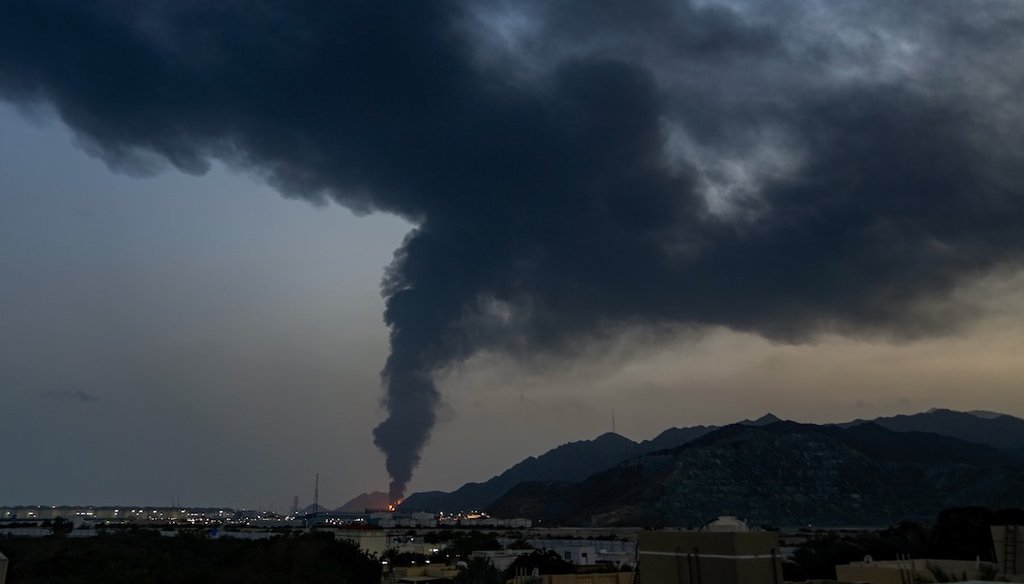
A large fire and a plume of smoke is visible after debris of an Iranian intercepted drone hit the Fujairah oil facility in the United Arab Emirates on March 3, 2026. (AP)

When President Donald Trump delivered his State of the Union address in late February, he pointed to his efforts to reduce the price of a key consumer product: gasoline.
Although Trump exaggerated how low U.S. gasoline prices are, he had a point about falling pump prices. At the time of his speech, gasoline prices had dropped to a nationwide average of $2.92 a gallon, down from $3.11 at his January 2025 inauguration.
Days later, the U.S. and Israel launched a war against Iran — and Trump’s year-plus progress on lowering gasoline prices was essentially wiped away.
It’s impossible to predict what will happen to gasoline prices in the near to medium term. But in the short term, experts widely expect them to rise.
"Significant disruptions in the supply chain and damage to refining and processing facilities could cause elevated prices to last longer than the duration of operations in Iran," said Hugh Daigle, a University of Texas-Austin petroleum and geosystems engineering professor.
Trump acknowledged that reality in remarks at a March 3 bilateral meeting, saying the U.S. might face "a little high oil prices for a little while, but as soon as this ends, those prices are going to drop, I believe, lower than even before."
How much have oil and gasoline prices increased?
Shortly after the war’s Feb. 28 start, prices for both crude oil — the material that is refined into gasoline — and gasoline have spiked.
The price of Brent crude, the benchmark for how much oil costs internationally, cost $70.77 per barrel when Trump gave his State of the Union address on Feb. 24. By early March 4, it had risen to $81.73, a 15% increase.
The March 4 price was just about where Brent crude prices stood when Trump was sworn in for his second term.
Consumers’ pump prices have also risen.
On March 4, GasBuddy, a gas price app, reported a national average price of $3.19 per gallon, up from $2.94 three days earlier. This brought gasoline above its price when Trump took office in January 2025, wiping out all the progress during his tenure, and then some.
A March 2 increase was the largest one-day price rise since March 2022, GasBuddy reported. That was shortly after Russia invaded Ukraine, destabilizing the global oil market.
GasBuddy predicted that the average nationwide gasoline price would climb to $3.30 or $3.35 per gallon in the short term. That would still be short of the level after Russia invaded Ukraine, when U.S. gas prices rose to about $5 a gallon, based on crude oil priced at about $130 a gallon.
The cost of crude oil is estimated to account for roughly half the cost of gasoline, exceeding the impact of other costs such as refining, distribution, taxes and profits.
Clark Williams-Derry, energy finance analyst at the Institute for Energy Economics and Financial Analysis, said the war’s effect on energy prices will depend on how long it lasts.
"If the situation settles down quickly, then the price impacts will be modest," he said. "But the longer the disruptions go on, the bigger the impact on U.S. consumers."
How can war raise gas prices?
The war poses several challenges for oil and energy markets.
One is geography. About one-fifth of the world’s oil passes through the Strait of Hormuz, a point between the Persian Gulf and the Gulf of Oman where Iran can block oil tankers from passing through.
Iranian media reported that the country has closed the strait and warned vessels seeking to cross they would be targeted.
This has several consequences. If oil-carrying ships cannot or will not enter the strait, it would reduce the amount of oil available on the market, which in turn leads to higher prices.
"The safety of our crews, vessels and customers’ cargo remains our key priority," Maersk, a major shipping company, wrote Feb. 1. "We are suspending all vessel crossings in the Strait of Hormuz until further notice." (Trump has said he will offer Navy escorts.)
The risk of military attacks on vessels also has caused shippers’ insurance costs to spike. Trump responded to this March 3, posting on social media that he ordered a federal agency to provide "at a very reasonable price, political risk insurance" for maritime shipping of energy products through the Persian Gulf.
"While the U.S. is a major producer of oil and gas, these are global markets and the U.S. can’t be fully insulated," said Rachel Ziemba, the head of Ziemba Insights, a political risk consulting firm.
Another factor is the risk of Iranian attacks on its neighbors’ energy infrastructure. Already, a Saudi oil facility suffered damage, as have liquefied natural gas complexes in Qatar, a country that accounts for almost 20% of global liquefied natural gas exports, which are particularly vital for Europe. Some LNG facilities are closing preemptively.
What are the broader economic impacts?
Higher gasoline costs reverberate through the entire economy. So does the price of diesel — a key factor in the cost of consumer goods, which are often transported using diesel-fueled trucks. GasBuddy predicted diesel prices could rise to $4.25 or $4.45 per gallon from a mid-February level of $3.71 per gallon.
If gasoline prices spur higher inflation — which has fallen slightly on Trump’s watch — then the Federal Reserve could decide to raise interest rates, which would stall Trump’s progress on lowering mortgage rates and bolstering homebuying.
"A prolonged conflict in the Middle East pushing oil to $90-100 for a sustained period would be a significant headwind for the global economy," Jennifer McKeown, chief global economist at research firm Capital Economics, wrote.
A president’s tools for lowering gasoline prices are limited. Trump has already encouraged more drilling in the U.S., and that added output could eventually come on line, but it would take time and would be subject to refining capacity in the U.S.
Trump could also release oil from the Strategic Petroleum Reserve, a large facility in Louisiana and Texas to store crude oil in case of emergencies, but he criticized his predecessor, President Joe Biden, for doing that. As a candidate, Trump promised to refill the reserve, not drain it.
Our Sources
Yahoo Finance, Brent Crude historical data, accessed March 3, 2026
Gas Buddy, "Gas Price Charts," accessed March 3, 2026
Energy Information Administration, "Gasoline and Diesel Fuel Update," accessed March 3, 2026
Energy Information Administration, "Weekly U.S. Regular All Formulations Retail Gasoline Prices," accessed March 3, 2026
Capital Economics, "The consequences of the Middle East conflict," March 2, 2026
Maersk, "Maersk Operations updates on situation in the Middle East," March 3, 2026
Donald Trump, X post, March 3, 2026
Patrick De Haan, X post, March 3, 2026
Patrick De Haan, X post, March 3, 2026
Patrick De Haan, "The Pump Reaction Is Accelerating: Oil Risk Premium Deepens, Retail Prices Respond," March 3, 2026
USA Today, "US stocks end weaker but way off session lows. What turned it around?" March 3, 2026
Reuters, "Qatar LNG, Saudi refinery, Israeli oil, gas fields down due to Mideast strikes," March 2, 2026
New York Times, "Gas Prices Begin to Climb, Trailing Surge in Crude Oil," March 2, 2026
Axios, "Iran attack on giant Saudi refinery pushes up oil prices," March 2, 2026
Al Jazeera, "Gas prices soar as QatarEnergy halts LNG production after Iran attacks," March 2, 2026
The Conversation, "Why surging oil prices are a shock for the global economy – but not yet a crisis," March 2, 2026
Washington Post, "Oil prices soar amid worries of sustained war in Iran," March 2, 2026
Bloomberg, "European Gas Jumps 28% as Middle East War Threatens Global Flows," March 2, 2026
Bloomberg, "US has no immediate plan to tap oil reserve on Iran concerns," March 3, 2026
New York Times, "Trump Lays Out His ‘Worst Case’ Scenario in Iran," March 3, 2026
PolitiFact, "No significant refill yet for Strategic Petroleum Reserve, but new law set to advance Trump’s pledge," July 7, 2025
PolitiFact, "State of the Union fact-check: Trump exaggerates on economy, immigration," Feb. 25, 2026
Email interview with Harold "Skip" York, nonresident fellow in energy and global oil at Rice University's Baker Institute for Public Policy, March 3, 2026
Email interview with Hugh Daigle, University of Texas-Austin petroleum and geosystems engineering professor, March 3, 2026
Email interview with Clark Williams-Derry, energy finance analyst at the Institute for Energy Economics and Financial Analysis, March 3, 2026
Email interview with Rachel Ziemba, head of Ziemba Insights, a political risk consulting firm, March 3, 2026
Browse the Truth-O-Meter
More by Louis Jacobson