Get PolitiFact in your inbox.

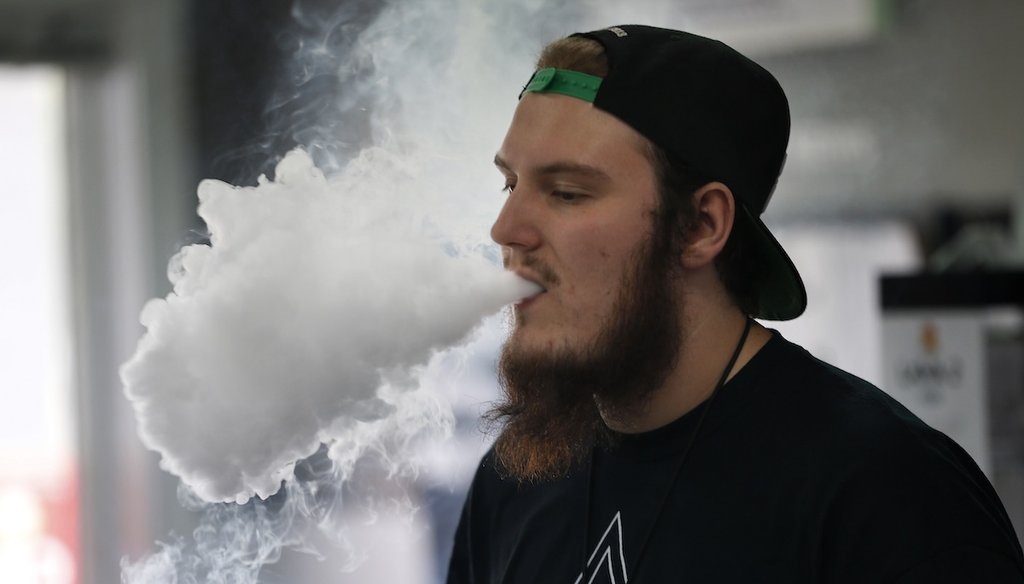
Devin Lambert, the manager at Good Guys Vape Shop, blows out vaping aerosol while using an e-cigarette in Biddeford, Maine, on Sept. 3, 2019. (AP)

If Your Time is short
-
Vape pens and e-cigarettes create aerosols that both users and bystanders inhale; that’s different from the smoke traditional cigarettes emit.
-
Studies link secondhand exposure to vaping aerosols with health problems. Still, vaping is relatively new and more research is needed.
-
No amount of vape pen or e-cigarette aerosol exposure is safe, but researchers said they expect a person with occasional brief exposures would have fewer negative health consequences than a person who vapes or is repeatedly exposed to secondhand aerosol.
Sometimes, you’re on the train or enjoying a bite to eat on a restaurant’s patio and you catch a whiff of an oddly sweet scent. A moment later, you see a puff dissipate around a nearby stranger and realize: You’re smelling a vape pen or an e-cigarette.
So what exactly are you inhaling? A lengthy list of chemicals, it turns out.
And recent Food and Drug Administration decisions have the potential to increase how often you’re exposed to these substances.
On May 5, under presidential pressure, the FDA for the first time authorized fruit-flavored e-cigarettes for people ages 21 and older. On May 8, the FDA said it would not prioritize cracking down on illegal e-cigarette sales if the companies behind the products were already pursuing agency approval. The decisions followed years of successful vaping industry lobbying that prompted President Donald Trump to change his policy approach to products he’d previously sought to restrict.
During his first presidency, Trump in 2019 tried to force companies to stop selling non-tobacco flavored e-cigarettes, popular among young people. Despite the regulation effort, underage use of unauthorized fruit or candy flavored vape products continued.
Data shows secondhand exposure is rising. In 2018, about 33% of U.S. middle and high school students reported secondhand exposure to aerosol from e-cigarettes. Despite decreases in youth e-cigarette use since then, a 2023 survey found that about 45.2% of students in grades 6 through 12 still reported second hand exposure to aerosols from e-cigarettes.
E-cigarettes first appeared in the U.S. in 2006. They were small, looked like traditional cigarettes and were primarily used by people who wanted to quit smoking, but over time developers modified the liquids to add flavors and the devices to alter the aerosol amounts. The terms e-cigarettes and vapes are generally used interchangeably.
The health risks of secondhand aerosols from vaping are less documented than those from secondhand smoke. But we know there are some. Here’s what research shows.
What’s in vape "smoke"?
When a person inhales from a vape pen, its heating component warms a liquid solution until it becomes aerosolized. These small particles suspended in the air contain many chemicals.
Vaping companies disclose some of the chemicals in liquids or vape pods, but not all.
A 2021 analysis of popular brands of vaping liquids found over 1,000 unknown chemicals in the liquids and subsequent aerosols — along with caffeine and potentially harmful chemicals such as a pesticide and flavorings linked to toxic effects.
Do you have questions about vaping? Send them to me at [email protected].
When selling in the U.S., companies are required to label their products as containing nicotine, the highly addictive chemical stimulant in tobacco plants. States regulate marijuana products, and most states require manufacturers to label when a product contains the cannabis plants’ psychoactive ingredient THC. Most standard e-cigarette liquids also contain propylene glycol, a liquid additive that helps preserve moisture and flavor, and vegetable glycerine, a thickener that creates heavier aerosol clouds. Flavorings add more chemicals.
Because vaping aerosols are created with heat, "Unwanted chemical reactions can produce more chemical substances, such as formaldehyde, acetaldehyde, benzene, toluene, and metals, some of which are harmful to our body," said Yang Wang, a University of Miami environmental engineering professor.
As for flavored vaping liquids, "Flavoring chemicals safe for ingestion are not necessarily safe for inhalation," Wang said.
One 2016 study found that vaping using liquids with higher concentrations of flavoring compounds can form more toxic organic compounds called aldehydes, sometimes at levels that exceed federal standards for workplace safety.
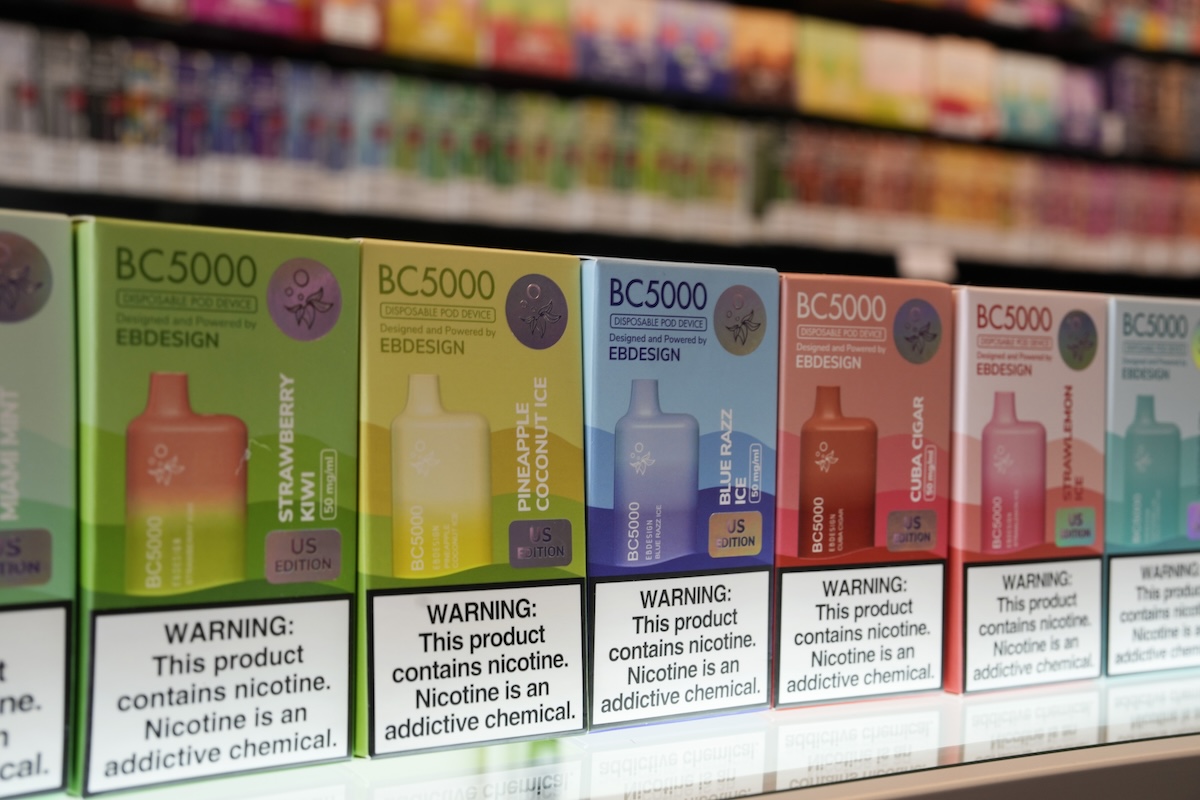
Varieties of disposable flavored electronic cigarette devices manufactured by EB Design, formerly known as Elf Bar, are displayed at a store in Pinecrest, Fla., June 26, 2023. (AP)
What are the risks of secondhand aerosol exposures?
Studies have linked secondhand exposure to vaping aerosols to health issues, but the exact risks remain unknown, researchers told PolitiFact.
That’s partly because the wide variation in vaping products makes it hard to study them and draw widely applicable conclusions, said Terry Gordon, an environmental medicine professor at NYU School of Medicine.
Vaping is still relatively new, and it takes time to conduct rigorous studies on many participants, said Jeannie Rodriguez, a professor at Emory University’s nursing school who studies secondhand e-cigarette aerosol exposure in children.
Different vape pens and e-cigarettes also produce differing aerosol amounts, which means exposure varies. In 2025, a group of researchers including Rodriguzez conducted a review of studies on secondhand e-cigarette aerosol exposure in children. It found these aerosols contain metals and chemicals such as formaldehyde, Rodriguez said.
Rodriguez cautioned that many of the studies researchers reviewed had small sample sizes. Animal studies have also linked secondhand aerosol exposure to respiratory problems, weakened immune systems, stunted growth and poor neurological outcomes, she said.
"This research is still in its infancy," Rodriguez said.
Some studies have shown negative health effects, though.
A 2022 study found in young adults, secondhand nicotine aerosol exposure was associated with increased risk of bronchitic symptoms and shortness of breath. Another showed secondhand exposure to e-cigarette aerosols was associated with mental health problems — similar to secondhand smoke exposure.
E-cigarette use also increases air pollution in homes, one 2022 study showed. Air pollution — particularly fine particles or PM2.5 — is known to have health risks.
More than one study has found that children exposed to nicotine e-cigarette aerosols secondhand absorb small amounts of nicotine — albeit much less than children exposed to secondhand cigarette smoke, according to a 2024 study’s findings.
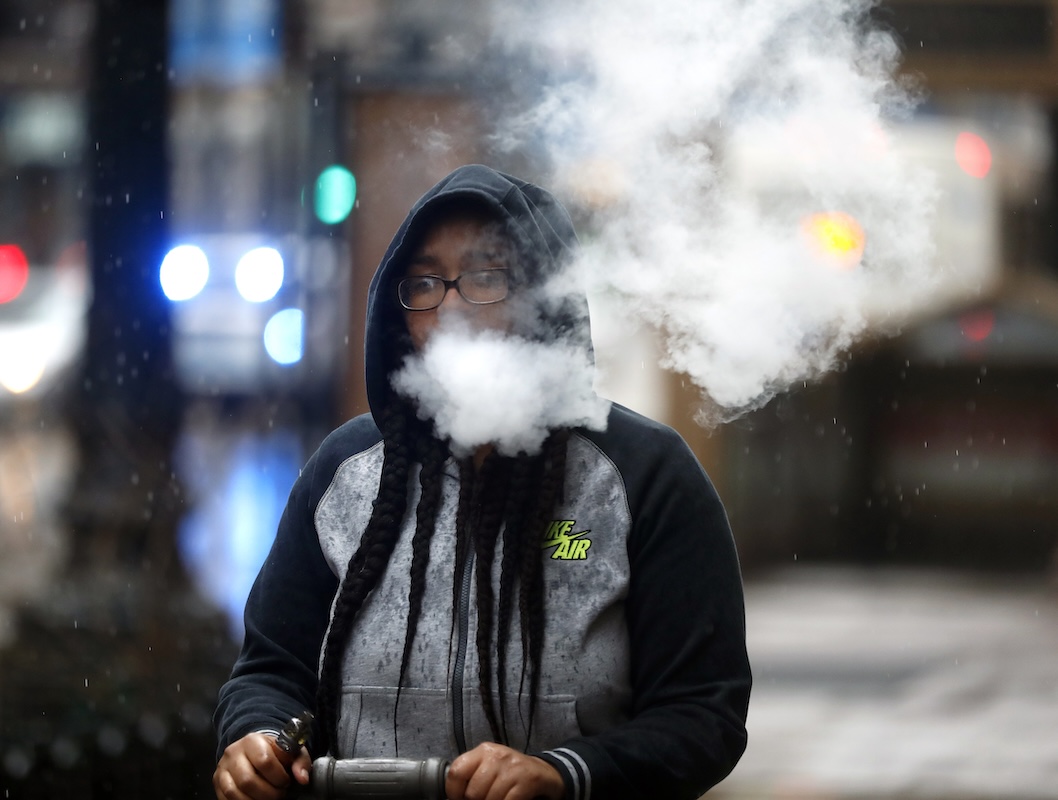
A commuter exhales while smoking an e-cigarette during rain on March 23, 2021, in Chicago. (AP)
What level of exposure is dangerous?
There’s currently no amount of e-cigarette aerosol exposure that researchers consider to be "safe," but researchers said occasional brief encounters with aerosol likely have fewer negative health outcomes than firsthand use or repeated ingestion of secondhand aerosols at home or work.
"For occasional short-time secondhand exposure, such as at a party or in public transportation, I would not expect clear long-term harm for most healthy adults," Wang said. "But some people may experience acute irritation, coughing or asthma symptoms."
The bigger concern, he said, is repeated exposure, especially in places with poor ventilation.
Based on what scientists know now, Rodriguez advised people to minimize vaping aerosol exposure whenever possible.
PolitiFact Researcher Caryn Baird contributed to this report.
Our Sources
Email interview with Yang Wang, a chemical, environmental and materials engineering professor at the University of Miami, May 15, 2026
Email interview with Jeannie Rodriguez, PhD, registered nurse, CPNP-PC, CHSE, is an associate professor and assistant dean at Emory University Nell Hodgson Woodruff School of Nursing, May 18, 2026
Interview with Terry Gordon, environmental medicine professor at NYU School of Medicine, May 18, 2026
Email exchange with Stephen Freeman, May 16, 2026
NBC News, Fight over fruit-flavored vapes pushed FDA chief to resign, May 14, 2026
NBC News, FDA announces its first OK of fruit-flavored e-cigarettes for adults in major shift under Trump, May 5, 2026
NPR, FDA To Banish Flavored E-Cigarettes To Combat Youth Vaping, Sept. 11, 2019
Cleveland Clinic, Vaping (E-Cigarettes): What It Is, Side Effects & Dangers, accessed May 18, 2026
Association of Health Care Journalists, CDC finds 'chemical of concern' in vaping-relating illness investigation, May 15, 2026
The Washington Post, Trump vows to ‘save’ vaping after private meeting with vaping lobbyist, Sept. 21, 2024
Donald Trump’s Truth Social post, Sept. 20, 2024
JAMA Network Open, Trends in the Prevalence of Exposure to e-Cigarette Aerosol in Public Places Among US Middle and High School Students, 2015 to 2018 | Public Health, Aug. 28, 2019
Oxford Academic Nicotine & Tobacco Research, Secondhand E-Cigarette and Tobacco Smoke Exposure and Stages of E-Cigarette Use in US 6th–12th Graders, April 2026
Chemical Research in Toxicology, Characterizing the Chemical Landscape in Commercial E-Cigarette Liquids and Aerosols by Liquid Chromatography–High-Resolution Mass Spectrometry, Oct. 5, 2021
Johns Hopkins University, Johns Hopkins researchers find thousands of unknown chemicals in electronic cigarettes, Oct. 7, 2021
The Real Cost, Vapes: product page, accessed May 18, 2026
University of Rochester Medicine, Vaping and E-Cigarettes, accessed May 18, 2026
NASA Earth Sciences, Aerosols and Their Importance, accessed May 18, 2026
Healthline, JUUL Pod Ingredients: What's in E-Cigarettes?, May 27, 2020
Innokin, What Are the Ingredients in Vape Juice?, Aug. 30, 2024
Edge Vaping, What's In Your Vape Juice? E-Liquid Ingredients Explained, accessed May 18, 2026
Department of Justice and Drug Enforcement Administration, Drug Fact Sheet: Marijuana/Cannabis, May 18, 2026
Chemical Research in Toxicology, Chemical Composition of Aerosols from the E-Cigarette Vaping of Natural and Synthetic Cannabinoids, Nov. 13, 2024
American Lung Association, What's in an E-Cigarette?, accessed May 18, 2026
Biological Research for Nursing, Passive Electronic Cigarette Vapor Exposure in Children: A Systematic Review, July 9, 2025
BMJ, Effects of electronic cigarettes and hookah (waterpipe) use on home air quality, Dec. 14, 2022
McGill University Newsroom, Air pollution: The silent killer called PM2.5, March 11, 2021
Environmental Science & Technology, Flavoring Compounds Dominate Toxic Aldehyde Production during E-Cigarette Vaping, Nov. 8, 2016
JAMA Network Open Secondhand Nicotine Absorption From E-Cigarette Vapor vs Tobacco Smoke in Children, July 11, 2024
PLOS One, Electronic cigarette power affects count concentration and particle size distribution of vaping aerosol, Dec. 31, 2018
BMC Public Health, Passive exposure to e-cigarette emissions is associated with worsened mental health, June 7, 2022
University College London News, Second-hand vaping exposure very low compared to second-hand smoking, July 10, 2024
RGA, Nicotine and the Cotinine Test: The cost of consumption, May 18, 2026
PLOS One, Benzene formation in electronic cigarettes, March 8, 2017
National Academies of Sciences, Engineering, and Medicine, Toxicology of E-Cigarette Constituents, accessed May 19, 2026
U.S. Centers for Disease Control and Prevention, E-Cigarette Use Among Youth | Smoking and Tobacco Use, accessed May 19, 2026
The Associated Press, Thousands of unauthorized vapes are pouring into the US despite the FDA crackdown on fruity flavors, June 26, 2023
Cureus, A Single 10-Minute E-cigarette Vapor Exposure Reduces Tidal Volume and Minute Ventilation in Normoxia and Normobaric Hypoxia in Adult Rats Oct. 9, 2023
Health Policy via ScienceDirect, Is secondhand smoke associated with mental health issues? A narrative review of the evidence and policy implication, October 2023
Drug Metabolism Review, Full article: Aldehyde toxicity and metabolism: the role of aldehyde dehydrogenases in detoxification, drug resistance and carcinogenesis, Nov. 28, 2018
STAT News, No FDA permission, no problem: New flavored vape policy worries experts, May 11, 2026
The New York Times, No FDA permission, no problem: New flavored vape policy worries experts, May 8, 2026
The Brink, E-Cigarette Brands Are Skirting the Rules About Health Warning Labels on Instagram, Study Finds Sept. 13, 2024
National Institute of Environmental Health Sciences, Smoking and Vaping | National Institute of Environmental Health Sciences, accessed May 19, 2026
U.S. Centers for Disease Control and Prevention, About E-Cigarettes (Vapes) | Smoking and Tobacco Use accessed May 19, 2026
Oxford Academic Nicotine & Tobacco Research, Unclear Labeling of Nicotine Products Poses Risks to Consumers, May 19, 2026
MarijuanaPackaging.com, Compliance Checklist for Vape Packaging Across U.S. States, Jan. 21, 2025
Cannabis & Cannabinoid Research, Requirements for Cannabis Product Labeling by U.S. State, April 19, 2022
NPR, Flavored vapes are supposed to be illegal, but they're still widely available, July 12, 2023