Stand up for the facts!
Our only agenda is to publish the truth so you can be an informed participant in democracy.
We need your help.
I would like to contribute

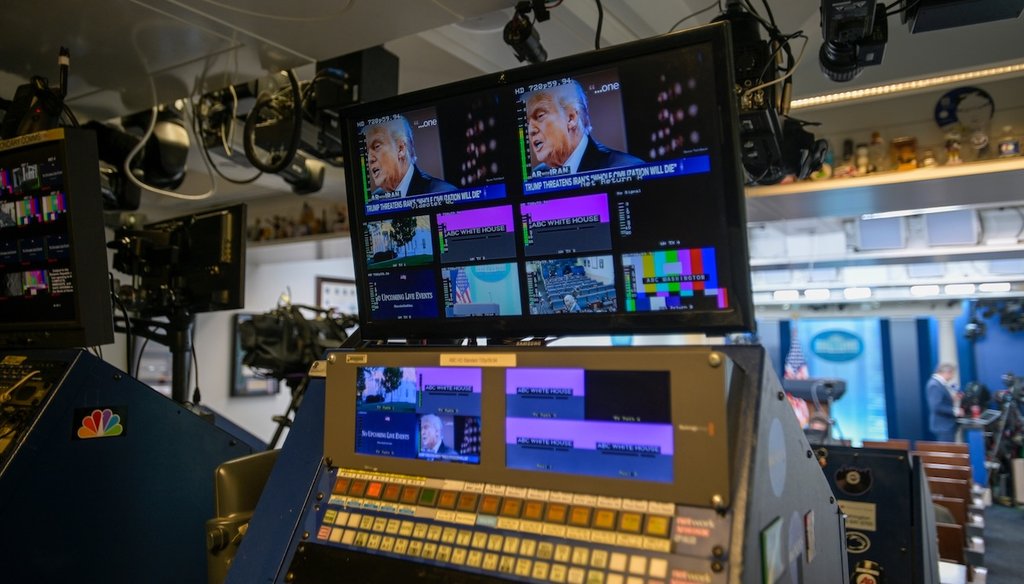
President Donald Trump is seen on television monitors in the James S. Brady Press Briefing Room at the White House in Washington, April 7, 2026. (AP)

Within two hours of declaring a ceasefire in the Iran war, President Donald Trump alleged that CNN knowingly published false information.
Trump said CNN reported a "fake" statement from Iran and U.S. authorities are probing whether CNN committed a crime by publishing it. It’s unclear what crime, if any, CNN would be charged with.
Trump shared a statement from Iran’s minister of foreign affairs that said Trump accepted Iran’s 10-point plan as a "basis for negotiations," that Iran agrees to a ceasefire and will reopen the Strait of Hormuz for two weeks. As of April 10, the strait was operating at about 10% of its normal pace, according to National Economic Council Director Kevin Hassett.
A separate statement that CNN reported on is what Trump called "fake." That lengthier statement attributed to Iran’s Supreme National Security Council outlined elements of the 10-point plan. The headline for CNN’s post said: "Iran claims victory, says it forced US to accept 10-point plan."
After Trump’s criticism, CNN stood by its reporting. Other news outlets also reported on the council’s statement. CNN’s journalists said it was one of multiple statements issued by Iranian officials.
First Amendment experts told us that penalizing speech only on the basis of its accuracy would be unconstitutional.
Here’s what we know.
What did Trump say?
On the evening of April 7, Trump announced a two-week ceasefire in the Iran war, provided that the country reopens the Strait of Hormuz. He said Iran proposed a 10-point plan that would be a "workable basis" for negotiation.
Trump posted twice about CNN on Truth Social in the hours that followed, alleging that the news outlet used a fake statement from a fake news site based in Nigeria and presented it as legitimate.
Trump’s first Truth Social post said:
"The alleged Statement put out by CNN World News is a FRAUD, as CNN well knows. The false Statement was linked to a Fake News site (from Nigeria) and, of course, immediately picked up by CNN, and blared out as a ‘legitimate’ headline. The Official Statement by Iran was just released, and posted on TRUTH, below. Authorities are looking to determine whether or not a crime was committed on the issuance of the Fake CNN World Statement, or was it a sick rogue player? CNN is being ordered to immediately withdraw this Statement with full apologies for their, as usual, terrible ‘reporting.’ Results of the investigation will be announced in the near future. President DONALD J. TRUMP"
Hours later, Trump followed up with another post that read:
"No one can believe that Fake News CNN put out a knowingly false and dangerous statement pretending it came from the upper levels of the Iranian Government. It didn’t! It was totally made up and posted, as a headline, for purpose of, perhaps, inflaming a very delicate situation. It was a new, trouble making site from Nigeria, and CNN just got caught cheating - A very dangerous thing to do!"
On X, the White House account Rapid Response 47 shared Trump’s comments and attached a screenshot of CNN’s blog post.
The Rapid Response post said, "This alleged statement by ‘Iran’ is a FRAUD! Correct immediately!"
Brendan Carr, chairman of the Federal Communications Commission, said CNN pushed out a "hoax headline."
On April 8, Trump said that CNN and The New York Times reported on a "fake" 10-point plan.
PolitiFact contacted the White House to ask what "fake news site" Trump was referring to as the source of CNN’s post and which authorities are looking into this incident; we received no response.
Nicole Taylor, a spokesperson for The New York Times, told PolitiFact that its April 8 article reported on a plan "directly released by Iranian state media, detailing what it said was the 10-point framework for talks." The story outlines Iran’s version of the proposal, and notes that a White House official said it is different from the plan Trump said was a basis for negotiations, she said.
What did CNN report?
Responding to Carr’s accusation of a "hoax headline," a CNN spokesperson said the Iran Supreme National Security Council’s statement came from official Iranian spokespeople "who are known to us" and multiple Iranian state media outlets also reported it.
CNN’s blog post was part of a live updates page on the Iran war. Michael Rios, who wrote the blog post, said the council issued a statement that the U.S. made agreements "in principle" to lift certain sanctions and withdraw U.S. combat forces in the region. The blog post did not link to the statement. (Iran’s Supreme National Security Council includes senior intelligence and foreign affairs figures.)
CNN’s post said Iranian officials issued multiple statements. Trump cited a single statement by an Iranian minister as the "official" one.
As of April 10, CNN’s blog post’s headline remained unchanged.
On CNN’s April 7 live broadcast, senior international correspondent Matthew Chance addressed Trump’s Truth Social comments, saying the statement in dispute already appeared in Iranian state news agencies.
When Trump called the statement fake on Truth Social, Chance said he followed up with the Iranian foreign ministry and asked if it could send him the statement, and it sent a document identical to the one CNN had. "And so, look, I think we're pretty confident, very confident, that this document is, you know, is authentic," Chance said.
Could CNN be criminally charged for its blog post?
The U.S. Constitution’s First Amendment protects freedom of the press. Trump did not specify what crime he thinks CNN may have committed.
Some states criminalize defamation, but CNN’s report did not defame a particular person or entity, said Mary-Rose Papandrea, First Amendment and free speech law professor at George Washington University. For a statement to be defamatory, it must "lower the reputation of a particular person or entity," she said. Defamation can take the form of libel, which is in written form, and slander, which is in spoken words.
It seems unlikely for Trump to argue that the post defamed him, Papandrea said, but even if he did, CNN could use 1964 The New York Times v. Sullivan defamation case as a defense. In that case, the paper published an advertisement that contained factual inaccuracies, and a police commissioner sued for defamation. The Supreme Court ruled that public officials suing news organizations for libel must show they acted maliciously or recklessly in publishing false information.
Some federal laws criminalize publishing sensitive national security information, but Papandrea said CNN’s report didn’t appear to do that, either.
Our Sources
Email interview with Mary-Rose Papandrea, George Washington University professor of First Amendment and free speech law, April 8, 2026
Email interview with Stuart Benjamin, law professor at Duke Law School, April 9, 2026
CBS News, Live Updates: U.S., Iran prepare for talks as shaky ceasefire holds, Strait of Hormuz traffic remains low, April 10, 2026
Truth Social post by Donald Trump, April 7, 2026
Truth Social post by Donald Trump, April 7, 2026
Truth Social post by Donald Trump, April 7. 2026
X post by Rapid Response 47, April 7, 2026
X post by Brendan Carr, April 7, 2026
Truth Social post by Donald Trump, April 8, 2026
CNN, Iran claims victory, says it forced US to accept 10-point plan, updated April 8, 2026
CNN Transcripts, Anderson Cooper 360 Degrees, April 7, 2026
Truth Social post by Donald Trump, April 7, 2026
The New York Times, Iran Releases 10 Points It Says Are Basis for Cease-Fire Talks, April 8, 2026
X post by NYTimes Communications, April 9, 2026
FindLaw, Defamation, Libel and Slander, accessed April 10, 2026
Cornell Law School Legal Information Institute, New York Times v. Sullivan (1964), accessed April 10, 2026
Middle East Eye, Full text of Iran's National Security Council statement on ceasefire, April 8, 2026
United Against Nuclear Iran, Organizational Chart of the Islamic Republic of Iran, accessed April 10, 2026
PolitiFact, Whoopi Goldberg gets it wrong on lying and the First Amendment, March 17, 2023
Email exchange with Nicole Taylor, spokesperson for The New York Times, April 9, 2026
Email exchange with a CNN spokesperson, April 9, 2026