Get PolitiFact in your inbox.

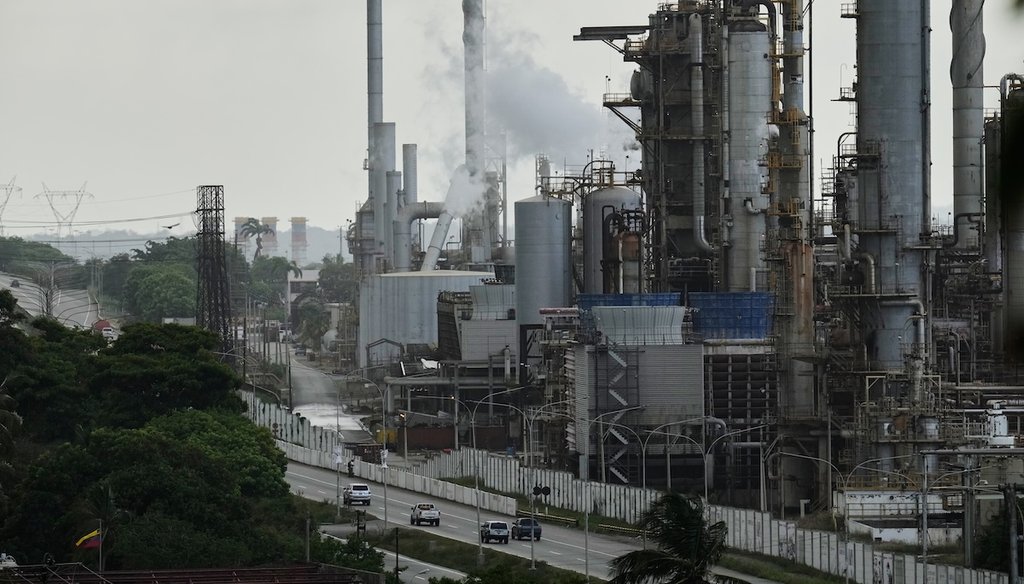
The El Palito refinery in Puerto Cabello, Venezuela, on Dec. 21, 2025. (AP)

One thing President Donald Trump has consistently promised after the U.S. ouster of Venezuelan President Nicolás Maduro is private U.S. investment in the country’s underproductive oil fields.
"We're going to have our very large United States oil companies, the biggest anywhere in the world, go in, spend billions of dollars, fix the badly broken infrastructure, the oil infrastructure, and start making money for the country," Trump said Jan. 3 in a Mar-a-Lago press conference.
He reiterated that Jan. 4 to reporters on Air Force One, saying, "We're going to have to have big investments by the oil companies to bring back the infrastructure. The oil companies are ready to go."
Are they? It’s less certain than Trump makes it sound.
When reporters sought concrete details about investments, Trump declined to offer them. Speaking on ABC’s "This Week" on Jan. 4, Secretary of State Marco Rubio echoed Trump, saying he expects "dramatic interest from Western companies," without offering specifics.
When contacted for comment, the White House told PolitiFact the administration has had conversations with multiple oil companies, without naming any. "All of our oil companies are ready and willing to make big investments in Venezuela that will rebuild their oil infrastructure," White House spokesperson Taylor Rogers said.
The American Petroleum Institute, the oil industry’s leading trade association, said in a statement to PolitiFact that the group is "closely watching" developments.
"Globally, energy companies make investment decisions based on stability, the rule of law, market forces, and long-term operational considerations," the statement said.
A ConocoPhillips spokesperson gave a similar response, according to media reports, saying the company "is monitoring developments" but that it would be "premature to speculate on any future business activities or investments."
Experts told PolitiFact there is ample reason for caution about a surge of new private investment in Venezuelan oil infrastructure. While Venezuela’s oil reserves are the world’s largest, obstacles include high up-front costs for building out infrastructure, limited profit potential amid today’s low oil prices and continuing concerns about political stability.
"I do not see a compelling business case for any U.S.-based company to invest billions of dollars over years to decades to try to turn a profit in Venezuelan oil," said Hugh Daigle, a professor with the University of Texas at Austin’s petroleum and geosystems engineering department.
Patrick De Haan, the head of petroleum analysis with GasBuddy, a gasoline price app, said the uncertainty over Venezuela’s governance is likely to worry oil companies.
"Oil companies probably aren't chomping at the bit to invest billions of dollars and take their chances until there's clarity in the Venezuelan regime," De Haan said. "I don't believe there will be beyond a negligible impact from the situation, potentially for years, and even then, only if things go very right."
What would be the upsides of oil industry investment in Venezuela?
U.S. companies such as ExxonMobil and ConocoPhillips exited Venezuela after Hugo Chávez, Maduro’s predecessor, moved to nationalize the oil industry in 2007. Chevron is the only major U.S. oil company that has been consistently producing oil in Venezuela in recent years.
How Venezuela’s nationalized, and in some cases internationally sanctioned, oil resources are opened will determine who benefits, said Kenneth Gillingham, a Yale University professor of environmental and energy economics.
If the market were opened only to the biggest U.S. oil corporations, those companies would mainly benefit, but their gains would be more limited if the market also were opened to companies based outside the U.S., Gillingham said. U.S. motorists could benefit from increased production pushing prices lower, but those gains would depend heavily on global market factors.
Some oil companies could be attracted to Venezuela because it would allow them to diversify their investments, said Skip York, a fellow at Rice University’s Center for Energy Studies.
Compared with crude oil in many countries, Venezuelan crude is relatively heavy. That means it takes longer to extract, but once the wells are in place, they can keep producing for longer periods of time.
The U.S. generally doesn’t produce heavy crude from its own deposits, but a portion of the U.S. refinery sector is specifically built to handle it. So having a steady supply of heavy Venezuelan crude could keep these refineries operational. Rubio cited this opportunity on "This Week."
If Venezuela returns to political and economic stability, York said, "one could expect returns of 15% to 20%, which could be competitive with other development opportunities."
Obstacles remain for U.S. oil companies
Oil experts cited several challenges to achieving large profits from Venezuelan reserves:
The up-front cost of improving infrastructure will be significant. "The Venezuelan oil industry has been nationalized for many decades now and has suffered from a lack of investment, both foreign and domestic," Daigle said. New investment would be needed to keep facilities and operations up to date, with no certainty of payback.
Venezuela’s political situation remains unsettled. "Not many companies are going to rush to go into an environment where there’s not stability," Ali Moshiri, who headed Chevron’s operations in Venezuela until 2017 and now runs a private oil company with interests there, told The New York Times.
At a minimum, Venezuela would need a new petroleum law framework, York said. Even after all the legal and financial issues have been resolved, he said, it would take "years to refurbish infrastructure and drill new wells."
Oil prices are low. High up-front infrastructure costs and risks from political instability could be justified financially if oil prices were high enough. But prices are relatively low. Since Trump became president, crude oil’s price per barrel has fallen by about one-quarter.
"With oil (prices) near multi-year lows, oil companies likely won't be running to spend money in Venezuela that could further erode oil prices," De Haan said.
The reluctance to spend significantly to expand production can already be seen domestically in declining industry efforts to drill new U.S. wells. A weekly count of oil rigs in use in the U.S. shows a 16% decline since their most recent peak in April.
If companies aren’t eager to spend on drilling in the U.S., with its established infrastructure and relative political stability, it’s not clear that they would go all in on Venezuela.
Our Sources
Donald Trump, remarks at a press conference, Jan. 3, 2026
Donald Trump, remarks aboard Air Force One, Jan. 4, 2026
Marco Rubio, remarks on ABC’s "This Week" Jan. 4, 2026
Federal Reserve Bank of St. Louis, "Crude Oil Prices: West Texas Intermediate (WTI) - Cushing, Oklahoma," accessed Jan. 5, 2026
Baker-Hughes Rig Count, accessed Jan. 5, 2026
New York Times, "Reviving Venezuela’s Flow of Oil Will Not Come Easily or Cheaply," Jan. 5, 2026
Associated Press, "Trump's idea to seize Venezuela's oil industry faces major hurdles," Jan. 5, 2026
Fox Business, "US oil giants mum after Trump says they’ll spend billions in Venezuela," Jan. 4, 2026
Email interview with Skip York, nonresident fellow at Rice University’s Center for Energy Studies, Jan. 5, 2026
Email interview with Kenneth Gillingham, Yale University professor of environmental and energy economics, Jan. 5, 2026
Email interview with Patrick De Haan, head of petroleum analysis with GasBuddy, Jan. 5, 2026
Email interview with Hugh Daigle, professor with the University of Texas-Austin’s petroleum and geosystems engineering department, Jan. 5, 2026
Email interview with Clark Williams-Derry, energy finance analyst at the Institute for Energy Economics and Financial Analysis, Jan. 5, 2026
Email interview with Abhi Rajendran, nonresident fellow with Rice University’s Center for Energy Studies, Jan. 5, 2026
Email interview with Mary Beth Gilani, external relations manager with the American Petroleum Institute, Jan. 5, 2026
Statement to PolitiFact from White House spokesperson Taylor Rogers, Jan. 5, 2026