Get PolitiFact in your inbox.

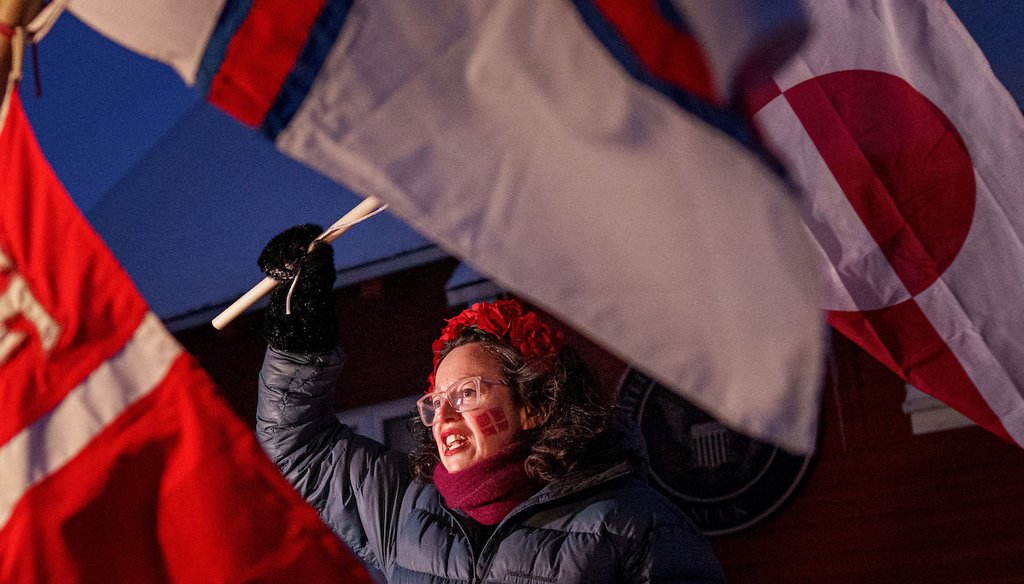
Aviaq Brandt protests against Trump's policy towards Greenland in front of the US consulate in Nuuk, Greenland, on Tuesday, Jan. 20, 2026 (AP)

In a text exchange with Norway’s Prime Minister, President Donald Trump said Denmark’s sovereignty over Greenland is flimsy. But the U.S.’s own actions over the past 100 years say otherwise.
In Trump’s message, sent Jan. 18, he said, "Why (does Denmark) have a ‘right of ownership’ anyway? There are no written documents, it’s only that a boat landed there hundreds of years ago, but we had boats landing there, also."
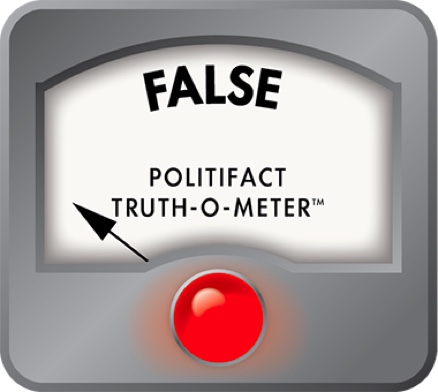
It’s inaccurate that there are no written documents establishing Denmark’s sovereignty over Greenland. Not only is Denmark’s sovereignty over Greenland well-established under international law, but the U.S. also has acknowledged it on several occasions, including in writing.
Denmark’s colonization of Greenland dates to the 1720s, and in 1933 an international court settled a territorial dispute between Denmark and Norway, ruling that Denmark "possessed a valid title to the sovereignty over all Greenland."
Greenland’s status as a Danish colony ended in 1953 when the territory was incorporated by constitutional amendment and given representation in the Danish Parliament. As a member of the United Nations, the U.S. voted to accept this change.
Since then, the Greenlandic people have pushed for greater autonomy, such as achieving home rule in 1979 and creating a separate parliament. The territory is now a district within the sovereign state of Denmark, with full voting rights in the Danish parliament. A 2009 law established that the Greenlandic people have the power to pursue independence from Denmark if they choose. To date, they have not done so.
Under international law, Greenland is still part of Denmark, much as Ohio is part of the U.S., one expert told us.
The United States has acknowledged Denmark’s control over Greenland several times.
As part of a 1917 agreement with Denmark to buy the Danish West Indies — now known as the U.S. Virgin Islands — then-Secretary of State Robert Lansing issued a written declaration that the U.S. "will not object to the Danish Government extending their political and economic interests to the whole of Greenland."
After taking responsibility — through written agreement — for Greenland’s defense in 1941, the U.S. established a military presence on the island. President Harry Truman tried to buy Greenland in 1946, but Denmark declined to sell.
The U.S. and Denmark signed another defense agreement in 1951 — and then updated and re-signed in 2004 — that affirms Greenland is "an equal part of the Kingdom of Denmark."
Our Sources
See sources linked in the story
Browse the Truth-O-Meter
More by Grace Abels