
Our only agenda is to publish the truth so you can be an informed participant in democracy.
We need your help.

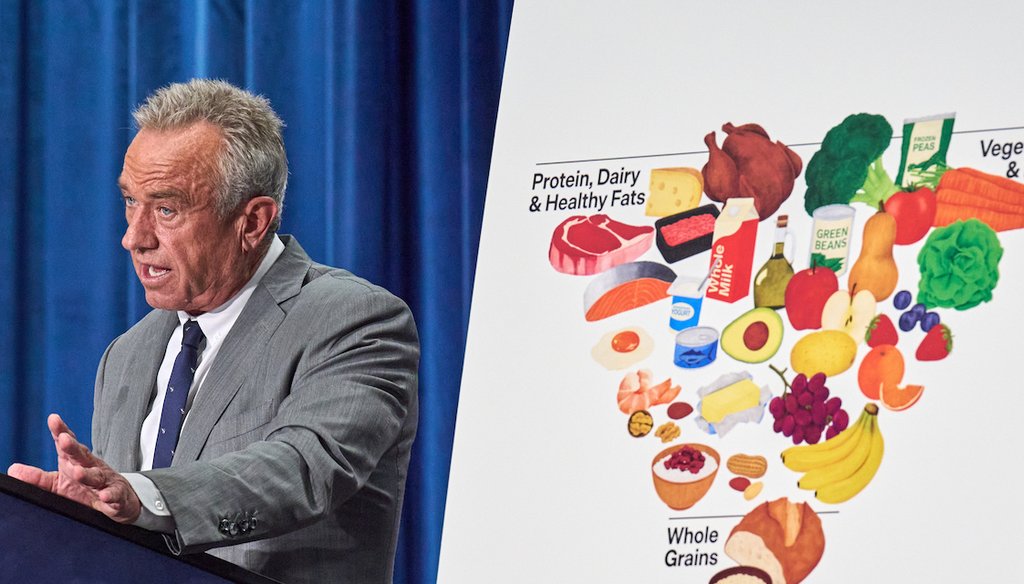
Health and Human Services Secretary Robert F. Kennedy Jr. speaks during an announcement, at Health and Human Services Headquarters, Thursday, Jan. 8, 2026, in Washington. (AP)

A 2017 report calculated all health care spending on people with chronic illness, not on the cost of treating chronic illness alone.
Most Americans have at least one chronic condition.
Chronic illness includes any condition lasting longer than a year that requires restrictions or ongoing treatment. Some of the most common types are asthma, anxiety, depression, hypertension, high cholesterol, Type 2 diabetes and osteoarthritis.
Have you seen the Mike Tyson ad telling people to eat "real food?" The black-and-white spot that debuted during the Super Bowl is the latest promotion for the federal government’s new dietary guidelines.
With a quick scroll, football watchers who visited the website in the ad would have encountered the statistic that "90% of U.S. healthcare spending goes to treating chronic disease — much of which is linked to diet and lifestyle."
This statistic also appeared in the dietary guidelines and on the CDC’s website. Health and Human Services Secretary Robert F. Kennedy Jr. said it this way in his Jan. 7 announcement: "The CDC reports that 90% of healthcare spending treats chronic disease."
This number grabbed podcaster Michael Hobbes’ attention. "I couldn't find anyone fact-checking this number," Hobbes said on the Jan. 30 episode of "Maintenance Phase," a podcast that digs into the science behind health and wellness trends.
No worries — PolitiFact is here to answer the call!
The 90% figure has roots in a 2017 report by the Rand Corp., a nonpartisan research organization. But one of the researchers told PolitiFact that the claim, as stated by Kennedy and RealFood.gov, didn’t accurately reflect their findings.
The Rand report calculated all health spending on people with chronic illnesses, which includes a majority of Americans. It did not isolate the total spending on treating chronic illness itself.
Here’s another way to think about it: If someone with asthma broke a leg, got glasses or picked up antibiotics, that all counted as spending on a person with a chronic disease — even if it’s not treating the asthma.
The department did not respond to our request for comment. HHS relayed the research more accurately in the dietary guidelines document and CDC website.
A trail of footnotes in the dietary guidelines leads to the 2017 Rand report.
Rand used data from an annual government-run survey. The Medical Expenditure Panel Survey asks families to report a year’s worth of personal health care use and spending — including doctor’s visits, prescriptions and hospital stays. It also collects data on people’s health conditions, which can be categorized as chronic or not chronic.
The sample size has varied over the years, ranging from about 18,000 to 37,000 people. Experts said it is among the best data sources on personal health spending.
The report defines a chronic condition as a mental or physical health condition lasting over a year that either requires functional restrictions or ongoing medical treatment. Many conditions fall into this category, including hypertension, diabetes, depression, anxiety, osteoarthritis, asthma, heart disease, high cholesterol, and cancer.
Using survey data collected in 2014, Rand researchers estimated almost 60% of Americans had at least one chronic condition.
Then they looked at people’s health care costs, including payments made by insurers and out-of-pocket costs.
According to Rand, spending on the 60% of people with one or more chronic conditions made up 90% of all spending. The 40% with no chronic illnesses made up 10% of the spending.
"A person in a year spends or incurs health care costs for multiple related things," said Christine Buttorff, a Rand health policy researcher and study co-author. "It could be their chronic disease, but it also could be something as simple as an acute illness where they had to go to the doctor or go to the emergency room for something totally unrelated to the chronic disease. So our estimates lump all of that together."
The claim that 90% of U.S. health care spending goes to treating chronic disease is "not an accurate reflection of our report," Buttorff said.
Estimating how much Americans spend on treating chronic illness is harder. It typically requires using insurance claims data, which is spread across government databases and private insurers.
It can be difficult to link expenses and conditions. If, for example, a person with asthma is hospitalized with pneumonia, is that part of their chronic disease treatment or an acute case? If a person pays to see a psychiatrist but has both anxiety and depression, which diagnosis is that cost linked to?
University of Washington researchers have been tackling this question. The university’s Institute for Health Metrics and Evaluation in 2025 analyzed personal health care spending from 2010 to 2019 on 148 health conditions, without distinguishing chronic illnesses from other ailments.
In 2019, the top three most expensive conditions were Type 2 diabetes ($143.9 billion), musculoskeletal disorders such as joint pain and osteoporosis ($108.6 billion), and oral disorders such as cavities and orthodontia ($93 billion).
"Reality is, we spend a ton of money on things that people don't associate with chronic diseases," said Joseph L. Dieleman, a University of Washington health metrics sciences professor and study co-author.
PolitiFact did not find any studies since 2018 that looked specifically at past chronic disease treatment spending.
One recent report tried to model future spending on chronic disease. A 2025 report from GlobalData and the Partnership to Fight Chronic Disease estimated an average of $2.2 trillion annually in medical costs over the next 15 years.
Given that current health care spending is over $5.3 trillion annually, that rate of spending would put chronic disease spending around 42% annually.
U.S. chronic illness rates are rising.
In 2010, about 50% of Americans had at least one chronic condition. The number has climbed closer to 75% in recent years, boosted in part by better diagnostics and longer lifespans.
"Chronic conditions linked to lifestyle choices such as physical inactivity or diet are a huge issue in the U.S., even if their use of this statistic isn’t quite right," Buttorff said.
Several of the most common chronic conditions — hypertension, Type 2 diabetes, heart disease, and high cholesterol — have been linked to diet and lifestyle related risk factors.
Others can’t always be linked to lifestyle, including mental health conditions, asthma, Type 1 diabetes, cancer, rheumatoid arthritis, Alzheimer's disease, and dementia.
Kennedy and his department said that 90% of health care spending is for treating chronic disease.
The statistic is based on all health spending on people with chronic diseases, not spending on treatment itself.
A majority of Americans have chronic illnesses, so it’s likely the real number is high. We were unable to find a reliable report that isolated chronic illness spending in the past few years, but a predictive report estimated it could be around 2.2 trillion annually, which would be less than half of current health spending. HHS did not provide evidence to support the claim about treatment spending.
We rate this statement False.
Staff Researcher Caryn Baird contributed to this report
Interview with Joseph L. Dieleman, a University of Washington health metrics sciences professor, Feb, 9, 2026
Interview with Christine Buttorff, a senior policy researcher at Rand Corporation, Feb. 6, 2026
Interview with Michael Hobbes, host of Maintenance Phase, Feb. 12, 2026
Expert statement from KFF, Feb. 6, 2026
YouTube, Super Bowl Ad: Processed Food Kills, Eat Real Food, Feb, 6, 2026
RealFood.gov, "homepage", accessed Feb. 19, 2026
RealFood.gov, "Dietary Guidelines for Americans, 2025–2030," Jan. 7, 2026
Centers for Disease Control and Prevention, "Fast Facts: Health and Economic Costs of Chronic Conditions," Aug. 8, 2025
YouTube, "Press Secretary Karoline Leavitt Briefs Members of the Media," Jan. 7, 2026
Rand Corporation, "Multiple Chronic Conditions in the United States," 2017
Agency for Healthcare Research and Quality, "Medical Expenditure Panel Survey Background," April 22, 2019
Agency for Healthcare Research and Quality, "Medical Expenditure Panel Survey Household Component Sample Sizes," Sept. 18, 2025
Agency for Healthcare Research and Quality, "Chronic Condition Indicator (CCI) for ICD-9-CM,"
JAMA, "Tracking US Health Care Spending by Health Condition and County," Feb. 14, 2025
Partnership to Fight Chronic Disease, "New Report: Chronic Disease Could Cost the U.S. $47 Trillion Over Next 15 Years," Dec. 18, 2025
Centers for Medicare & Medicaid Services, "Historical | CMS," Jan. 14, 2026
Agency for Healthcare Research and Quality, "(PDF) Multiple Chronic Conditions Chartbook: 2010 MEPS Data," 2014
Preventing Chronic Disease, "Trends in Multiple Chronic Conditions Among US Adults, By Life Stage, Behavioral Risk Factor Surveillance System, 2013–2023," April 2025
Agency for Healthcare Research and Quality, "Combined Prevalence of Chronic Conditions or Obesity for Adults in 2022," August 2025
Centers for Disease Control and Prevention, "Diabetes Risk Factors," May 15, 2024
Centers for Disease Control and Prevention, "High Blood Pressure Risk Factors," Dec. 13, 2024
Centers for Disease Control and Prevention, "Risk Factors for High Cholesterol," May 15, 2024
Centers for Disease Control and Prevention, "Heart Disease Risk Factors," Dec. 2, 2024
Milken Institute, "Costs of Chronic Diseases in the US," Aug. 2018














In a world of wild talk and fake news, help us stand up for the facts.