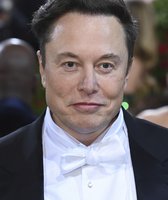
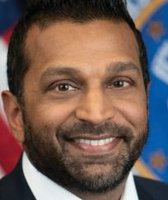
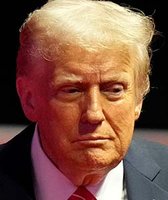
“You cannot bring a firearm loaded with multiple magazines to any sort of protest that you want. It’s that simple.”

Our only agenda is to publish the truth so you can be an informed participant in democracy.
We need your help.

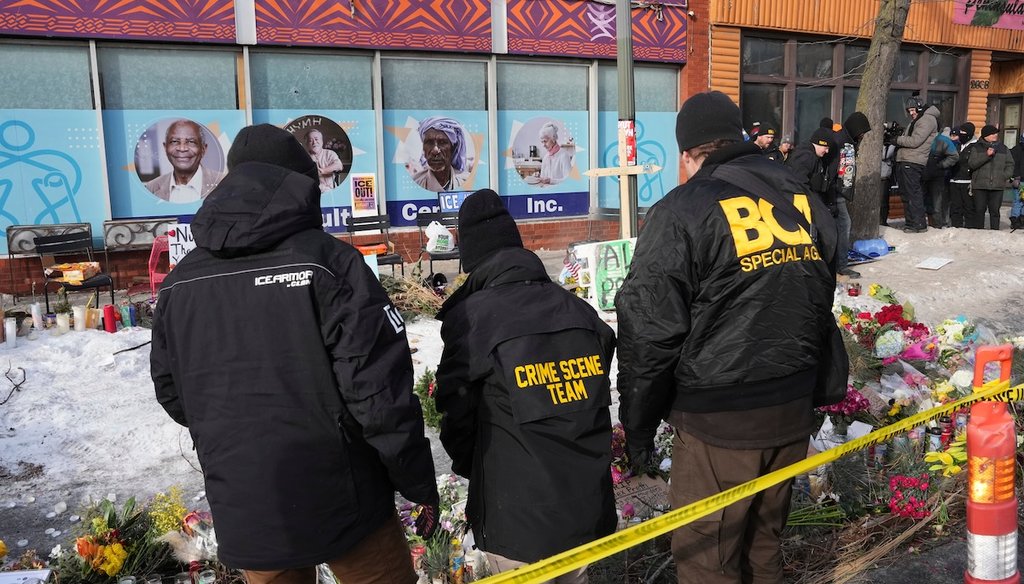
On Jan. 25, 2026, Minnesota Bureau of Criminal Apprehension officers stand near where Alex Pretti was fatally shot by a U.S. Border Patrol officer in Minneapolis. (AP)
Some states have laws that ban guns at protests, but Minnesota’s concealed carry law for guns does not. Alex Pretti, who was killed by federal immigration agents Jan. 24, had a concealed carry permit.
Some states have even more permissive laws than Minnesota, allowing people to bring guns to protests even if they don’t have concealed carry permits.
Although the Supreme Court hasn’t ruled on the question of bringing guns to protests, recent decisions have granted wide leeway for gun rights.
After the fatal shooting of concealed carry permitholder Alex Pretti, debate over gun rights added a new layer to the federal government’s aggressive immigration enforcement activity in Minneapolis.
Top Trump administration officials said because Pretti carried a handgun and ammunition, he planned to assassinate law enforcement.
The day after Pretti was killed, FBI Director Kash Patel discussed the case on Fox News’ "Sunday Morning Futures."
Patel said, "You cannot bring a firearm loaded with multiple magazines to any sort of protest that you want. It’s that simple. You don’t have the right to break the law and incite violence."
The administration shared an image of a gun and extra ammunition it said Border Patrol agents took from Pretti on Jan. 24 on Nicollet Avenue in south Minneapolis.
Video footage that surfaced in the first 48 hours after the shooting does not show Pretti holding the gun in his hands or pointing it at federal agents at any point. Some footage shows agents had disarmed Pretti shortly before he was shot.
The administration said the Department of Homeland Security would conduct an internal investigation, but its scope was reportedly limited.
The shooting of a protester who had a concealed carry permit prompted criticism by gun-rights advocates, who pointed to Second Amendment protections.
"Every peaceable Minnesotan has the right to keep and bear arms — including while attending protests, acting as observers, or exercising their First Amendment rights," the Minnesota Gun Owners Caucus wrote. "These rights do not disappear when someone is lawfully armed, and they must be respected and protected at all times."
The FBI declined to comment for this article. Patel sought to clarify his stance in a Jan. 26 interview with Fox News' Sean Hannity, saying, "We are not going after people and infringing on their freedom of speech to peacefully protest. We are definitely not going after people in their Second Amendment rights to bear arms — only if you incite violence and or threaten to do harm to law enforcement officials and break the law in any other way."
We asked 13 legal experts about Patel’s statement. They agreed that Patel was wrong about the Minnesota law, although they cautioned that some states do ban guns at protests.
In general, "There is no blanket prohibition or long-standing tradition against bringing otherwise lawfully owned and carried firearms to a protest, parade, demonstration, or other public event," said Clark Neily, senior vice president for legal studies at the libertarian Cato Institute. "To the contrary, the default practice or tradition is that someone who is lawfully carrying a firearm may bring it to public gatherings, including protests and demonstrations."
It hasn’t been unusual to see people carrying guns at protests in recent years, such as at a 2020 protest against Michigan’s pandemic laws at the state capitol in Lansing.
Experts widely agree that because the state legally permitted Pretti to carry a gun, he was within his rights in Minnesota to do so, including at a protest.
While some states’ laws restrict guns at protests, "Minnesota has no such law in place," said Konstadinos Moros, director of legal research and education at the Second Amendment Foundation.
Eleven states and the District of Columbia ban concealed weapons at demonstrations and protests, and 11 states and the district ban open carry of weapons at demonstrations or protests, according to a tracker assembled by the anti gun-violence group Giffords. Of these, seven states and D.C. ban both.
Several gun law experts also told PolitiFact they are unaware of any states that explicitly ban something else Patel mentioned: extra magazines for ammunition.
Some social media commentators said Pretti broke the law by not physically carrying his permit or other identification. (Homeland Security Secretary Kristi Noem and former top Customs and Border Patrol official in Minneapolis Greg Bovino have alleged that Pretti carried no ID.) State law says not carrying a permit is a "petty misdemeanor" subject to a fine of up to $25. Such a violation "does not constitute a crime," state law says.
Federal officials have said that Pretti went beyond observing and was interfering with a law enforcement activity. Experts agreed that Pretti would have been legally barred from threatening, interfering with or lying to officers. "As a general matter, peacefully observing a demonstration is different from criminally obstructing law enforcement," said David B. Kopel, research director at the conservative Independence Institute.
Video footage that has surfaced so far does not show that Pretti criminally obstructed law enforcement, though uncertainties and gaps remain. Some footage begins as he helps a woman who had been pushed into the snow by a federal agent; he was holding a phone in his hand.
A majority of states have more expansive laws than Minnesota’s, allowing concealed carrying of guns without a permit. "In those states with broad public-carry rights, the mere fact that an individual is armed at a protest is not itself a crime," said Darrell Miller, a University of Chicago law professor.
Legal experts said the Supreme Court’s record bolsters a Second Amendment right to carry guns at protests, which are sometimes referred to in laws as "public gatherings" or "assemblies."
The most recent notable Supreme Court decision is New York State Rifle & Pistol Association Inc. v. Bruen from 2022. The justices, in a 6-3 decision, found that the right to carry a firearm in public for self-defense has deep historical roots, and that a "special need" is not necessary to exercise it.
The decision allowed states to ban public carry in certain "sensitive places," such as schools and government buildings, and some states have moved to restrict the carrying of firearms at some events, such as protests, said Timothy Zick, a William & Mary Law School professor. Whether those laws would pass muster at the Supreme Court depends on whether there were similar laws during the 18th and possibly the 19th century, Zick said.
A Supreme Court case currently under review, Wolford v. Lopez, will decide whether Hawaii can restrict people’s ability to bring guns onto private property that is open to the public. The people suing to block the law won the previous round, at the Ninth Circuit Court of Appeals. Moros said that victory at an appeals court that’s "pretty hostile" to the Second Amendment is notable.
In another decision released Jan. 20, the Fourth Circuit Court of Appeals found that Maryland's prohibition on carrying guns near public demonstrations is constitutional. This split between circuits could make the Supreme Court more likely to weigh in on a case that explicitly involves protests and gun rights, Moros said.
Neily agreed that based on the recent court record, it’s "quite likely that laws against carrying otherwise lawfully possessed firearms at protests and other public events would be struck down under the Second Amendment."
Patel said, "You cannot bring a firearm loaded with multiple magazines to any sort of protest that you want. It’s that simple."
Some states have laws that ban guns at protests, but Minnesota’s concealed carry law does not include such a ban. Pretti had a concealed carry permit. Even if he did not have the permit or an ID on him at the time, Minnesota law considers that a minor infraction. Some states’ laws are more permissive than Minnesota, allowing people to bring guns to protests even if they don’t have a concealed carry permit, as Pretti did.
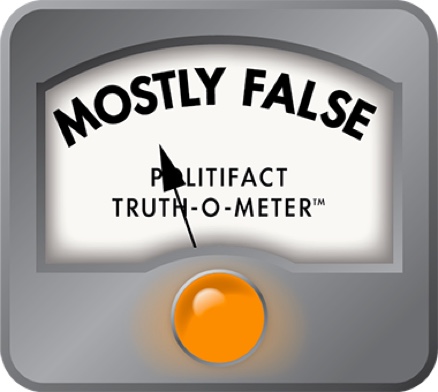
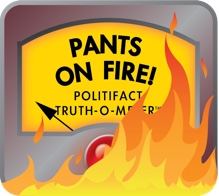
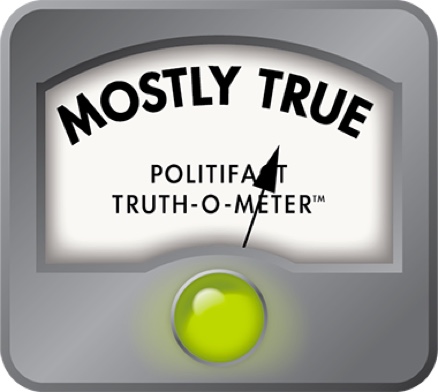
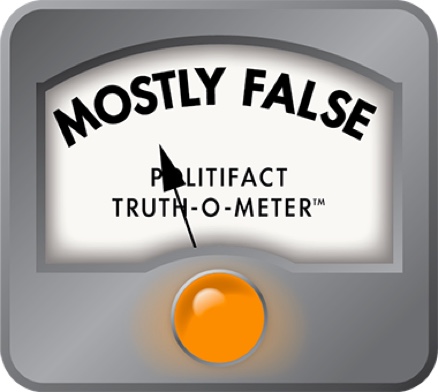
The statement contains an element of truth — the legality of bringing guns to protests depends on the state — but ignores that this incident happened in Minnesota, where the law allows guns at protests. We rate the statement Mostly False.
Kash Patel, interview on Fox News’ Sunday Morning Futures, Jan. 25, 2026
Kash Patel, interview with Fox News’ Sean Hannity, Jan. 26, 2026
Kristi Noem, press conference, Jan. 24, 2026
Gregory Bovino, press conference, Jan. 24, 2026
Stephen Miller, X post, Jan. 24, 2026
Minnesota Statutes, 624.714 Carrying of Weapons Without Permit; Penalties, accessed Jan. 26, 2026
Minnesota Statutes, 609.02 Definitions, accessed Jan. 26, 2026
New York State Rifle & Pistol Association Inc. v. Bruen (2022)
SCOTUSBlog, "Supreme Court appears sympathetic to gun owners’ challenge to Hawaii law," Jan. 20, 2026
Giffords, "Prohibitions on Firearms at Demonstrations, Protests, or Licensed Public Gatherings," accessed Jan. 26, 2026
Bearing Arms, "2A Groups Respond After Fatal Shooting of Minneapolis Protester and Concealed Carry Holder," Jan. 25, 2026
Minnesota Gun Owners Caucus, "Press Release: MN Gun Owners Caucus responds to the shooting death of Alex Pretti," Jan. 24, 2026
PolitiFact, "Fact-check: Trump officials’ statements about Alex Pretti’s fatal shooting by Border Patrol agent," Jan. 26, 2026
Email interview with Jacob D. Charles, Pepperdine University law professor, Jan. 26, 2026
Email interview with Ian Ayres, Yale Law School professor, Jan. 26, 2026
Email interview with Megan Walsh, visiting clinical law professor at the University of Minnesota, Jan. 26, 2026
Email interview with Mark Osler, University of St. Thomas law professor, Jan. 26, 2026
Email interview with Nelson Lund, George Mason University law professor, Jan. 26, 2026
Email interview with Eugene Volokh, UCLA law professor, Jan. 26, 2026
Email interview with Saul Cornell, Fordham University historian, Jan. 26, 2026
Email interview with Nicholas Johnson, Fordham University law professor, Jan. 26, 2026
Email interview with Darrell Miller, University of Chicago law professor, Jan. 26, 2026
Email interview with Timothy Zick, College of William & Mary law professor, Jan. 26, 2026
Email interview with Robert J. Spitzer, emeritus political scientist at the State University of New York-Cortland, Jan. 26, 2026
Email interview with David B. Kopel, research director at the Independence Institute, Jan. 26, 2026
Email interview with Clark Neily, senior vice president for legal studies at the Cato Institute, Jan. 26, 2026



In a world of wild talk and fake news, help us stand up for the facts.