Stand up for the facts!
Our only agenda is to publish the truth so you can be an informed participant in democracy.
We need your help.
I would like to contribute

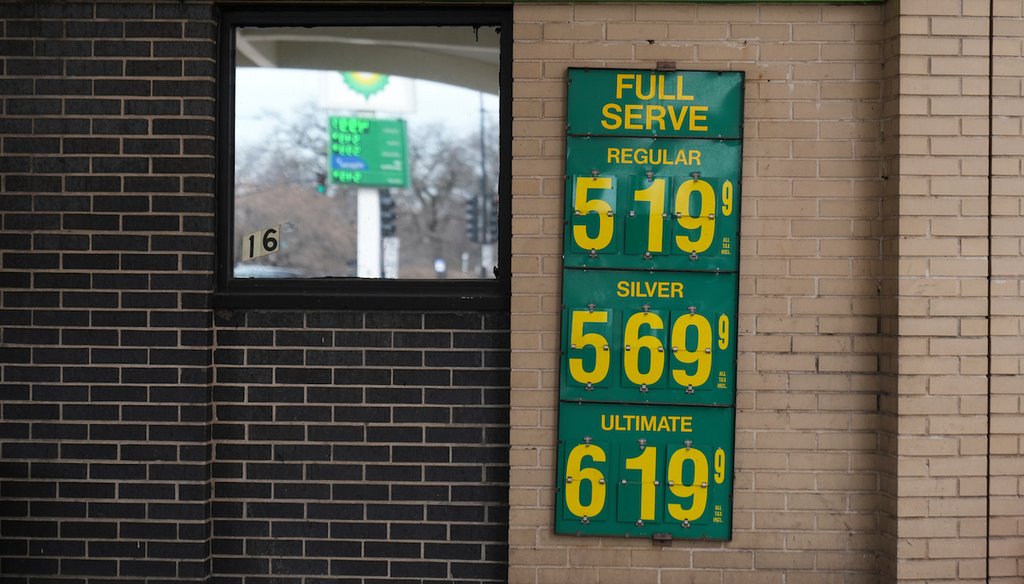
Gas prices are displayed at a station March 24, 2026, in Chicago. (AP)

If Your Time is short
-
Shortly after the U.S. and Israel attacked Iran on Feb. 28, prices for both gasoline and crude oil — the material that is refined into gasoline — spiked and have continued to rise.
-
The average national price is about $4 per gallon as of late March, up from about $3 per gallon before the war.
-
Economists predict that the average household will spend hundreds of dollars more this year on gasoline compared to predicted gas spending before the start of the war.
Democrats running for reelection this year say President Donald Trump’s actions are hurting Americans’ wallets, with gasoline prices soaring since the U.S. and Israel attacked Iran.
"At a buck a gallon, every American driver is going to pay $500 more in gasoline prices at the pump this year," Sen. Edward Markey, D-Mass., said March 20 on CNN.
Gasoline prices rose from an average national price under $3 a gallon before the Feb. 28 attack on Iran to almost $4 per gallon now, according to the GasBuddy gas price app.
Markey’s prediction that every driver will pay $500 more this year depends on many factors. But one economic forecast projects that, if trends continue, average annual U.S. household spending on gasoline will increase by between $700 to more than $800 — even higher than what Markey said. The estimates are based on driver behavior remaining the same and gas prices rising and retreating, but not to pre-war prices.
Markey faces a Sept. 1 Democratic primary challenge from U.S. Rep. Seth Moulton. The primary is likely to be more competitive than the general election because no Republican has won a U.S. Senate seat in Massachusetts since 2010.
Subhead: Prices spiked quickly after the war started
Shortly after the war’s start, prices for both crude oil — the material that is refined into gasoline — and gasoline spiked.
The war poses several challenges for oil and energy markets. About one-fifth of the world’s oil passes through the Strait of Hormuz, a point between the Persian Gulf and the Gulf of Oman, where Iran can block oil tankers from passing.
The strait was effectively closed to tankers for weeks. In a March 22 letter to a United Nations maritime organization, Iran said that "nonhostile" ships may pass through. But it remained unclear if shipowners would decide to use the strait. Few ships have sailed through the strait since the war began.
If oil-carrying ships cannot or will not enter the strait, it will reduce the amount of oil available on the market, which in turn leads to higher prices.
Trump has acknowledged the spike in gasoline prices but predicted the cost increases are temporary and said they will "come tumbling down along with everything else."
Economists predict average household will spend hundreds more for gasoline this year
A Markey spokesperson said if gasoline is $1 per gallon more than it was before the war and that trend persists, a household purchasing roughly 10 gallons a week or about 500 gallons for the year would pay $500 more.
Neale Mahoney, an economics professor at the Stanford Institute for Economic Policy Research, along with other economists, wrote March 18 that retail prices are expected to peak at an average $4.36 per gallon in May and then decline each month but not to January’s pre-war price. Their estimate predicts "the average household will pay $740 more in gas costs over the remainder of the year," assuming no change in drivers’ behavior.
The estimate was based on certain assumptions, including investment management firm Goldman Sachs’s forecast that the Strait of Hormuz would be closed for three weeks. As of March 25, that timeframe had effectively passed. The economists wrote that there are substantial variations across households but used an 84 gallon per month household average.
After Goldman Sachs updated its forecast to say the straight would see a limited flow of ships for six weeks, the economists revised their estimates and projected that the average household will spend $857 more this year on gasoline.
Not every driver will face increased costs of hundreds of dollars
Where Markey’s comment falls short is in saying "every American driver" will bear the same or similar increased costs. Gasoline prices vary by state and city and not every household uses gas-powered vehicles at the same rate. Electric vehicle owners wouldn’t be directly affected by gasoline prices.
The Institute on Taxation and Economic Policy, a left-leaning think tank, found that the southern U.S. has been the hardest hit and will pay $39 more per month in higher gas prices, compared with $34 nationally or $24 in the Northeast.
"Residents of some states purchase more gasoline because their populations are more dispersed, commutes are longer, transit service is sparser, and even the types of vehicles people own are different," the group said.
Clark Williams-Derry, an energy analyst at the institute for Energy Economics and Financial Analysis, said if the $1 per gallon price increase continues for a year, total costs would rise nationally by $136.5 billion a year.
According to the Federal Highway Administration, there were 240 million licensed drivers in the U.S. in 2024. "Assuming cost increases of $136.5 billion per year divided by 240 million licensed drivers, a simplistic average suggests that gasoline costs will rise by ~$574 dollars per driver over the course of a year," Williams-Derry wrote in an email. "So the number quoted by Markey is actually LOWER than the average cost increase per American driver."
It’s possible that the yearly extra burden for drivers could exceed the estimates if the impact on the strait worsens.
"Even if the Strait of Hormuz were re-opened today, it would take months for oil markets to get back to where they were before this price shock," Williams-Derry said. "The longer the supply disruptions in the Persian Gulf and beyond persist, the longer the price disruptions will last and the more severe they'll get."
Chief Correspondent Louis Jacobson contributed to this fact-check.
RELATED: Ask PolitiFact: What is the Strait of Hormuz and how does it affect oil prices?
RELATED: Ask PolitiFact: What does the Iran war mean for US gasoline prices?
Our Sources
CNN, Transcript and interview with Sen. Edward Markey, March 20, 2026
Neale Mahoney, Spiking Gasoline Prices May Wipe Out Larger Tax Refunds Touted by Trump, March 18, 2026
Neale Mahoney, X post, March 24, 2026
The Institute on Taxation and Economic Policy, These States Are Most Impacted by the Spike in Gas Prices, March 23, 2026
Gas Buddy, Gas price chart, Accessed March 24, 2026
New York Times, Why It’s So Hard to Reopen the Strait of Hormuz, March 24, 2026
The Hill, Iran will allow ‘non-hostile vessels’ to pass through Strait of Hormuz, March 24, 2026
ABC News, UN says 20,000 seafarers stranded due to Strait of Hormuz closure, despite Iran claiming it's open, March 25, 2026
Sen. Edward Markey’s press office, Statement to PolitiFact, March 24, 2026
Email interview, Patrick De Haan, head of petroleum analysis, GasBuddy, March 24, 2026
Email and telephone interview, Neale Mahoney, an economics professor at the Stanford Institute for Economic Policy Research, March 24, 2026
Email interview, Clark Williams-Derry, energy analyst at the institute for Energy Economics and Financial Analysis, March 24, 2026