Stand up for the facts!
Our only agenda is to publish the truth so you can be an informed participant in democracy.
We need your help.
I would like to contribute

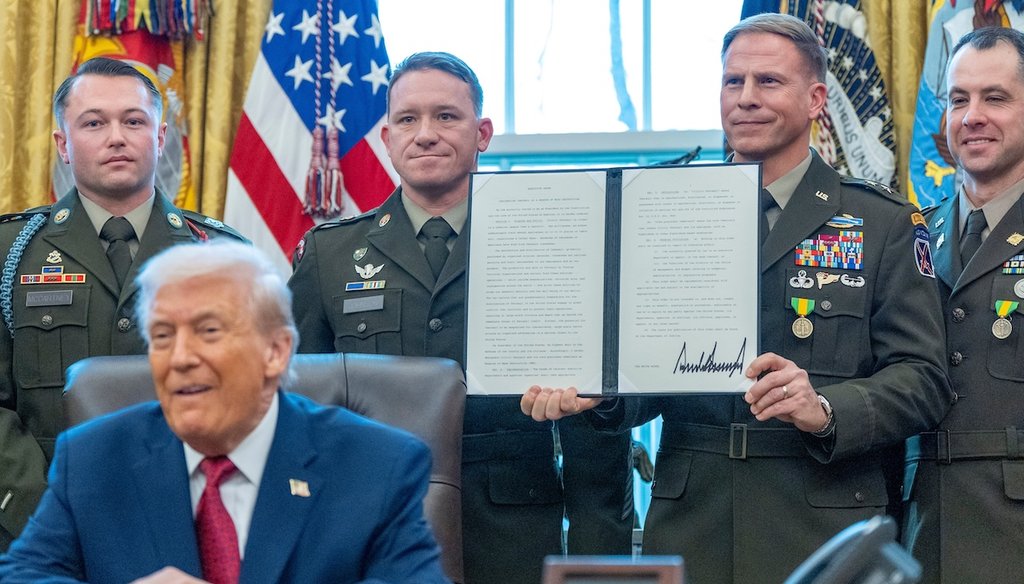
Soldiers hold an executive order about fentanyl signed by President Donald Trump in the Oval Office on Dec. 15, 2025. (AP)

With a Dec. 15 executive order, President Donald Trump became the first U.S. president to classify a narcotic as a weapon of mass destruction.
Trump used U.S. deaths from fentanyl to justify the drug's new designation, estimating that up to 300,000 people die annually from the drug; that number is exaggerated. In the 12 months through April 2025, about 42,000 people died from synthetic opioids other than methadone, and most of the deaths were caused by fentanyl.
"Illicit fentanyl is closer to a chemical weapon than a narcotic," his order said. "Two milligrams, an almost undetectable trace amount equivalent to 10 to 15 grains of table salt, constitutes a lethal dose."
The United States’ legal definition would have to be expanded to include fentanyl. Is it legally sound to classify fentanyl as a weapon of mass destruction, a label historically used to describe nuclear, biological or chemical weapons of war? Experts differed in their assessments.
Michael O’Hanlon, research director in the Brookings Institution’s foreign policy program, said he thinks Trump’s designation is plausible.
"The sheer number of deaths it has caused is staggering, and while they happen user by user rather than indiscriminately, as with traditional weapons of mass destruction, those who suffer from it often don’t even know that they’ve taken it," he said.
Other experts expressed skepticism. Brendan R. Green, a University of Cincinnati political scientist who specializes in military and nuclear policy, said he’s not convinced fentanyl fits in the weapons of mass destruction category.
Given the historical use of the term, he said, "it is not even close to reasonable to call fentanyl a weapon of mass destruction."
The biggest impact could be for framing the debate about possible U.S. military intervention, experts said, citing former President George W. Bush’s use of weapons of mass destruction — falsely — to justify the Iraq War.
What is the traditional definition of weapons of mass destruction?
Historically, weapons of mass destruction, or WMDs, have included nuclear, biological and chemical weapons, and sometimes radiological weapons, such as radioactive "dirty bombs."
Among the characteristics these weapons share is that they can kill indiscriminately, on a large scale, with victims potentially including civilians.
Fentanyl doesn’t fit those descriptions. While the drug can kill unsuspecting people — including people who think they’re consuming a different drug, or people who enter a space where illicit drugs are consumed — fentanyl does not kill large numbers of people at once, and people not involved with illicit drugs are unlikely to encounter it by chance.
Fentanyl also isn’t a weapon of war, and other poisons such as arsenic or cyanide (or bullets) are not classified as weapons of mass destruction despite their death toll. Fentanyl also has a legitimate use in medical settings, unlike nuclear weapons, nerve gas or biological agents.
Federal law defines a weapon of mass destruction as:
-
A destructive device, such as an explosive or incendiary bomb, rocket, or grenade.
-
A weapon that uses "toxic or poisonous chemicals or their precursors."
-
A "biological agent (or) toxin."
-
A weapon "designed to release radiation or radioactivity at a level dangerous to human life."
Mark F. Cancian, a senior defense and security adviser at the Center for Strategic and International Studies, a national security-focused think tank, said it would be "a stretch" to call an illegal drug like fentanyl a weapon.
"That is certainly not what Congress intended when it passed the law," Cancian said. Lawmakers "were thinking about ISIS and al-Qaida."
There is precedent for the use of aerosolized fentanyl as a weapon: In October 2002, Russia’s military used a gas believed to be related to fentanyl to incapacitate Chechen rebels occupying a theater in Moscow. More than 100 rebels and hostages died from the agent and from inadequate medical support.
The executive order notes the possibility of weaponizing fentanyl as one reason to classify it as a WMD, but the main focus of the executive order is on the effect of "trafficking," "smuggling" and the "manufacture, distribution, and sale of illicit fentanyl and its core precursor chemicals," rather than terrorist or military weaponization.
John P. Caves Jr., a National Defense University research fellow, was skeptical of labeling fentanyl a weapon of mass destruction in 2019, when Trump’s first administration considered whether to make the change.
While Caves urged action under the Chemical Weapons Convention — the international treaty that bars the use of chemical agents — as well as defensive countermeasures by the U.S. military, he wrote that he didn’t see a need for the Defense Department to officially designate fentanyl compounds as weapons of mass destruction.
What legal or military effect could Trump’s order have?
Trump’s executive order has more power as a call to arms with the public than as a legal document, experts said.
Under international law, the executive order "has absolutely no meaning," said Anthony Clark Arend, a Georgetown University professor who specializes in international law.
To be able to use force legally under international law, the U.S. would have to cite an "actual, or imminent, armed attack against the U.S.," Arend said. "Bringing drugs to sell in the United States, as horrible as that may be, does not constitute an ‘armed attack’ under any reasonable interpretation of those words," he said.
In the context of U.S. law, the order could hand the administration some new tools, Cancian said.
Federal law says for "emergency situations involving weapons of mass destruction," require a serious threat to U.S. interests.
"This was written with a 9/11-type situation in mind, but the administration might stretch it to justify troop movements into cities," even though the law specifically forbids arrests or participation in any search or seizure, Cancian said.
Categorizing fentanyl as a WMD could provide the administration with an argument to the public about why the U.S. should intervene in another country.
The administration could frame the quest to eliminate WMDs as focusing on Venezuela, whose government is the target of Trump administration criticism and which is in close proximity to two dozen U.S. strikes of alleged drug-carrying boats this year. The administration has falsely linked Venezuela and fentanyl, however; most fentanyl in the U.S. comes from Mexico, with the precursors commonly made in China.
Green said he thinks the executive order mostly advances the administration’s ability to rally public support for military action.
"A string of presidents have already asserted extremely broad powers" over using the military, he said. Calling fentanyl a weapon of mass destruction could provide a "political hook for military action. But it hardly seems necessary, given long-standing precedent" about what presidents are allowed to do, he said.
Our Sources
White House, "Designating Fentanyl as a Weapon of Mass Destruction," Dec. 15, 2025
Donald Trump, remarks in the Oval Office, Dec. 15, 2025
18 U.S. Code § 2332a - Use of weapons of mass destruction
10 U.S. Code § 282 - Emergency situations involving weapons of mass destruction
Centers for Disease Control and Prevention, "Provisional Drug Overdose Death Counts," accessed Dec. 16, 2025
Drug Enforcement Administration, "Facts About Fentanyl," accessed Dec. 16, 2025
Journal of Medical Toxicology, "ACMT and AACT Position Statement: Preventing Occupational Fentanyl and Fentanyl Analog Exposure to Emergency Responders," Aug .25, 2017
Annals of Emergency Medicine, "Unexpected ‘gas’ casualties in Moscow: A medical toxicology perspective," May 2003
John P. Caves, Jr., "Fentanyl as a Chemical Weapon," December 2019
Northern New England Poison Center, "Poison Information," accessed Dec. 16, 2025
Organisation for the Prohibition of Chemical Weapons, "The Chemical Weapons Convention," accessed Dec. 16, 2025
BBC, "Eight killed in latest strikes on alleged drug boats, US military says," Dec. 16, 2025
ABC News, "Owner of day care where baby died from fentanyl pleads guilty to federal charges," Oct 29, 2024
The Atlantic, "The New ‘Weapon of Mass Destruction,’" Dec. 16, 2025
Task and Purpose, "Exclusive: DHS is considering classifying fentanyl as a ‘weapon of mass destruction,’" April 15, 2019
PolitiFact, "What is fentanyl? The facts and myths on the synthetic opioid driving drug overdoses," Aug. 21, 2025
Email interview with John Pike, director of globalsecurity.org, Dec. 16, 2025
Email interview with Michael O’Hanlon, director of research in the foreign policy program at the Brookings Institution, Dec. 16, 2025
Email interview with Anthony Clark Arend, Georgetown University government and foreign service professor, Dec. 16, 2025
Email interview with Mark F. Cancian, senior adviser in defense and security at the Center for Strategic and International Studies, Dec. 16, 2025
Email interview with Brendan R. Green, University of Cincinnati political scientist, Dec. 16, 2025