Stand up for the facts!
Our only agenda is to publish the truth so you can be an informed participant in democracy.
We need your help.
I would like to contribute

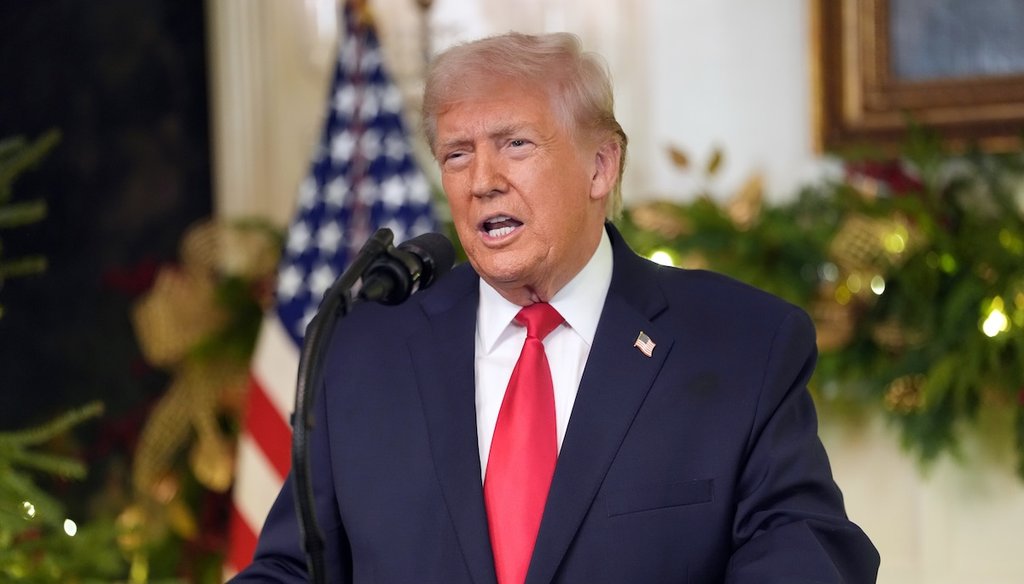
President Donald Trump speaks during an address to the nation from the Diplomatic Reception Room at the White House, Wednesday, Dec. 17, 2025, in Washington. (AP)


In a prime-time White House address, President Donald Trump told the nation that his 11 months in office have brought historic improvements to American lives after years of what he described as immigration and economic chaos.
And more good news was coming, he said during the 18-minute, live-televised speech Dec. 17. He said the U.S. would be sending $1,776 checks to 1.45 million U.S. military personnel, a new "warrior dividend."
"The checks are already on the way," Trump said. "Nobody understood that one until about 30 minutes ago."
The picture Trump painted contrasts with what Americans say they feel. Just 36% of Americans polled in December by NPR/PBS News/Marist said they approve of how he is handling the economy, and more than 1 in 3 said their personal finances had deteriorated in the past year. Consumer confidence is near the lows reached when inflation was around 9% in mid-2022 under President Joe Biden.
The picture Trump painted also skewed the facts. Trump exaggerated, by trillions of dollars, the amount of expected foreign investment he has attracted to the U.S. He overstated the historic scale of tax cuts in his domestic spending law and its savings for older Americans, and he repeated false talking points about the number of immigrants in the country illegally and their origin. He said crime has been at record levels, but violent crime rates were roughly twice as high in the early 1990s.
While Trump repeated some statements we have fact-checked before, we took a closer look at his big-picture summation of the economy, drug prices, the newly announced military dividends and tax refunds.
Trump: "Inflation has stopped, wages are up, prices are down."
Inflation hasn’t stopped. Wages are up. Prices, which are measured by inflation rates, aren’t down.
At the time of Trump’s speech, the most recent publicly available inflation data showed that prices had increased by 3% year over year in September, exactly where year-over-year inflation stood when Trump took office in January. The following day, the Bureau of Labor Statistics released updated data showing 2.7% inflation for November. That was a decline, but it was not zero, and it was still above the Federal Reserve’s target of 2% inflation.
Trump has a better story to tell on wages. Since he’s been in office, wage gains have outpaced inflation.
Trump: I have worked to "slash prices on drugs and pharmaceuticals by as much as 400, 500, and even 600%"
Trump has made similar claims before — citing decreases as high as 1,000% — but price cuts this large are not mathematically possible.
A 100% reduction would mean that a consumer pays nothing for a medication.
A 200% reduction would mean the pharmaceutical company pays the consumer the full price of the medicine.
A 400% reduction would mean the company pays the consumer three times the price of the medicine.
A 500% cut would bring the consumer four times the price, and a 600% cut would give the consumer five times the price to accept the medicine. Any of these decreases are unrealistic.
Trump: "In honor of our nation's founding in 1776, we are sending every soldier $1,776."
The cost for more than 1.45 million service members to receive these checks would come to $2.58 billion. It was not immediately clear where that money would come from, though Trump said, "We made a lot more money than anybody thought" from tariffs.
If Trump’s tariffs remain in place for all of 2026, they would generate $191 billion in revenue that year, according to the center-right Tax Foundation.
But typically an expenditure this large would require Congress to pass a law making the appropriation, which wouldn’t have happened if the checks are already in the mail, as he said. Trump has floated several conflicting destinations for increased tariff revenues, including $2,000 dividends for Americans, federal debt reduction and eliminating the federal income tax (which would not be feasible).
The White House did not immediately respond to an inquiry from PolitiFact on this point.
Trump: "Next spring is projected to be the largest tax refund season of all time."
There is reason to believe tax refund checks will be sizable in early 2026, with the largest refunds likely to go to the highest income households.
"We do expect refunds to be higher next tax filing season because some of the tax changes included in the One Big Beautiful Bill Act were effective for tax year 2025," said Joseph Rosenberg, a senior fellow with the Urban Institute-Brookings Institution Tax Policy Center.
Those provisions include higher standard deductions, a larger child tax credit, a higher limit on the state and local tax deduction, and new deductions for tips, overtime, car-loan interest and older people.
Rosenberg’s group estimates that, overall, tax bills will go down by about $125 billion, or $650 per taxpayer. Taxpayers’ savings will vary widely, however, with higher-income households generally benefiting more, Rosenberg said. His group estimates that among the bottom one-fifth of taxpayers by income, about 16% of households will receive a tax cut. In the top one-fifth by income, about 91% will see a tax cut, averaging about $2,300.
To a degree, the size of refunds will depend on whether taxpayers changed their withholding, said Garrett Watson, Tax Foundation policy analysis director.
If taxpayers kept their old withholding rates, Watson said, then "instead of gradually receiving the benefit of the tax cuts through higher take-home pay during the year, most taxpayers will receive it all at once when they file their returns."
Email suggestions for fact-checks to [email protected].
UPDATE, Dec. 18, 2025: This story has been updated to include figures from inflation data the federal government released on Dec. 18, the morning after Trump’s speech.
Our Sources
Email interview with Joseph Rosenberg, senior fellow with the Urban Institute-Brookings Institution Tax Policy Center, Dec. 17, 2025
Email interview with Garrett Watson, Tax Foundation policy analysis director, Dec. 17, 2025
Other sources linked in article