Stand up for the facts!
Our only agenda is to publish the truth so you can be an informed participant in democracy.
We need your help.
I would like to contribute

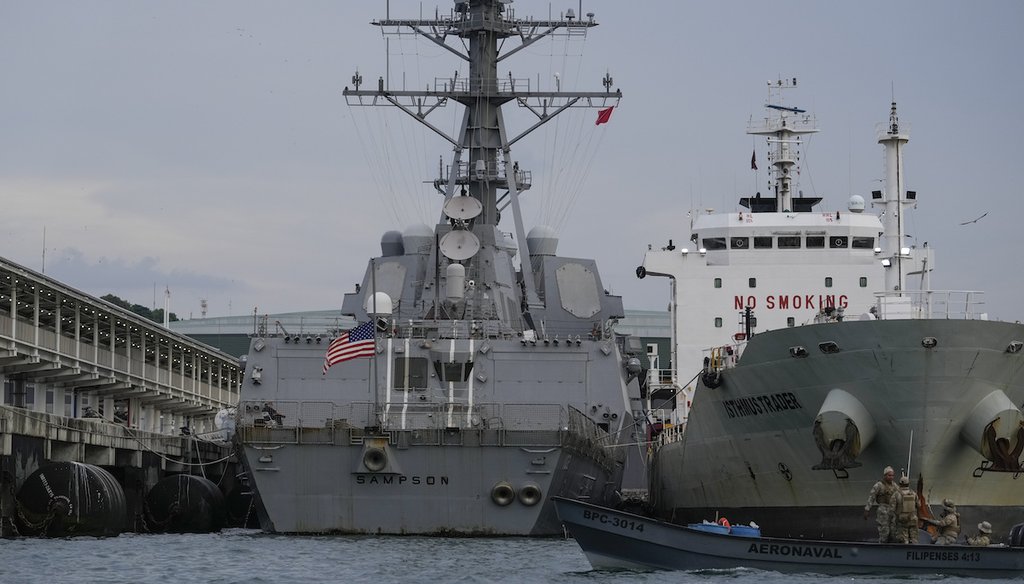
The U.S. Navy warship USS Sampson docks at a port in Panama City, Aug. 30, 2025. (AP)


If Your Time is short
-
The U.S. military attacked and destroyed what it called a "drug-carrying-boat" from Venezuela on Sept. 2, saying it was heading to the U.S. and the people on board were members of the Venezuelan Tren de Aragua criminal gang.
-
The Trump administration has not released much information about the strike, but a White House spokesperson told PolitiFact the strike was consistent with international law governing military action.
-
Legal experts’ opinions on the strike’s legality vary. Even if it were illegal, though, experts said it is unlikely administration officials will face consequences.
A U.S. military attack against what officials called a drug-carrying boat from Venezuela is raising questions about the strike’s legality.
On Sept. 2, President Donald Trump announced that the U.S. military had struck the vessel in the southern Caribbean, killing 11 people on board. Moments later, Secretary of State Marco Rubio said on X that the boat had come from Venezuela and was being operated by a "designated narco-terrorist organization."
Trump later posted on Truth Social what he said was video footage of the strike, saying the boat had been heading to the U.S. and the people on board were members of Tren de Aragua, a Venezuelan gang that the Trump administration has designated a foreign terrorist organization. (Venezuela counter argued that the footage was made with artificial intelligence.) The Trump administration has also alleged that Tren de Aragua is under the control of Venezuela’s president, Nicolas Maduro.
Some legal experts said the attack was illegal under maritime law or human rights conventions; others said it contradicted longstanding U.S. military practices.
When asked by a reporter Sept. 4 what legal authority the Pentagon had invoked to strike the boat, Defense Secretary Pete Hegseth said, "We have the absolute and complete authority to conduct that." He did not detail the legal authority used; he said it was done in defense of Americans at risk of being killed by drugs trafficked into the country.
White House deputy press secretary Anna Kelly told PolitiFact on Sept. 5 that the strike was in defense of U.S. national interests "against the operations of a designated terrorist organization." Kelly said it was taken "in the collective self-defense of other nations who have long suffered due to the narcotics trafficking and violent cartel activities of such organizations. The strike was fully consistent with the law of armed conflict," meaning it complied with international law and U.S. policy.
As of late afternoon on Sept. 8, the administration hadn’t released the identities of those on board; how the U.S. learned that they were Tren de Aragua members carrying drugs; what kind of drugs were on board; and how the strike was carried out.
Sen. Mark Warner, D-Va., the vice chair of the committee that oversees U.S. intelligence agencies, said Sept. 7 on CBS’ "Face the Nation" that he expects to be briefed this week about what happened.
"My fear is there are still international laws of the sea about how the process of interdicting these kinds of boats — there's supposed to be a firing of a warning shot," Warner said. "You're supposed to try to take it peacefully. "
Here are some of the key questions about the incident.
What is Tren de Aragua?
Tren de Aragua is a criminal gang that operated with the government’s knowledge out of a prison run by Venezuela government officials, Ronna Risquez, a Venezuelan investigative journalist who published a book about Tren de Aragua, said in March. It has established a small foothold in some parts of the U.S.
A March 15 White House proclamation said, according to evidence, Tren de Aragua has invaded the U.S. As a result, Trump said any person 14 years or older who is a Tren de Aragua member and who has neither U.S. citizenship nor permanent residency can be arrested, detained and deported using the Alien Enemies Act.
The Alien Enemies Act of 1798 allows the president to detain and deport people from a "hostile nation or government" without a hearing when the U.S. is either at war with that country or the country has "perpetrated, attempted, or threatened" an invasion or raid legally called a "predatory incursion" against the U.S.
He used the act to deport suspected members of Tren de Aragua or send them to a maximum-security prison in El Salvador, a controversial use of the law. Earlier this month, a federal appeals court ruled that the administration cannot quickly deport Tren de Aragua members using the Alien Enemies Act.
A U.S. intelligence report cast doubt on the notion that the gang is run by Maduro.
In late August, Trump began sending warships to Venezuelan waters, including at least 4,500 military troops, in an effort to combat drug trafficking. In turn, Maduro has ratcheted up Venezuela’s military footing, including mobilizing 8 million citizens.
Was the recent U.S. attack on the vessel unusual?
It’s rare but not unprecedented for the U.S. to use lethal military force to target suspected drug traffickers, said Mike LaSusa, deputy director of content at InSight Crime, a think tank focused on crime and security in the Americas. He cited the 1989 U.S. invasion of Panama, in which the U.S. intervened to overthrow Panamanian dictator Manuel Noriega after he was indicted on drug charges in the U.S.
"The U.S. has more commonly supported other countries with intelligence, equipment and training to carry out their own lethal operations against suspected drug traffickers," LaSusa said.
Anthony Clark Arend, a specialist in international law at Georgetown University, agreed. "While the U.S. has seized vessels on the high seas that were allegedly engaging in drug trafficking, to my knowledge the U.S. has not engaged in a direct attack against such a vessel previously," Arend said.
Was the attack legal?
The U.S. has not signed the United Nations Convention on the Law of the Sea, but U.S. military legal advisors have previously said that the U.S. should "act in a manner consistent with its provisions."
Separately, under Article 2(4) of the United Nations Charter, the U.S. "would only have the right to use military force against a foreign vessel on the high seas if it could be demonstrated that the vessel was engaging in an armed attack against the United States or that such an armed attack was imminent," said Anthony Clark Arend, a Georgetown University specialist in international law.
That section of the charter prohibits the "threat or use of force against the territorial integrity or political independence of any state" unless it has been approved by the United Nations Security Council — which this attack was not — or if force is used in self-defense of an "armed attack" or an imminent armed attack.
"There has been no evidence presented that the vessel was engaging in an armed attack or was about to be engaging in an armed attack," Arend said.
Some experts said less lethal options were available.
"I am not adamantly opposed to considering this a threat, but we had recourse short of armed attack, most notably disabling the ship and arresting the crew," said Michael O’Hanlon, a senior fellow at the Brookings Institution. "So in that sense, I believe we did not act consistently with the laws of war."
Even if the U.S. action was illegal, it’s unlikely administration officials would face consequences, experts said.
"In the real world, it is probably a bit fuzzy," said John Pike, director of globalsecurity.org, a think tank. Beyond the 2024 Supreme Court decision granting presidents broad leeway from prosecution for official duties, Pike said, "the Supreme Court has typically ruled such matters as nonjusticiable — political rather than legal."
Should the administration have informed Congress?
Under the War Powers Resolution of 1973, the Trump administration was supposed to provide Congress with information on Sept. 4 about why the strike was carried out. The law requires congressional notification within 48 hours of sending U.S. armed forces into certain situations abroad.
We asked Kelly Sept. 5 if the White House had submitted a response yet, but she did not answer the question. PolitiFact also checked the Reiss Center on Law and Security database, which keeps track of threat reports the president has submitted to Congress. The last one submitted was in June.
"Congress and the courts have historically been very deferential to presidents when they assert the authority to use military force, especially when the president invokes ‘terrorism’ as the threat being addressed," LaSusa said.
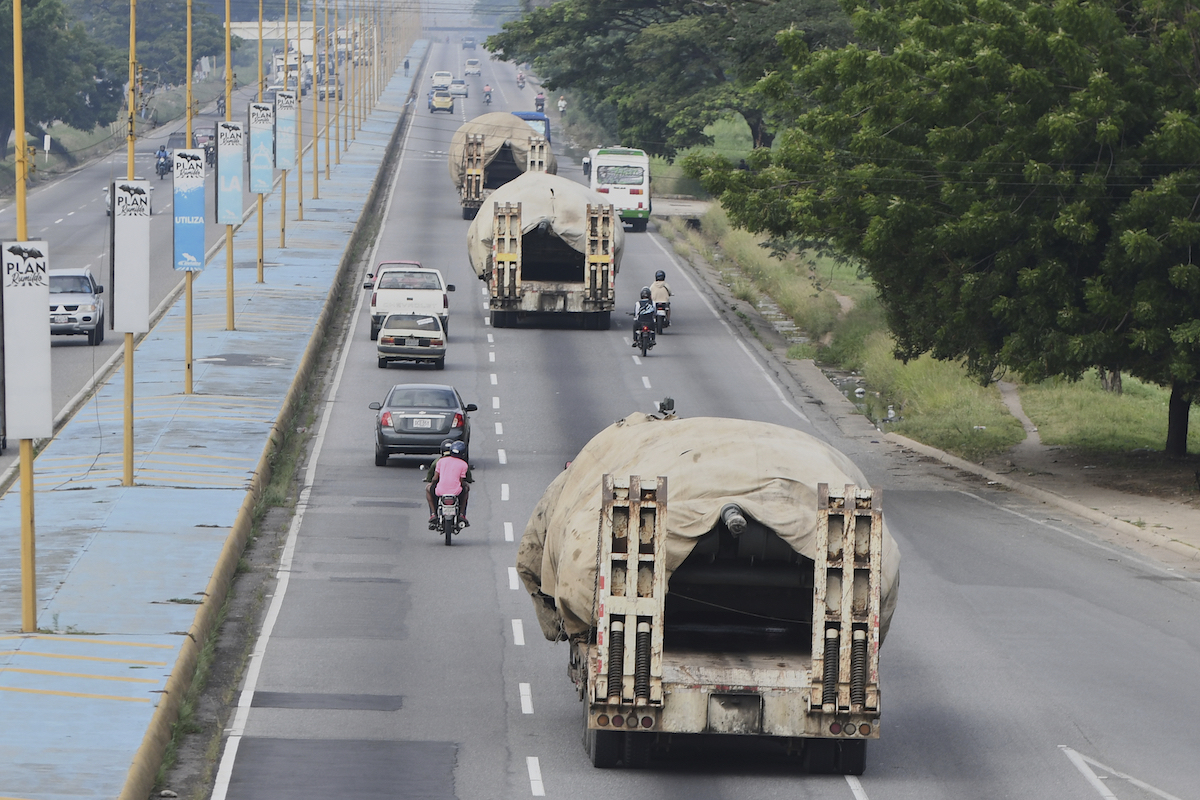
Trucks transport tanks east from Valencia, Venezuela, on Aug. 27, 2025, after the government announced a military mobilization following the U.S. deployment of warships off Venezuela. (AP)
It’s possible to envision further escalation, said Susan H. Allen, a George Mason University international affairs professor.
"Blowing up a boat on international waters is an aggressive act — one that Venezuela may take as an act of war," Allen said. "This is how wars start. If Venezuela responds with similar violence against a U.S. ship, what stops this from escalating into all-out war?"
Our Sources
Fox News, Hegseth says Trump admin had the authority to conduct lethal cartel boat strike, Sept. 5, 2025
Live Now from Fox, FULL TUESDAY: Trump 'major announcement' from Oval Office, Sept. 2, 2025
Newsweek, Full List of US Navy Ships Trump Has Sent to the Caribbean, Sept. 3, 2025
U.S. Department of State, Designation of International Cartels, Feb. 20, 2025
Marco Rubio’s X post, Sept. 2, 2025
Donald Trump’s Truth Social post, Sept. 2, 2025
El Diario, Ronna Rísquez, la periodista que se adentró en las fauces del Tren de Aragua, March 18, 2023
The White House, Invocation of the Alien Enemies Act Regarding the Invasion of The United States by Tren De Aragua, March 15, 2025
PolitiFact, Tren de Aragua: What we know about the Venezuelan gang Donald Trump promised to deport, Nov. 1, 2024
Congress.gov, The Alien Enemy Act: History and Potential Use to Remove Members of International Criminal Cartels, April 2, 2025
PolitiFact, Why did a court rule that Trump can’t deport Tren de Aragua members using the Alien Enemies Act?, Sept. 3, 2025
The White House, Designating Cartels And Other Organizations As Foreign Terrorist Organizations And Specially Designated Global Terrorists, Jan. 20, 2025
NPR, U.S. intelligence memo says Venezuelan government does not control Tren de Aragua gang, May 6, 2025
PolitiFact, Ask PolitiFact: Is Tren de Aragua invading the US, as Trump says? Legal experts say no., March 19, 2025
NPR, U.S. sending warships to Venezuelan waters, Aug. 25, 2025
History.com, The U.S. invades Panama, accessed Sept. 5, 2025
Stockton Center for International Law, U.S. Position on the U.N. Convention on the Law of the Sea, accessed Sept. 5, 2025
PolitiFact, Did Trump violate War Powers Act by bombing Iran nuclear sites?, June 22, 2025
Email interview with Anna Kelly, White House deputy press secretary, Sept. 5, 2025
Email interview with Mike LaSusa, deputy director of content at InSight Crime, Sept. 5, 2025
NYU Law, Reiss Center on Law and Security launches War Powers Resolution Reporting Project, Feb. 24, 2020
Reiss Center on Law and Security, War Powers Resolution Reporting Project, accessed Sept. 8, 2025
Reiss Center on Law and Security, 48-hour database, accessed Sept. 8, 2025
NPR, What is Tren de Aragua's footprint in the U.S.? Experts say smaller than federal officials say, April 8, 2025
NBC News, The truth about Tren de Aragua, the gang at the center of Trump's immigration crackdown, March 18, 2025
CBS News, Venezuela suggests video of boat apparently carrying drugs is AI, Sept. 3, 2025
Email interview with Susan H. Allen, international affairs professor at George Mason University, Sept. 5, 2025
Email interview with John Pike, director of globalsecurity.org, Sept. 5, 2025
Email interview with Michael O’Hanlon, senior fellow at the Brookings Institution, Sept. 5, 2025
Email interview with Anthony Clark Arend, professor of government and foreign service at Georgetown University, Sept. 5, 2025