Get PolitiFact in your inbox.

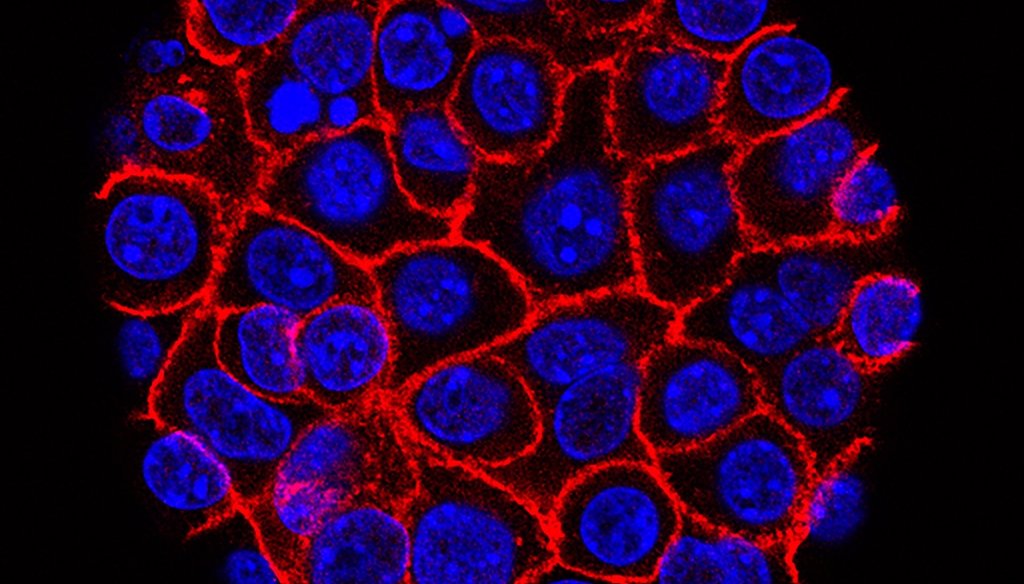
This undated microscope image from USC via the NIH shows pancreatic cancer cells, nuclei in blue, growing as a sphere encased in membranes, red. (AP)

If Your Time is short
-
An experimental pill to treat metastatic pancreatic cancer almost doubled patients’ survival times compared with chemotherapy.
-
The drug isn’t Food and Drug Administration approved, so it’s not readily available for all patients. Some eligible patients might be able to get the medication before it is FDA approved using a special program for people with life-threatening diseases.
-
Doctors who treat pancreatic cancer said they expect full FDA approval for the pill within months.
Good news is rare when it comes to pancreatic cancer.
Early detection is difficult. Post-diagnosis survival times are relatively short. Existing treatments are mostly available in the disease’s early stages. Even though just 3.2% of newly diagnosed cancers are pancreatic, it is the nation’s third-leading cause of cancer deaths.
So when Dr. Rachna Shroff, who has been treating pancreatic cancer patients for 16 years, saw promising findings from a recently published clinical trial, she felt what she described as a monumental shift.
"The data brought tears to my eyes," said Shroff, the University of Arizona Cancer Center’s chief of hematology and oncology.
The study showed that an experimental pill from the company Revolution Medicines almost doubled metastatic pancreatic cancer patients’ survival times compared with chemotherapy.
What happens next will determine whether and when patients may be able to access the drug, daraxonrasib (de-RAK-son-ra-sib). Here’s what these findings could mean for patients in the near future.
Q: What did the study find?
A: The study, a phase 3 clinical trial, involved 500 metastatic, or stage four, pancreatic cancer patients who had already received a first-line treatment such as chemotherapy.
After the initial treatment stopped working or proved unsuccessful, the patients were randomly assigned to receive either the daraxonrasib pill once daily, or a second-line chemotherapy treatment.
Among patients who took daraxonrasib, the median overall survival time was 13.2 months — almost twice chemotherapy’s median overall survival time of 6.7 months.
Shroff said the study showed a trifecta of promising results: It extended survival times, was linked to increased tumor shrinkage and patients reported it positively changed their quality of life.
"It really checks all the boxes," Shroff said.
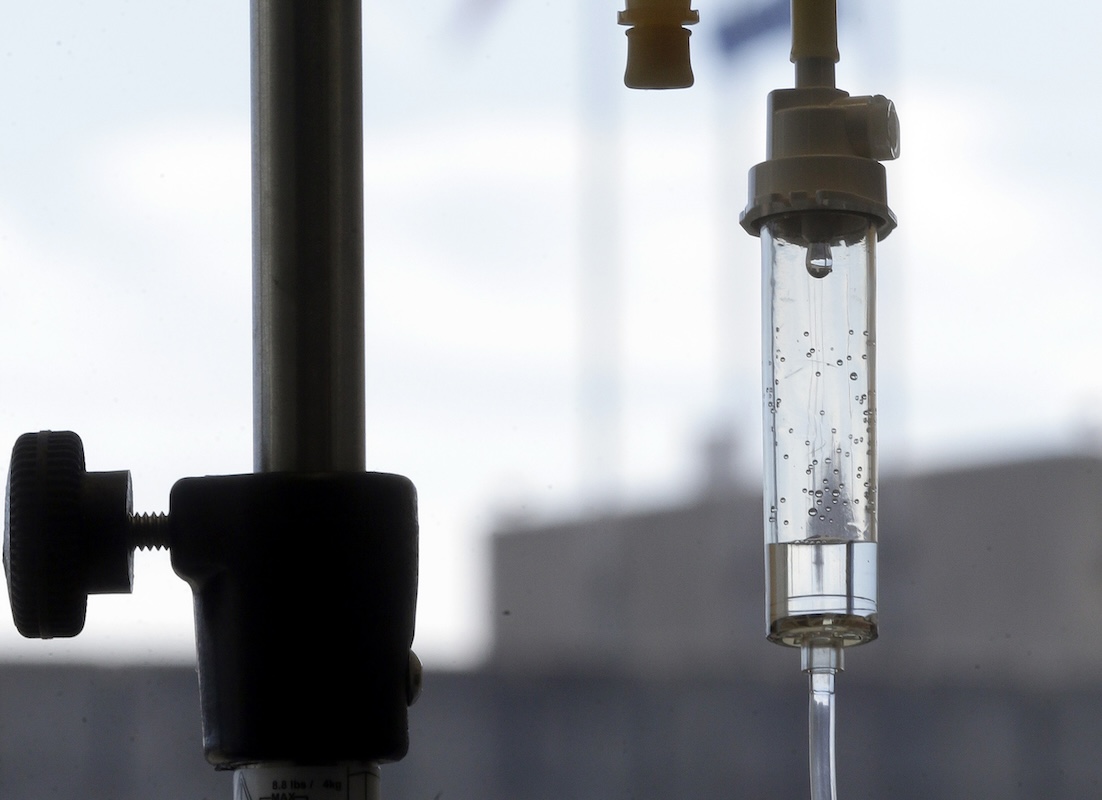
Chemotherapy is administered to a cancer patient via intravenous drip in Durham, N.C. on Sept. 5, 2013. (AP)
Q: Who is a good candidate for daraxonrasib?
A: Right now, the drug is an option for pancreatic cancer patients who have already received some kind of treatment. But researchers are also studying its use as a potential first-line treatment for newly diagnosed people.
The genetic factors of a patient’s cancer might also affect whether daraxonrasib is a suitable treatment option.
The National Comprehensive Cancer Network’s guidelines urge people to get tested for genetic mutations specific to their pancreatic cancer. This helps doctors determine the best treatment options and clinical trial eligibility as treatments are tested and clinical guidelines evolve, Shroff said.
"There are so many drugs beyond daraxonrasib" being tested, Shroff said, including those that target the cancer’s specific genetic mutations. Plus, with pancreatic cancers that have certain genetic mutations, there might be existing FDA-approved drugs that are the best treatment option.
Q: Is daraxonrasib available for patients now?
A: The drug isn’t Food and Drug Administration approved, so it’s not readily available for all patients. But phase 3 clinical trials are one of the final steps before the FDA reviews and potentially approves a drug.
That said, the FDA on April 30 granted Revolution Medicines’ request for expanded treatment access, sometimes called "compassionate use."
Under this program, patients who have life-threatening diseases can get investigational drugs if they are ineligible for — or cannot access — clinical trials and have no other comparable treatments available to them. Eligibility also requires patients to be over 18 years old and have previously treated metastatic pancreatic cancer.
A doctor who believes a patient would be a good candidate for "compassionate use" of daraxonrasib can submit paperwork to Revolution Medicines, the FDA and an ethics committee or institutional review board requesting approval. Sometimes patients must cover the cost of institutional review boards evaluations.
It’s unclear how many patients are seeking access to daraxonrasib through the "compassionate use" program. Revolution has not said how many people are expected to receive daraxonrasib via expanded access. Demand is already high, and the company said it expects it to remain that way.
Shroff said as soon as it was possible to do so, she and her colleagues at the University of Arizona Cancer Center began the process of requesting that their patients be considered. As of June 2, she said her patients hadn’t received the pill.
Q: How soon could the FDA approve daraxonrasib?
A: It’s hard to know for sure because the FDA will set the timeline. But Dr. Daniel King, a gastrointestinal medical oncologist at the Northwell Health Cancer Institute in New York, said it could be approved as soon as the fourth fiscal quarter, which includes October, November and December. Shroff also guessed it could be a matter of months.
The FDA has signaled its intent to move quickly. In October 2025, the agency said it was including daraxonrasib in a pilot program that aims to speed up FDA reviews. The FDA said pilot program participants would receive a decision one to two months after a drug company’s complete application is filed.
The FDA also designated daraxonrasib a "breakthrough therapy," a label that makes the drug eligible for an expedited review process.
In a statement to PolitiFact, Revolution Medicines said it is working on filing its new drug application with the FDA as soon as possible and parts of it are already being processed by the agency.
Q: How much does daraxonrasib cost for people who can get it now?
A: Revolution Medicines said it is providing the daily dose of the pill for free to patients in the expanded access program.
Private insurers and Medicare often do not cover the cost of investigational medications that patients can get with special approval, but the company providing the treatment can choose to provide it at no cost.
Q: How much will daraxonrasib cost if the FDA approves it? And will insurance cover it?
A: Revolution Medicines told PolitiFact it would provide pricing details after the FDA approves it.
Doctors said they expect major insurers will cover daraxonrasib, once approved.
King said he anticipates the drug will become part of the National Comprehensive Cancer Network’s treatment guidelines.The group’s guidance informs what Medicaid, Medicare and private insurance companies cover.
"With this kind of impact on outcomes, I can’t imagine that it will not be covered," Shroff said.
Q: Does daraxonrasib have side effects?
A: Yes, 100% of the patients who took the pill in the clinical trial reported adverse effects, most commonly rash, diarrhea, stomatitis (inflammation of the tissue lining your mouth or lips), nausea and vomiting.
The second-line chemotherapy treatment also caused side effects in 97.9% of cases, most commonly fatigue, anemia, nausea, diarrhea and neutropenia — reduced levels of certain white blood cells that leave a person more susceptible to infection.
While 11.2% of patients stopped chemotherapy treatment because of side effects, only 1.2% of those on daraxonrasib stopped taking the medication for that reason.
Once the pill is widely available for patients, Shroff said physicians will continue to work across disciplines — with dermatologists to treat the skin reaction, for example — to make sure patients can tolerate the medication.
PolitiFact Researcher Caryn Baird contributed to this report.
Our Sources
Interview with Dr. Rachna Shroff, the division of hematology/oncology chief at the University of Arizona Cancer Center, June 2, 2026
Interview with Dr. Daniel King, a gastrointestinal medical oncologist at the Northwell Health Cancer Institute in Lake Success, NY, June 1, 2026
Emailed statement from Revolution Medicines, June 3, 2026
New England Journal of Medicine, Daraxonrasib or Chemotherapy in Previously Treated Metastatic Pancreatic Cancer, May 31, 2026
The Washington Post, ‘Landmark’ pancreatic cancer drug keeps patients alive for twice as long, May 31, 2026
The Washington Post, FDA expands access to a promising drug for one of the worst cancers, May 1, 2026
University of Colorado Anschutz, FDA’s Expedited Review of Drug Could Be a ‘Game Changer’ for Pancreatic Cancer, Feb. 16, 2026
The Associated Press, Experimental pill promises new hope for deadly pancreatic cancer, May 31, 2026
Food and Drug Administration, FDA Permits Expanded Access for Investigational Pancreatic Cancer Drug, May 1, 2026
BBC, Daily pill doubles survival time for pancreatic cancer patients, June 1, 2026
American Society of Clinical Oncology, Multi-Selective RAS(ON) Inhibitor Nearly Doubles Survival Time in People With Metastatic Pancreatic Cancer - ASCO, May 31, 2026
ABC News, Experimental pancreatic cancer drug offers new hope in major trial, June 1, 2026
UC Medicine, Trial Phases 1, 2 & 3 Defined | Clinical Research Management (CRM) | Research | Psychiatry and Behavioral Neuroscience, accessed June 1, 2026
National Cancer Institute, Cancer Stat Facts: Pancreatic Cancer, June 1, 2026
Pancreatic Cancer Action Network, How Common Is Pancreatic Cancer?, Sep. 30, 2024
National Cancer Institute, Definition of rare cancer - NCI Dictionary of Cancer Terms, accessed June 2, 2026
Cleveland Clinic, Stomatitis (Oral Mucositis): Types, Symptoms & Treatment, accessed June 2, 2026
Cleveland Clinic, Neutropenia: What it Is, Types, Symptoms & Causes, accessed June 2, 2026
University of Cincinnati College of Medicine, Trial Phases 1, 2 & 3 Defined, accessed June 2, 2026
Food and Drug Administration, Expanded Access, accessed June 3, 2026
Food and Drug Administration, FDA Awards First-Ever National Priority Vouchers to Nine Sponsors, Oct. 16, 2025
Revolution Medicines, Expanded Access Policy – Revolution Medicines, accessed June 3, 2026
ClinicalTrials.gov, Study Details | NCT07573215 | Expanded Access Program for Daraxonrasib (RMC-6236) in Previously Treated Metastatic Pancreatic Adenocarcinoma, accessed June 4, 2026
UCLA Health, Investigational targeted therapy doubles survival in metastatic pancreatic cancer, May 31, 2026
National Comprehensive Cancer Network, About Clinical Practice Guidelines, accessed June 3, 2026
JAMA Network Open, National Comprehensive Cancer Network Guideline Recommendations of Cancer Drugs With Accelerated Approval, Nov. 14, 2023
Food and Drug Administration, Breakthrough Therapy, accessed June 4, 2026
Revolution Medicines, Revolution Medicines Announces FDA Breakthrough Therapy Designation for Daraxonrasib in Previously Treated Metastatic Pancreatic Cancer with KRAS G12 Mutations, June 23, 2025
Pancreatic Cancer Action Network, How Common Is Pancreatic Cancer? Sept. 30, 2024
Pancreatic Cancer Action Network, Pancreatic Cancer Early Detection, accessed June 4, 2026
National Cancer Institute, NCI-Designated Cancer Centers, accessed June 5, 2026
The Cancer Letter, Hybrid cancer centers exploring links with NCI-designated institutions, Jan. 26, 2018
Centers for Disease Control and Prevention, Relative Cancer Survival | U.S. Cancer Statistics, April 30, 2026
American Cancer Society, How Cancer Care Is Delivered, accessed June 4, 2026
Food and Drug Administration, New Drug Application (NDA), accessed June 4, 2026