
Thirty percent of U.S. medical residents are international medical graduates, and 10,000 of 43,000 residency spots are filled by H-1B visa holders.

Our only agenda is to publish the truth so you can be an informed participant in democracy.
We need your help.

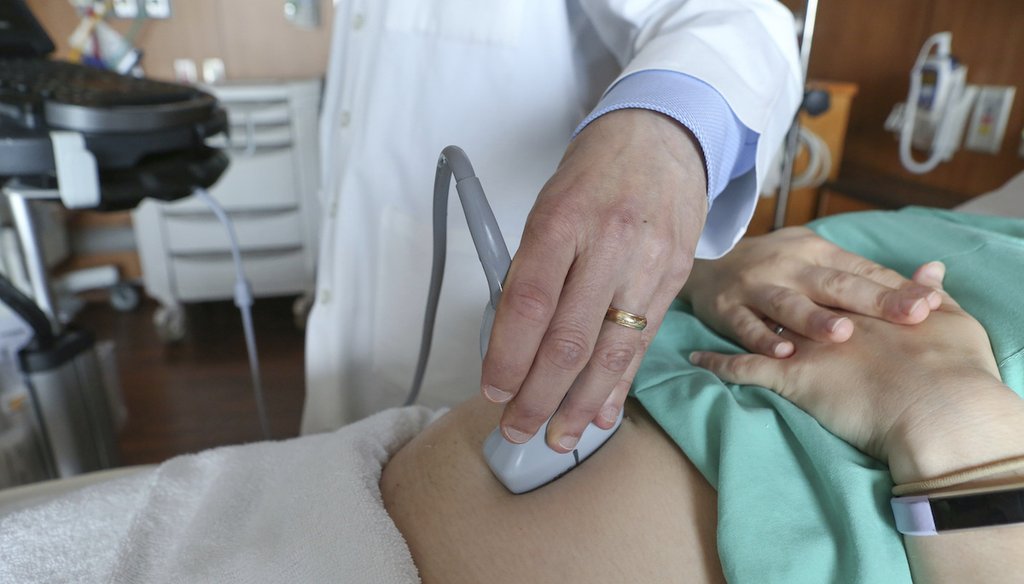
A doctor performs an ultrasound scan on a pregnant woman on Aug. 7, 2018, at a hospital in Chicago. (AP)

Approximately 30% of U.S. medical residents are international medical graduates, but that includes foreign international graduates and U.S. citizens who graduated from international schools.
Ten thousand total U.S. physicians hold H-1B visas, including those in residency and those who have completed their residency.
President Donald Trump announced that H-1B visa fees would increase to $100,000, a move that some social media users said could worsen U.S. physician shortages.
As of Sept. 21, new H-1B visa applications will require a $100,000 fee, up from $2,000 to $5,000.
The Trump administration said the fee is to prevent American workers from "being replaced with lower-paid foreign labor." The H-1B visa program lets employers temporarily hire foreign workers in specialty fields.
Several medical associations sent a Sept. 25 letter to Homeland Security Secretary Kristi Noem, asking for physicians and other medical personnel to be exempted from the new H-1B visa fee, because of a critical need for doctors as the U.S. population grows. While policy experts said the proclamation allows for exempting certain industries from the fee, the Trump administration hasn’t announced any exceptions yet.
A doctor who also hosts a podcast posted data on X that he said showed how many medical residency spots are filled by H-1B visa holders.
"This will be absolutely devastating in the medical field. ~30% residents are international medical graduates & ~10k of 43k residency spots are filled by docs with H-1B visas," the Sept. 19 post said. "Previously the h-1B fee was <$5,000. No hospital will pay a $100k fee for a $55k resident salary."
Residency is the phase of physician training when recent medical school graduates participate in supervised clinical training in a healthcare facility.
The X post is partially accurate but leaves out important details about international students and medical residents in the U.S.
The X post cited as evidence a 2025 National Resident Matching Program report that says approximately 30% of U.S. medical residents are international medical graduates. It’s important to note, though, that this category includes foreign graduates and U.S. citizens who graduated from international schools. The report says that of international medical graduates who obtained a spot in first-year U.S. residency programs, 3,108 were U.S. citizens and 6,653 were noncitizens.
It’s inaccurate that 10,000 of 43,000 resident spots are filled by H-1B visa holders. The X post cites a 2017 report that analyzed 2016 Labor Department data. This data shows how many working U.S. physicians were certified for H-1B visas. It includes all doctors, not only those in residency. (More recent Labor Department data from the last quarter of 2025, covering determinations from Oct. 1, 2024, through June 30, shows that around 9,000 physicians were certified for H-1B visas.)
The American Medical Association says the most common visa used by medical graduates for medical residency is the J-1 visa, which is for graduate medical education or training, among other purposes.
The majority of H1-B visa workers have been hired in STEM — science, technology, engineering and math — occupations, with about two-thirds working in computer-related fields, according to the Congressional Research Service.
Nancy Nielsen, University at Buffalo senior associate dean for health policy, also confirmed to PolitiFact that the most common visa used for medical residency is the J-1 visa. She said for context, in her school, they have about 830 medical residents and only 27 are on H-1B visas.
PolitiFact reached out to the Educational Commission for Foreign Medical Graduates, a division of Intealth, which helps medical graduates with sponsorship obtain training in the U.S., and the commission said to its knowledge, no centralized data repository exists for H-1B physicians in residency.
The H-1B visa is available to graduates of foreign medical schools who have a license or other authorization required by the state where they’ll practice, and people who have an unrestricted license to practice medicine or have graduated from a U.S. medical school, according to the American Medical Association.
Prospective H-1B employers must attest that they will pay the H-1B worker the greater of the actual wage paid to similar employees or the prevailing wages for that occupation.
The visa status is generally valid for up to three years and renewable for another three years, but can be extended if the employer sponsors the worker for permanent residency.
Congress caps the number of new H-1B visas at 85,000 per fiscal year, including 20,000 for noncitizens who earned a U.S. master’s degree or higher. The fiscal year 2025 cap was met in December 2024.
Daniel Costa, director of immigration law and policy research at the Economic Policy Institute, a left-of-center think tank, told PolitiFact that the H-1B visa fee must be paid by the employer, not the employee.
"The H-1B employees are generally not allowed to pay for the primary fees for visas and processing, they are the responsibility of the employer," Costa said via email Sept. 24.
An X user said that 30% of medical residents are international medical graduates and 10,000 of 43,000 medical residency spots are filled by doctors with H-1B visas.
Data shows that approximately 30% of medical residents are international medical graduates, which includes both U.S. citizens and noncitizens. Ten thousand doctors hold H-1B visas, but that represents all physicians, not only those in residency. The American Medical Association says the most common visa used by medical graduates for medical residency is the J-1 visa.
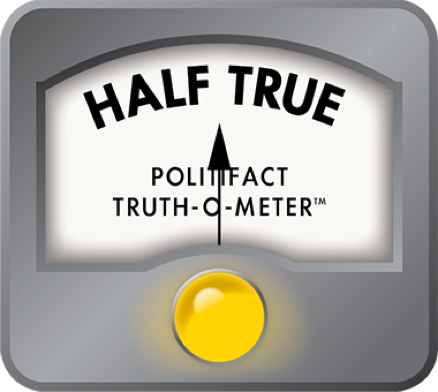
The statement is partially accurate but leaves out important details. We rate it Half True.
White House, RESTRICTION ON ENTRY OF CERTAIN NONIMMIGRANT WORKERS, Sept. 19, 2025
Linkedin, Nicholas Mark, MD, accessed Sept. 25, 2025
X post, Sept. 19, 2025
AMA, What is residency?, May 20, 2024
USCIS, H-1B Employer Data Hub, accessed Sept. 25, 2025
USCIS, Characteristics of H-1B Specialty Occupation Workers, April 29, 2025
AMA, The physician shortage will worsen—unless Congress acts now, June 16, 2025
AAMC, New AAMC Report Shows Continuing Projected Physician Shortage, March 21, 2024
Congress gov, U.S. Employment-Based Immigration Policy, Nov. 19, 2024
U.S. Department of Labor, Performance Data, accessed Sept. 25, 2025
USCIS, H-1B Cap Season, accessed Sept. 25, 2025
Federal Register, Notice of proposed rulemaking., accessed Sept. 25, 2025
JAMA, Distribution of Physicians With H-1B Visas By State and Sponsoring Employer, April 17, 2017
The National Resident Matching Program, Results and Data: 2025 Main Residency Match, May 29, 2025
HRSA, State of the Primary Care Workforce, 2024, Nov. 2024
Email interview with Ryan Honick, Department of Labor public affairs specialist, Sept. 25, 2025
Email interview with Jennifer Sellers, public information officer of the American Medical Association, Sept. 24, 2025
Email interview with Cecilia Esterline, senior immigration policy analyst at the Niskanen Center, Sept. 23, 2025
Email interview with Daniel Costa, director of immigration law and policy research at the Economic Policy Institute, Sept. 22, 2025
Email interview with Elizabeth Ingraham, spokesperson at Intealth, Sept. 24, 2025
The White House, Fact Sheet: President Donald J. Trump Suspends the Entry of Certain Alien Nonimmigrant Workers, Sept. 19, 2025
USCIS, USCIS Reaches Fiscal Year 2025 H-1B Cap, Dec. 2, 2024
Email interview with Jackson Health System spokesperson, Sept. 26, 2025
Email interview with USCIS spokesperson, Pamela Wilson, Sept. 26, 2025
Email interview with White House spokesperson, Sept. 23, 2025
Email interview with Nancy Nielsen, University at Buffalo senior associate dean for health policy, Sept. 26, 2025
AMA, AMA urges DHS to exempt physicians from new $100,000 H-1B visa fee, Sept. 25, 2025
AMA, Immigration information for international medical graduates, accessed Oct. 2, 2025








In a world of wild talk and fake news, help us stand up for the facts.