
"Republicans have effectively ended medical research in the United States of America."


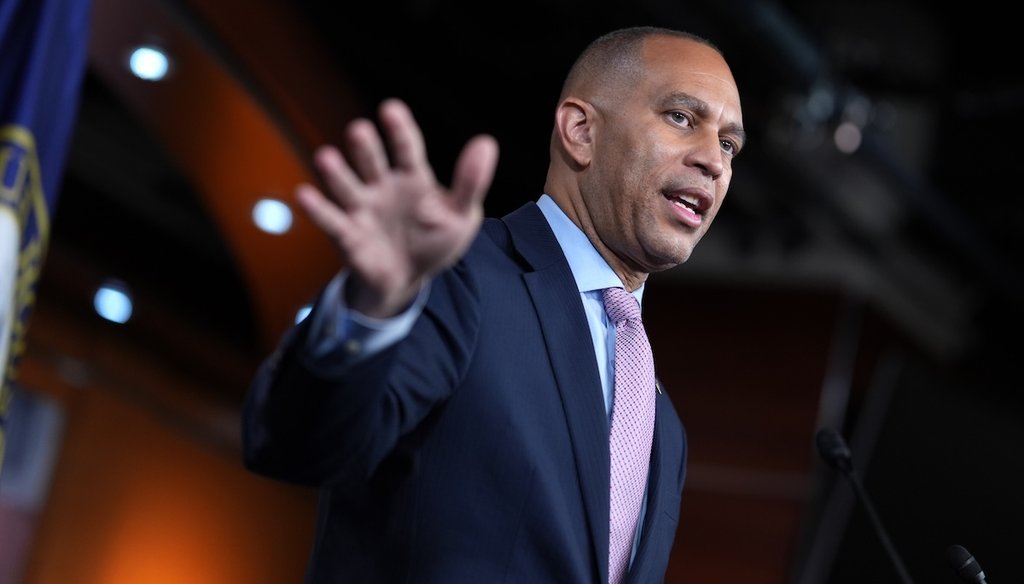
House Minority Leader Hakeem Jeffries, D-N.Y., meets with reporters at the Capitol in Washington on Sept. 25, 2025, days before a possible government shutdown. (AP)

During his second term, President Donald Trump has already eliminated grants, capped indirect research funding and reduced employment at agencies involved in medical research. He’s also proposed aggressive medical research cuts at the National Institutes of Health and other agencies starting in 2026.
If Trump gets his way on cutting NIH funding by 39%, the institutes would still be budgeted for more than $27 billion in fiscal year 2026.
Appropriations committees in both the Senate and the House have already rejected Trump’s proposed cuts to medical research, voting for stable or slightly increased funding.
President Donald Trump has made historically large cuts to medical research, some of them aimed at ending what he refers to as diversity, equity and inclusion in federally funded studies. His administration is proposing more: Overall funding for the National Institutes of Health would return to its 2007 level if Trump’s budget proposal were to be enacted. A recent New York Times story highlighted Trump’s billions in proposed National Cancer Institute cuts and carried the headline, "Trump Is Shutting Down the War on Cancer."
In the midst of a fight with Republicans over spending and a possible government shutdown, House Minority Leader Hakeem Jeffries, D-N.Y., criticized the Trump administration’s efforts to cut back medical research funding during a Q&A with reporters.
"Republicans have effectively ended medical research in the United States of America," Jeffries said Sept. 24.
Has the Trump administration really ended medical research? While a substantial amount has disappeared, and more could be on the way out if Trump gets his way, Jeffries exaggerated the outlook, even allowing for his "effectively" caveat. Billions of dollars would remain even in the most austere scenario, and there’s uncertainty about whether his most severe proposed cuts will receive congressional approval.
Even after proposing substantial cuts to the budget of the National Institutes of Health — the main engine funding U.S. medical research — Trump’s proposal would give the institutes $27 billion for fiscal year 2026.
And Trump’s proposal is not final; Congress could increase that amount. Some experts call that scenario likely.
"The appropriations language making its way through Congress is much less draconian, so it may be too early to know where all this is going to land," said Richard Frank, a senior fellow at the Brookings Institution, a Washington, D.C., think tank.
Jeffries’ office did not provide additional evidence for his statement.
Trump’s cuts so far take several forms, said Joshua Weitz, a University of Maryland biology professor who co-founded the Science and Community Impacts Mapping Project, which is tracking the impacts of federal funding cuts nationally. Some of these cutbacks are being challenged in court.
Weeks after Trump’s inauguration, the National Institutes of Health announced major cuts to "indirect costs" — funds that pay for facilities, safety and grant administration. It capped indirect costs for labs working on NIH grants at 15%. Previously, the average rate was about 28%, and sometimes above 60%, according to NIH. Weitz says a more appropriate calculation — one that measures indirect costs as a share of direct costs, rather than as a share of total costs — would make the historic rate higher, 42%.
The White House has terminated thousands of research grants worth approximately $5 billion. Some of these were canceled for being related to diversity, equity and inclusion, a top target of the administration, such as a $3.8 million Asian Bipolar Genetics Network study to a $1.05 million Alzheimer’s and dementia study focusing on Black Americans. Others were related to administration efforts to punish elite universities for allegedly allowing antisemitism on campus, leading to hiring freezes and holds on clinical trials, Harvard University economist David Cutler and Harvard economist Edward Glaeser co-wrote a recent paper in JAMA Health Forum. "A fraction of these grants have been reinstated, but science does not turn on and off like a spigot," Weitz said. "Interrupting research leads to wasted studies, risks projects, and is already causing job loss."
Through early April, the NIH ousted 1,200 employees, and granted an unknown number of retirements and resignations. At the Food and Drug Administration, which approves drugs, thousands of jobs have been eliminated.
The president’s budget proposal would cut NIH funding from about $45 billion to about $27 billion. That’s a roughly 39% cut for a budget item that in recent decades has almost always increased from year to year. The proposed budget would eliminate the National Institutes for Nursing Research, the National Center for Complementary and Integrative Health, the Fogarty International Center, and the National Institute on Minority Health and Health Disparities.
NIH represents the lion’s share of medical research funding, but the administration is also proposing cuts to other agencies that are part of the medical research network. These include the Advanced Research Projects Agency for Health, for which the administration proposes a $555 million cut; the Center for the Biomedical Advanced Research and Development Authority, which would lose a proposed $361 million; and Congressionally Directed Medical Research Programs, which could lose its entire $650 million budget under Trump’s proposal. The Centers for Disease Control and Prevention, which funds or undertakes some research, would see its overall budget fall by almost $5 billion, or more than half.
The consequences of these cuts could be significant.
"Our research shows that while cutting NIH funding may appear to save money in the short term, it can trigger a chain of effects that increase long-term health care costs and slow the development of new treatments and public health solutions over time," Harvard University health policy and data specialists Mohammad S. Jalali and Zeynep Hasgül wrote for The Conversation.
Between 2010 and 2019, all but two of the 356 drugs approved by the Food and Drug Administration received some NIH funding, one study found. So any cuts could reduce the number of drugs in the pipeline, experts say.
Once all the follow-on impacts reverberate throughout the U.S. economy and health care system, the cuts could prompt an "$8 trillion health care catastrophe," Cutler and Glaeser wrote. They estimated that the losses from reduced health would be 16 times greater than the proposed budgetary savings.
The cuts are extensive but do not end U.S. medical research.
Trump’s slashed NIH budget would still spend more than $27 billion in fiscal year 2026.
"Novel biomedical discoveries that enhance health and lengthen life are more vital than ever to our country’s future," the agency said in its budget proposal. "NIH research is critical to protect national security and sustain the United States’ scientific competitiveness, globally."
The president’s proposal highlighted initiatives on nutrition, obesity, heart disease, diabetes, asthma, autism, and cancer, all priorities of Health and Human Services Secretary Robert F. Kennedy Jr.
The FDA would receive a 3.8% budgetary cut under Trump’s budget proposal, to almost $6.8 billion.
Despite the Republican majority’s generally close alignment with Trump’s policy agenda, Congress is on record rejecting his proposed medical research cuts, at least in the preliminary stage.
The Senate and House appropriations committees have voted for modest increases in NIH’s budget rather than Trump’s large cuts. They also voted to fund CDC and FDA at higher levels than Trump set out in his budget proposal.
These increases are not guaranteed; they will have to go through negotiations between lawmakers and the president before final passage.
"Congress is likely to approve much smaller cuts than the Administration had proposed," said Sherry Glied, a professor at New York University’s Robert F. Wagner Graduate School of Public Service.
Jeffries said, "Republicans have effectively ended medical research in the United States of America."
Trump has proposed severe cuts to medical research at the National Institutes of Health and other agencies, including caps on indirect costs for grantees’ labs, terminated grant funding and staff reductions. But this is not tantamount to effectively ending U.S. medical research.
Even if Trump gets his way on a 39% cut to NIH’s budget in 2026, the institutes would still have more than $27 billion to spend in fiscal year 2026.
Trump’s fellow Republicans in Congress may not go along with cuts on the scale the president proposed. Appropriations committees in both the Senate and the House have already rejected Trump’s steep cuts on medical research.
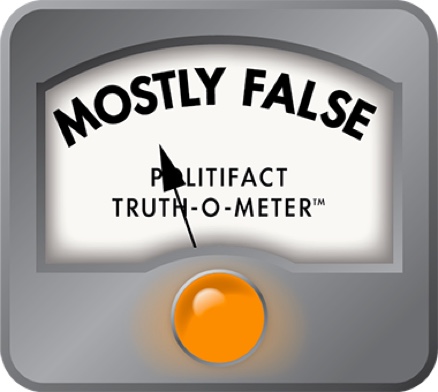
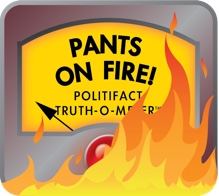
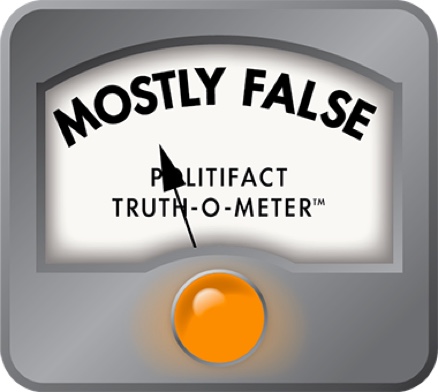
Trump’s medical research cuts are real and sweeping, but they have not "effectively ended medical research." We rate the statement Mostly False.
UPDATE, Oct. 1, 2025: This article has been updated to provide more detail from Joshua Weitz about the previous level of NIH’s indirect costs.
CORRECTION, Oct. 3, 2025: Trump’s budget proposal includes a 3.8% cut for the FDA. An earlier version of this story described it inaccurately based on Research!America data, which the group has since corrected.
Hakeem Jeffries, remarks at a press briefing, Sept. 24, 2025
Department of Health and Human Services, proposed fiscal year 2026 budget, accessed Sept. 29, 2025
Research!America, fiscal year 2026 budget and appropriations chart, accessed Sept. 29, 2025
National Institutes of Health, historical budget document index, accessed Sept. 29, 2025
National Institutes of Health, "Supplemental Guidance to the 2024 NIH Grants Policy Statement: Indirect Cost Rates," Feb. 7, 2025
Department of Health and Human Services, "Fact Sheet: HHS’ Transformation to Make America Healthy Again," April 2, 2025
Science and Community Impacts Mapping Project
David M. Cutler and Edward Glaeser, "Cutting the NIH—The $8 Trillion Health Care Catastrophe" (JAMA Health Forum), May 29, 202
Richard G. Frank and Sherry Glied, "The Trump administration’s NIH and FDA cuts will negatively impact patients" (Brookings Institution), May 14, 2025
Nature, "What research might be lost after the NIH’s cuts? Nature trained a bot to find out," Sept. 24, 2025
Nature, "Judge rules against NIH grant cuts — and calls them discriminatory," June 16, 2025
Mohammad S. Jalali and Zeynep Hasgül, "Proposed cuts to NIH funding would have ripple effects on research that could hamper the US for decades" (The Conversation), Sept. 12, 2025
Mohammad S. Jalali and Zeynep Hasgül, "Potential Trade-Offs of Proposed Cuts to the US National Institutes of Health" (JAMA Health Forum), July 25, 2025
Ekaterina Galkina Cleary, Matthew J. Jackson, Edward W. Zhou and Fred D Ledley, "Comparison of Research Spending on New Drug Approvals by the National Institutes of Health vs the Pharmaceutical Industry, 2010-2019" (JAMA Health Forum), April 28, 2023
New York Times, "Trump Is Shutting Down the War on Cancer," Sept. 14, 2025
U.S. News & World Report, "NIH Cuts to University Research Funding: FAQ," July 9, 2025
Associated Press, "Supreme Court lets Trump cut $783 million of health research funding amid anti-DEI push," Aug. 21, 2025
Associated Press, "Scientists warn Trump’s medical research cuts endanger patients as judge blocks the move for now," Feb. 10, 2025
Reuters, "Trump begins mass layoffs at FDA, CDC, other US health agencies," April 1, 2025
NPR, "Universities across the U.S. freeze hiring as federal funding hangs in the balance," March 12, 2025
The Hill, "Senate panel rejects Trump cuts to NIH, other health agencies," July 31, 2025
Science, "House Republicans add to support for maintaining NIH budget in 2026," Sept. 2, 2025
Email interview with Glenn O’Neal. senior director of communications with Research!America, Sept. 25, 2025
Email interview with Richard Frank, senior fellow at the Brookings Institution, Sept. 25, 2025
Email interview with David Cutler, Harvard University economist, Sept. 25, 2025
Email interview with Joshua Weitz, professor of biology at the University of Maryland and co-founder of the Science and Community Impacts Mapping Project, Sept. 25, 2025
Email interview with Sherry Glied, professor at New York University’s Robert F. Wagner Graduate School of Public Service, Sept. 25, 2025












In a world of wild talk and fake news, help us stand up for the facts.