Stand up for the facts!
Our only agenda is to publish the truth so you can be an informed participant in democracy.
We need your help.
I would like to contribute

The concept of truth feels particularly bleak in 2025.
Government leaders deploy up-is-down narratives at an exhausting clip. Online worlds drip with artificial intelligence-generated slop that incites rage. Chatbots answer questions with fabricated information, and the government folds it into a report card on America’s health.
The last 10 years have been an ugly era for facts, marked by a drumbeat of untruths and near-constant charges of "fake news" from the decade’s most influential player, President Donald Trump.
The trouble with drumbeats is, as a matter of survival or sanity, we tend to tune out or grow numb to them. Even people with influence who might lament "misinformation" move on to other fights. The word itself is downgraded — at best it’s a red flag, at worst it’s a punchline.
I understand why the outlook feels hopeless, but it’s time to revisit the basics of why it’s important to call out lies. They’re more than just words. Lies harm livelihoods and families.
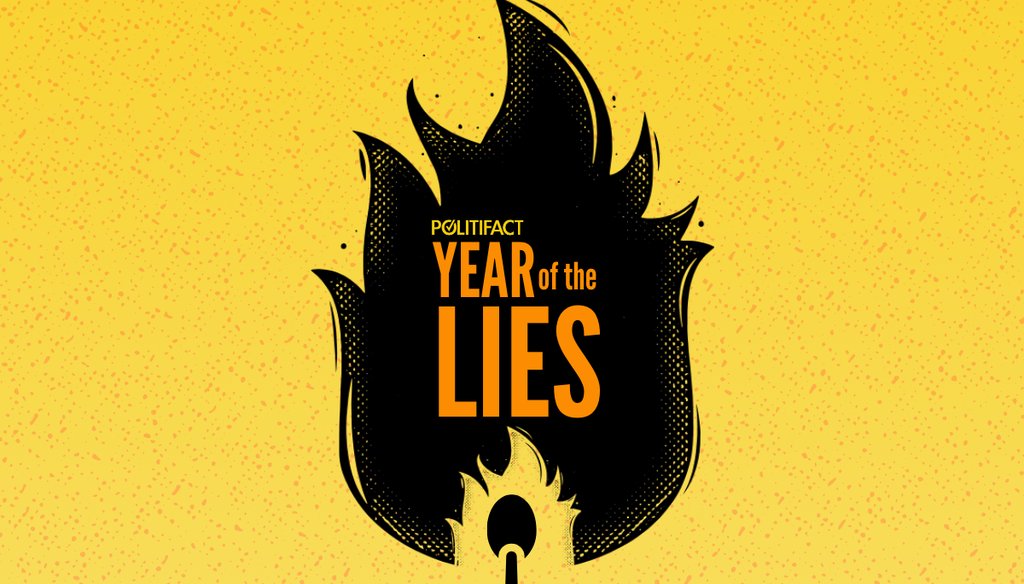
After the truth beatdown of 2025, PolitiFact’s usual approach of singling out just one lie seems insufficient to meet the moment. So where does that leave our annual Lie of the Year report?
Recalibrate
PolitiFact wrestles words to the ground every day.
We investigate all manner of deception — inaccuracies of omission, willful manipulation and conspiracy theories — and then explain how word choices shape those messages.
We have long stuck to the practice of not describing a falsehood or inaccuracy as a "lie," because those three letters confer a degree of intent that we don’t have the capacity to prove.
There is one notable exception. Each December since 2009 we have published a year-end report dubbed "Lie of the Year" to recognize a statement, collection of statements or theme that is worthy of note for a consequential undermining of reality.
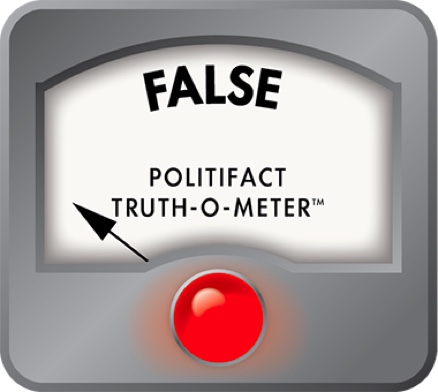
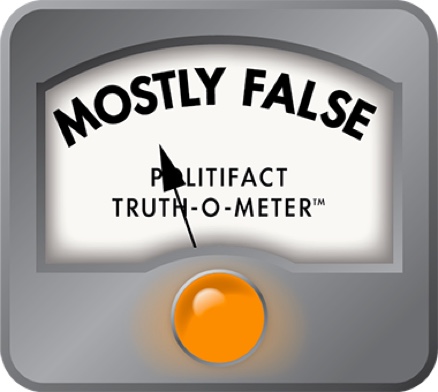
Trump and his running mate JD Vance’s claim that Haitian migrants were eating dogs and cats in Springfield, Ohio, took the 2024 distinction. (It was Trump’s fourth Lie of the Year award; he was a supporting character in three others.) Other "winners" include Robert F. Kennedy Jr.’s 2023 presidential campaign of health conspiracy theories; Vladimir Putin’s 2022 lies about the Ukraine invasion; 2021 downplay of the Capitol insurrection; 2020 lies about COVID-19; and Barack Obama’s 2013 assurance that under his new health law Americans could keep their health plan if they liked it.
This annual exercise isn’t about finding the most ridiculous of claims; that pool is as wide as the ocean. Our criteria has always been finding claims that tick three key boxes: They are repeated often, demonstrably false and, perhaps above all, consequential.
In 2025, options for the top lie include Trump’s made-up math to justify deadly boat strikes off Venezuela’s coast, Democratic Gov. JB Pritzker’s disconnected assessment of food stamp "SNAP machines," Israeli Prime Minister Benjamin Netanyahu’s claim of "no starvation" in Gaza, and a heaping of dishonest talking points on tariffs, the record-setting U.S. government shutdown, immigration raids and the Jeffrey Epstein files.
It’s not uncommon for people to joke or roll their eyes when they hear politicians and pundits say two plus two equals five, or what’s red is really blue. But the stakes are too high for such cultural rationalization or tolerance of assaults on facts.
So while we are glad that our fans and foes enjoy the debate about the single best/worst whopper, we are stepping back this year and recalibrating the Lie of the Year — focusing less on the offenders who perpetuate the falsehoods, and more on those who are hurt by them.
So "congratulations" 2025. PolitiFact names you Year of the Lies.
This week, we’ll tell three stories that spotlight what happens when things are not true. The people suffering the consequences of these lies are not aberrations.
This is what happened when lies trampled real people:
-
A farmer couldn’t sell soybeans to his usual big foreign customer or plan for next year’s crop. A tit-for-tat trade war sparked by U.S. tariffs on China left a cloud of uncertainty.
-
A pediatrician quit her long practice of seeing patients in person. In clinical care's already pressurized environment, the Trump administration’s unproved claims on everything from Tylenol to vaccines had added chaos and safety concerns to her days.
-
Two brothers, who came to the U.S. as children to escape gang violence in El Salvador, attended school, stayed out of trouble and complied with government check-ins, arrived at their most recent appointment only to be suddenly shackled, detained and deported. They and many others like them were not the "worst of the worst" criminals that the administration claimed would be the first to be shipped home.
To be clear, these are just three examples in a Year of the Lies. Their stories illustrate a broader need to not dismiss that false claims have consequences.
Lies and Consequences

The Farmer
Trump in his inaugural address said he would "tariff and tax foreign countries to enrich our citizens."
In the weeks ahead of "Liberation Day," his April 2 unveiling of "reciprocal" tariffs with other countries, he told farmers, "Get ready to start making a lot of agricultural product to be sold INSIDE of the United States." He added, "Have fun!"
North Dakota farmer Randy Richards didn’t have fun, and he didn’t get rich. Amid rising prices for farm basics such as fertilizer and equipment, the third-generation farmer’s soybeans sat in storage instead of on a train bound for export to China. The superpowers’ tariff tit-for-tat created market instability and uncertainty for farmers, just as experts and advocates had warned.
READ: Farmer says some Trump tariff statements ‘as far from the truth as you can get’
The Doctor
In a bonkers September news conference, Trump, along with Kennedy, who is now Health and Human Services secretary, warned pregnant women that taking Tylenol, the only over-the-counter pain reliever approved for them, could lead their babies to develop autism.
"If you're pregnant, don't take Tylenol and don't give it to the baby after the baby is born," Trump said Sept. 22.
Medical experts called Trump’s comments irresponsible and affirmed research supporting the drug’s safe use during pregnancy; forgoing treatment for pain can lead to uncontrolled fevers, causing maternal and fetal harm.
It was not the first flimsy connection to autism the Trump administration pushed, nor would it be the last. Trump and Kennedy created chaos from the top down as they worked to redefine longstanding medical guidance on vaccines and autism informed by shaky science, half-truths and omissions.
For South Florida pediatrician Dr. Mona Amin, Trump’s Tylenol bit was another absurd claim in a year of disruptive pseudoscience from the federal government that unmoored her practice and changed her outlook on patient care.
READ: How Trump’s talk about Tylenol, autism and vaccines affected one pediatrician
The Brothers
Trump and his administration officials sold their mass deportation strategy as pursuing the "worst of the worst" immigrants. He said in his inaugural address, "We will begin the process of returning millions and millions of criminal aliens back to the places from which they came."
On Oct. 31, after 10 months of data and anecdotes showing a small share of detainees were violent offenders, CBS News’ Norah O’Donnell asked Trump about his "worst of the worst" approach.
Trump cut in, "That’s what we’re doing."
The data says otherwise. The deportation strategy is far broader than the administration routinely claims. About 5% of the more than 65,000 people in ICE detention have violent crime convictions, according to a late November analysis of government data from the libertarian Cato Institute. That leaves about more than 70% of detainees, or about 48,000 people, with no criminal convictions. About half have no pending charges or arrests.
Among tens of thousands of examples of nonviolent people whose lives have been upended by deportation are José and Josué Trejo López, brothers who came to the U.S. from El Salvador as children. They had no criminal backgrounds and kept up with required immigration check-ins over years. Until the last one: Agents detained them in March during a routine ICE appointment. Authorities deported them two months later to El Salvador, where they have no family.
READ: ‘Worst of the worst’? ICE deports brothers after years of check-ins, good conduct
Trump famously detailed his "truthful hyperbole" concept in his 1987 book "The Art of the Deal." He called it "an innocent form of exaggeration — and a very effective form of promotion."
When we asked the administration how Trump draws the line between truthful hyperbole and false claims with consequences, and how the White House views misinformation more broadly, spokesperson Kush Desai said: "Americans’ trust in the mainstream media is at historic lows. When it comes to misinformation, the media should look in the mirror instead of pointing at President Trump."
The Power and Poison of Technology
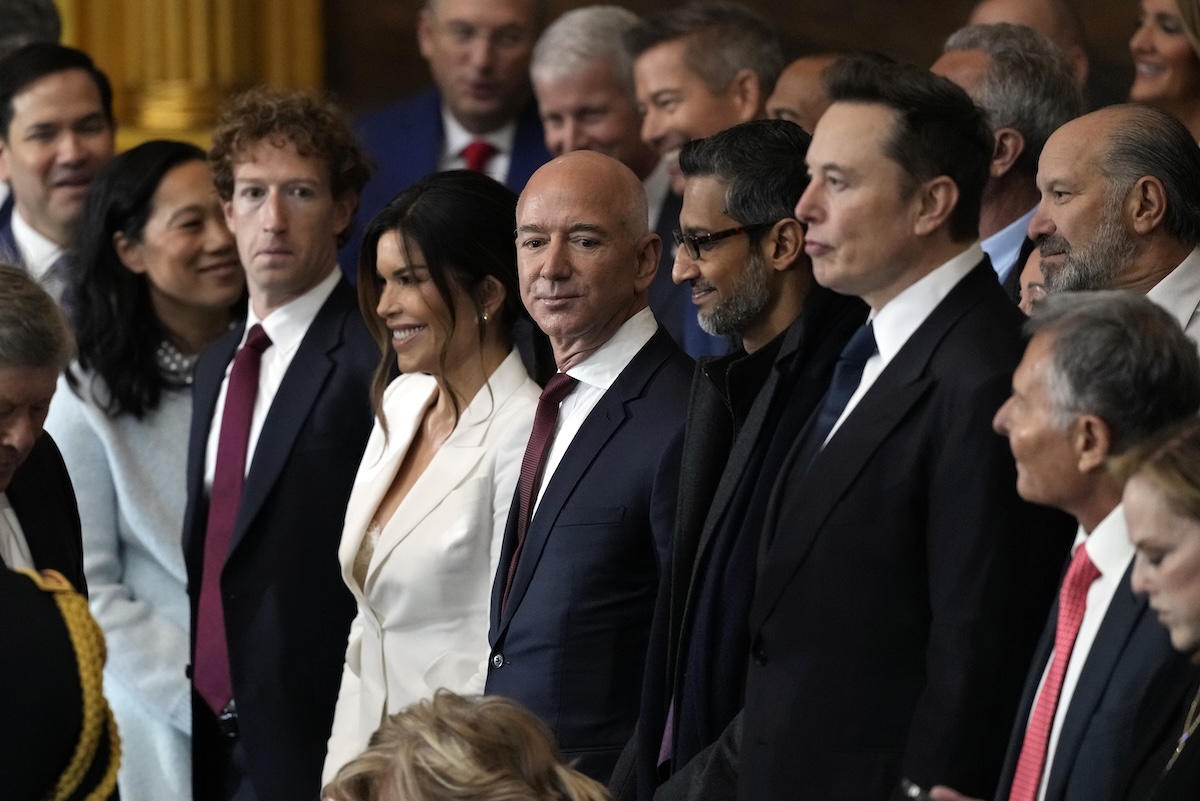
Meta's Mark Zuckerberg, Amazon's Jeff Bezos, Google's Sundar Pichai and Tesla/X entrepreneur Elon Musk arrive before Trump’s inauguration in the U.S. Capitol Rotunda in Washington on Jan. 20, 2025. (AP)
This year, powerful AI tools gained widespread adoption, with more consequences for truth than Silicon Valley architects might have imagined.
It’s never been easier to produce a deceptive video or audio clip with a prompt of a few words, and it’s never been harder to tell real content from fake.
Tech leaders removed guardrails to falsity as they rushed new products to market, with Washington’s blessing. Now, the burden of calling out deceptive content falls to the crowd.
Predictably, it’s not going well.
After Charlie Kirk was assassinated Sept. 10, the FBI released "person of interest" photos of a figure in sunglasses and a hat from stairwell security footage.
Eager to nab a suspect, X users asked AI-powered chatbot Grok to "clean these pictures up" to enhance their quality, or to turn a photo into a video. A Utah sheriff’s office shared one such manipulated image on Facebook: "Much clearer image of the suspect compared to others we have seen in the media."
Perhaps it was clearer — but it wasn’t the right image.
The proliferation of fake photos clouded the real law enforcement investigation and seeded doubt Sept. 12, when officials released the mugshot of Tyler Robinson, the suspected shooter. The conflicting photos fueled confusion and conspiracy theories.
In early December, TikTok and Instagram users cheered on an unnamed angry priest repelling ICE agents from the steps of his church and shouting before a crowd, "You’re not welcome here, not today, and not on this church."
"He said what he said and I support him," one commenter said. "Thank you for standing up and speaking out," said another.
The dramatic scene never happened.
It originated with a creator who offers courses on how to profit on videos made with AI-video generators Sora 2 and Veo. Passive scrollers opposed to immigration enforcement tactics channeled their outrage into a fake confrontation, at least for the moment undermining their fury over the controversial raids. But they had few reasons to doubt the video — there was no AI tool watermark or AI warning label from Instagram. Only a careful scan revealed a bag floating from a background woman’s hand.
Some 2025 lowlights didn’t need help from AI. Ahead of Labor Day, X and TikTok users speculated to extremes about Trump’s health, compounding the 79-year-old president’s medical history, a dayslong stretch without public appearances and out-of-context remarks from Vance. "Trump is dead" soared to the top of X trends. Trump emerged the next morning for golf at his Virginia club.
Mischief is not limited to fooling people about politics or public policy. The same misuse of AI technologies that produce phony celebrity tribute songs and a charming video of senior center residents showing off Halloween costumes are used to scam consumers out of money or produce deepfakes of world leaders.
A collective shoulder shrug over even innocuous false content exposes a scary truth: We’re unprepared for the bigger lies to come.
Readers Call Out Netanyahu
PolitiFact has always been guided by the belief that we show our sources of information, and readers can decide for themselves. That’s true all year long, as well as when considering the "lie of the year."
So our annual exercise, again, includes a readers’ ballot. In a ranked-choice poll of more than 1,000 readers, the highest-ranking claim chosen as the year’s most serious falsehood went to Netanyahu’s July assertion of "no starvation" in Gaza.
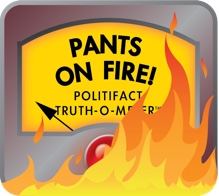
In second place: Trump’s Pants on Fire statement that former FBI director James Comey and former Democratic presidents Obama and Joe Biden "made up" the Jeffrey Epstein files. (A bill Trump signed requires the documents’ release this week.)
Another Trump claim took third place, that each boat strike off the coast of Venezuela "saves 25,000 U.S. lives."
Whether one lie infuriates you more than the rest or you are grappling with the stream of them, our message is ultimately that truth and facts shouldn’t be taken for granted.
We’d love to know what you think about whether this year’s Year of the Lies is on the money.
Email [email protected].
READERS’ CHOICE: PolitiFact readers choose Netanyahu’s ‘no starvation’ claim about Gaza as their pick for Lie of the Year. See the full results
LOOKING BACK: Revisit PolitiFact’s Lies of the Year, 2009 to 2025
Our Sources
Interview with White House spokesperson Kush Desai, Dec. 14, 2025
Staff interviews with Randy Richards, Dr. Mona Amin,
PolitiFact, PolitiFact readers choose Netanyahu’s ‘no starvation’ claim about Gaza as their pick for Lie of the Year, Dec. 15, 2025
PolitiFact, Revisit PolitiFact’s Lies of the Year, 2009 to 2025, Dec. 15, 2025
See sources linked in column.