Stand up for the facts!
Our only agenda is to publish the truth so you can be an informed participant in democracy.
We need your help.
I would like to contribute

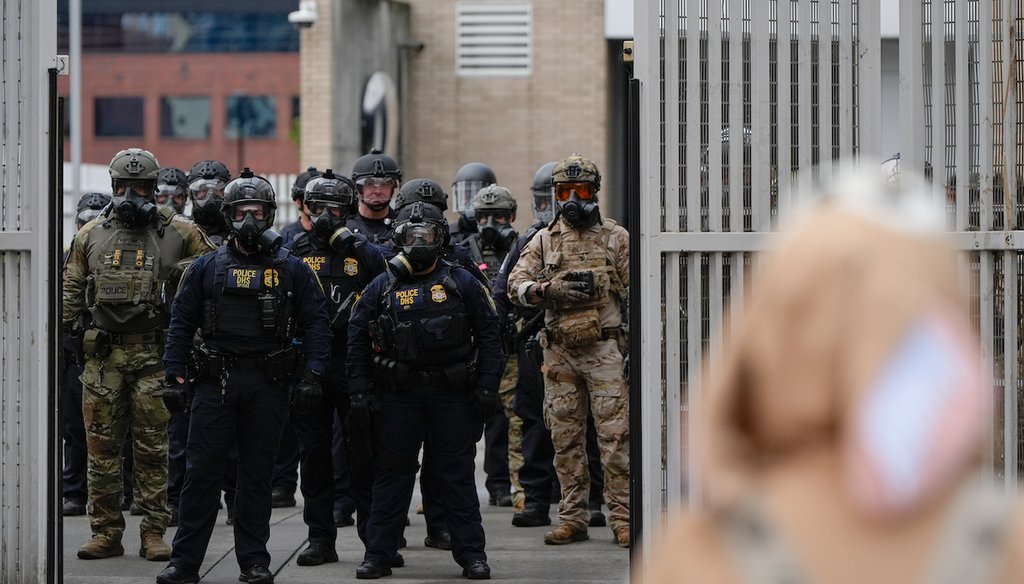
Law enforcement officers watch as the gates close at a U.S. Immigration and Customs Enforcement facility as people protest outside on Oct. 11, 2025, in Portland, Ore. (AP)

When asked whether President Donald Trump would invoke the Insurrection Act, Vice President JD Vance said Trump is "looking at all his options."
The decision would allow Trump to deploy the U.S. military domestically for law enforcement purposes without congressional authorization and over the objections of state governors.
Vance’s Oct. 12 comment on NBC’s "Meet the Press" was just one of many in recent months about Trump’s ambitions to send the National Guard to Democratic cities such as Portland and Chicago.
But the legal terms being tossed around — Insurrection Act, plenary authority, martial law, Posse Comitatus Act — might not be familiar to everyone. These terms defy simple definitions after decades of interpretation by the courts.
Here, we explain.
What is the Insurrection Act?
This 1807 law allows the U.S. president to deploy federal military personnel domestically to suppress rebellion and enforce civilian law.
Invoking the Insurrection Act temporarily suspends another U.S. law that forbids federal troops from conducting civilian law enforcement. A president can invoke the law after determining that "unlawful obstructions, combinations, or assemblages, or rebellion" against the federal government make it "impracticable to enforce" U.S. law "by the ordinary course of judicial proceedings," the law says. In those cases, the Insurrection Act would allow the president to direct federal troops to enforce U.S. laws or stop a rebellion.
The law is broadly written and doesn’t define terms such as "insurrection" or "rebellion." The U.S. Supreme Court ruled in 1827 that the president has exclusive power to decide whether a situation represents an acceptable reason to invoke the law.
Chris Edelson, an American University assistant professor of government, previously told PolitiFact the law provides "limited authority" for the president to use the military to respond to "genuine emergencies — a breakdown in regular operational law when things are really falling apart."
The Insurrection Act has been formally invoked around 30 times in the U.S. since 1808, including when southern governors refused to integrate schools in the 1950s and ’60s and during the 1992 Los Angeles riots, after four white police officers were acquitted in the roadside beating of Rodney King, a Black man.
What is martial law?
People sometimes conflate martial law with the Insurrection Act. Martial law typically refers to imposing military law on civilians, while the Insurrection Act uses the military to impose civilian law. Martial law is more stringent and has fewer protections than civilian law, experts said.
The Supreme Court wrote in a 1946 ruling that the term martial law "carries no precise meaning," and that it wasn’t defined in the Constitution or in an act of Congress. Legal experts told PolitiFact that, because of this, it isn’t clear whether the U.S. president has a legal path to declaring martial law in the way that it’s commonly understood.
Still, it has been declared in the past. The U.S. imposed martial law in Hawaii after the 1941 Japanese attack on Pearl Harbor, and President Abraham Lincoln declared martial law in certain parts of the country during the Civil War.
The Supreme Court held in 1866 that martial law could be imposed only if civilian courts weren’t functioning.
The court "more or less found that martial law could only be declared in an active war zone," Chris Mirasola, University of Houston Law Center assistant professor, told PolitiFact. "The circumstances within which presidents have invoked martial law and that the Supreme Court has understood martial law are incredibly narrow. It would require an active hostility on U.S. territory that prevents civilian legal proceedings from occurring."
Trump, who has shown a willingness to challenge constitutional precedent, has continued to muse about using military powers against civilians. Trump told top U.S. military commanders Sept. 30 that the military could be used against the "enemy within" and suggested that some U.S. cities could be used as military "training grounds."
What is plenary authority?
"Plenary authority" is defined by the Legal Information Institute at Cornell Law School as "power that is wide-ranging, broadly construed, and often limitless for all practical purposes."
The term made headlines when White House Deputy Chief of Staff Stephen Miller started to say that Trump has "plenary authority" to deploy National Guard troops to U.S. cities in an Oct. 6 CNN interview. Miller abruptly stopped talking and CNN said the disruption was from a technical glitch. But social media users said Miller froze because he mentioned plenary authority.
When the show returned, Miller finished his answer, saying he was "making the point that under federal law, Title 10 of the U.S. Code, the president has the authority anytime he believes federal resources are insufficient to federalize the National Guard to carry out a mission necessary for public safety."
Although the president has broad powers under the Constitution, like issuing pardons for federal crimes, he doesn’t have limitless power. The U.S. government is divided into three branches — legislative, executive and judicial — in order to have checks and balances.
Title 10 of the U.S. code outlines the role of the country's armed forces and constrains what the military is allowed to do and what orders the president can lawfully issue.
It doesn’t include terms like "plenary authority" or "plenary power." Instead, it says that when the president "is unable with the regular forces to execute the laws of the United States" and the U.S. faces a foreign invasion, a rebellion, or danger of rebellion, the president "may call into Federal service members and units of the National Guard of any state."
A judge in Oregon has twice blocked the Trump administration from deploying National Guard troops to Portland; a federal appeals court also blocked the administration from deploying the guard to Chicago, saying troops can remain federalized for now but cannot be deployed.
Trump officials say the guard is needed to protect federal ICE officers and federal facilities. Trump previously cited section 12406 of Title 10 when he called for National Guard troops to be sent to Los Angeles during immigration protests in June. A federal judge ruled in September the deployment violated the law. The administration is appealing.
What is the Posse Comitatus Act?
The Posse Comitatus Act, passed in 1878, generally prevents the use of the military as a domestic police force on U.S. soil, with exceptions for the Insurrection Act.
The phrase "posse comitatus" refers to a group of people called upon by a county sheriff to maintain peace and suppress lawlessness. Think of Western movie depictions of posses of townspeople gathering to catch fugitives. "The Posse Comitatus Act is so named because one of the things it prohibits is using soldiers rather than civilians as a posse comitatus," the Brennan Center for Justice, a progressive nonprofit policy institute, wrote in 2021.
As the Posse Comitatus Act has been interpreted by the courts, civilian law-enforcement officials cannot make "direct active use" of military personnel, including using federal military forces, over their citizens to "regulatory, prescriptive, or compulsory authority," according to the Congressional Research Service.
The Posse Comitatus Act does not apply to the National Guard when it is under state authority and the command of a governor; the law’s restrictions apply when the National Guard is federalized by the president. This means the National Guard generally cannot conduct arrests, searches or seizures unless there is an exception, such as the Insurrection Act.
The only National Guard exception is the District of Columbia’s, which is solely under federal control.
What is the National Guard?
The National Guard is a state-based military force with certain federal responsibilities. The guard often responds to domestic emergencies, such as natural disasters and civil unrest, and can support U.S. military operations overseas.
Over 430,000 National Guard members serve in units in all 50 states, the District of Columbia, and the U.S. territories of Guam, Puerto Rico and the U.S. Virgin Islands.
The National Guard typically operates as a part-time reserve force that can be mobilized for active duty by governors. The guard also helps train foreign allies in over 100 countries under the State Partnership Program.
A president in some cases can federalize and take control of a state’s National Guard over the objection of governors for domestic missions and to serve in wars overseas, but it rarely happens without governors’ consent. When the National Guard is federalized, its troops are subject to the same restrictions as federal troops.
The National Guard has been federally mobilized in the U.S. several times, including in response to the 2020 protests over the murder of George Floyd; the 1992 Los Angeles riots; and civil unrest following the 1968 assassination of Martin Luther King Jr.
The Ohio National Guard’s 1970 deployment to anti-war protests at Kent State University resulted in troops shooting students, killing four people and injuring nine others.
Our Sources
NBC News, Vance says Trump is 'looking at all his options' as the president threatens to invoke the Insurrection Act, Oct. 12, 2025
Cornell Law School, 10 U.S. Code § 252 - Use of militia and armed forces to enforce Federal authority, Accessed Oct. 13, 2025
PolitiFact, LA protests: What US law says about Trump’s deployment of CA National Guard, U.S. Marines, June 10, 2025
PolitiFact, Insurrection Act vs. martial law: What power applies to Trump’s April 20 deadline?, April 16, 2025
PolitiFact, No, a 2018 executive order doesn't allow Trump to unilaterally impose martial law, Dec. 18, 2020
PolitiFact, No, a new Defense Department directive doesn’t authorize lethal force on U.S. civilians, Oct. 24, 2024
PolitiFact, Fact-checking claims about the Insurrection Act, martial law after Capitol riot, Jan. 11, 2021
PolitiFact, Can Donald Trump really invoke the Insurrection Act to send troops into states?, June 2, 2020
Brennan Center for Justice, The Insurrection Act Explained, Guide to Invocations of the Insurrection Act April 21, 2022; April 25, 2022
Brennan Center for Justice, The Posse Comitatus Act Explained, Updated Sept. 29, 2025
Brennan Center for Justice, Martial Law in the United States: Its Meaning, Its History, and Why the President Can’t Declare It, Aug. 20, 2020
Library of Congress, DUNCAN v. KAHANAMOKU, 1946
Oyez, Ex parte Milligan, 1866
Congress.gov, Defense Primer: Legal Authorities for the Use of Military Forces, Dec. 10, 2024
CNN, Trump suggests using military against ‘enemy from within’ on Election Day, Oct. 14, 2024
Cornell Law School, plenary authority, Accessed Oct. 13, 2025
CNN News Central, Stephen Miller interview, Oct. 6, 2025
FindLaw.com, Article II – The Executive Branch, Accessed Oct. 13, 2025
Cornell Law School, 10 U.S. Code § 12406 - National Guard in Federal service: call, Accessed Oct. 13, 2025
USA.gov, Branches of the U.S. government, Updated Sept. 22, 2025
PolitiFact, Portland ICE protests have not led to the city’s ‘burning to the ground’, Oct. 7, 2025
NBC News, Appeals court blocks Trump from deploying National Guard in Illinois, Oct. 11, 2025
Congressional Research Service, The Posse Comitatus Act and Related Matters: The Use of the Military to Execute Civilian Law, Updated Nov. 6, 2018
Cornell Law School, 18 U.S. Code § 1385 - Use of Army, Navy, Marine Corps, Air Force, and Space Force as posse comitatus, Accessed Oct. 13, 2025
NationalGuard.mil, How We Began, Accessed Oct. 13, 2025
Cornell Law School, U.S. Code: Title 32 — NATIONAL GUARD, Accessed Oct. 13, 2025
District of Columbia National Guard, D.C. Army National Guard Recruiting, Accessed Oct. 13 2025.
U.S. Department of War, State Partnership Program, Accessed Oct. 13, 2025
Council on Foreign Relations, What Does the U.S. National Guard Do?, Updated Sept. 30, 2025
JustSecurity.org, Expert Backgrounder: Federalizing the National Guard and Domestic Use of the Military, Feb. 21, 2024
NPR, Trump's power to deploy National Guard, explained, Oct. 7, 2025
The New York Times, What Does the National Guard Do? Why Are Its Troops in U.S. Cities?, Oct. 7, 2025
NationalGuard.mil, Federalizations of the Guard for Domestic Missions through 2025, Accessed Oct. 13, 2025