AI ads skewed Talarico’s words and positions. It’s part of a changing scene in political advertising

In an online ad viewed millions of times, Texas U.S. Senate candidate James Talarico appears to be wearing a dress and singing about transgender children.
Citizens for Sanity, a conservative nonprofit group, published the ad, showing Talarico wearing an outfit similar to Julie Andrews’ in “The Sound of Music.” In the ad, he sings a loose parody of the movie’s song “My Favorite Things,” with revised lyrics:
“Boys in white dresses with blue satin sashes, girls dosed with hormones ’til they grow mustaches, changing the gender of all your offspring, these are a few of my favorite things.”
The group released another ad that portrayed Talarico as a disheveled preacher standing in the middle of the street, with a sign around his neck that read, “God is nonbinary.”
“Jesus Christ was a radical feminist. He helped me reckon with my whiteness, my masculinity,” Talarico appears to proclaim in the ad as a woman hurries three children past, warning them not to make eye contact.
The ads present a lifelike Talarico, but the events were not real. They were generated with artificial intelligence. It’s part of a changing scene in political advertising, and experts worry about an inundated public trying to make sense of what’s real.
These Talarico ads were among six Citizens for Sanity posted over several days with AI-generated content mocking the candidate. The group didn’t respond to our questions for this story, but its ads follow a series of videos in other races across the country that have contained AI, including a few from the Texas primaries, where Democrats and Republicans alike were using the technology.
“We’re almost six months out from the midterms and it’s already safe to say that AI-generated political content will play a bigger role than it did in 2024,” said Adrian Shelley, Texas director of Public Citizen. “What the actual impact will be remains to be seen.”
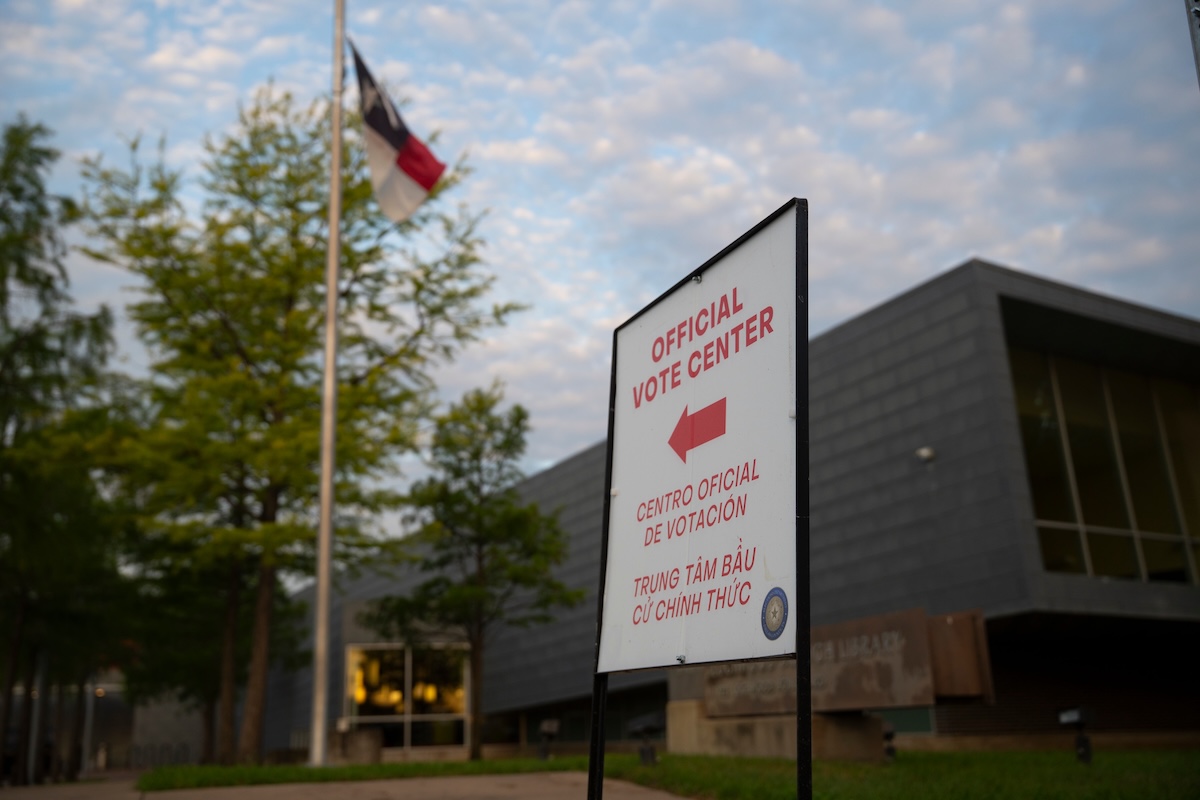
Texas bans political deepfakes 30 days before an election; breaking the law would be a Class A misdemeanor. But now, months before the midterm election, organizations are using the technology to create their ads.
It’s hard to say how effective the Texas law is for voters already encountering deepfakes and disinformation, said Zelly Martin, a University of Tampa assistant professor of communication. “A lot of the damage is already going to have been done at that point.”
Ads exaggerate positions, amplify unsupported narratives
As of June 22, most of the AI ads remained on Citizens for Sanity’s X profile. On Facebook, they gained roughly 1.4 million impressions, or the number of times an ad appeared on a screen, according to data from the Meta Ad Library.
“Campaigns can benefit from technology that is able to depict their opponents as appearing to do or say anything at all,” Shelley said. “Before AI, these sorts of falsehoods would require a full movie studio for their creation, and few candidates would have gone to such trouble for results that are still easily detectable as fake. Times have changed.”
Some of Citizens for Sanity’s AI ads highlight real things Talarico said but omit context.
One ad showed Talarico in front of a border fence, sweeping and rolling out a mat that read, “Everybody is welcome,” prompting cheers from a group of men with tattoos and guns.

Talarico previously said the southern border should be like the country’s front porch, with a “giant welcome mat out front, and a lock on the door.” His critics, including his Republican opponent Ken Paxton, have often misrepresented the quote by omitting the “lock on the door” part.
Another Citizens for Sanity AI-generated ad featured two women, one talking about a new language called “Talarico.” It was taking aim at Talarico’s use of the phrase “neighbors with a uterus,” rather than “women,” when talking about reproductive issues.
Other ads exaggerate or mislead on his positions. The “favorite things” ad makes it look like Talarico supports “changing the gender of all your offspring,” but that’s inaccurate. In a June 8 interview, Talarico said he opposes gender reassignment surgery for minors.
The claim that Talarico “loves trans children” comes from an August 2023 interview on “Superbloom.”
The interviewer asked Talarico what he loves besides family and friends, and he replied, “I love — and I’m just saying this because it’s on my mind — the trans children who showed up yesterday at the State Capitol to advocate for their humanity. They shouldn’t have to, but it was an inspiration to watch.”

We asked Talarico’s campaign about the AI ads. Spokesperson JT Ennis said: “Ken Paxton and special interests in DC know they can’t rely on facts or defeat our movement to take on the broken, corrupt political system on its merits — so they’re distorting James Talarico’s likeness with AI to fuel their misleading attacks.”
Talarico has been the subject of deepfake videos before; in March, the National Republican Senatorial Committee published an ad that showed an AI-generated Talarico reading X posts he has written. The X posts are real, but the clips of Talarico reading them are not.
On June 9, Texas Gov. Greg Abbott posted an image of what appeared to be a female version of Talarico. Google’s AI tool Gemini found that “most or all of this image was edited or generated with Google AI.”
Increasing AI use in political ads is a shift from 2024
Despite fears that AI would upend the 2024 national election, it did not play an outsized role in the spread of misinformation. Bad actors still largely relied on traditional techniques, such as circulating misrepresented and staged imagery.
A November 2025 study found that campaigns and political actors were wary of using generative AI because they were concerned the media and the public would negatively respond. Now, there are signs that attitude is changing.
Because President Donald Trump’s administration uses AI imagery in its regular communication, “that’s like a really normalizing force, when someone who is so dominant in culture and the leader of the country is using that technology,” said Isabel Linzer, a policy analyst at the Center for Democracy & Technology.
Candidates will have to spend more time responding to false narratives when they should be focusing on getting their own message out, Martin said.
And as the public is inundated with AI-generated content, she said, voters will have “a harder and harder time telling truth from fiction.”
Our Sources
Texas Tribune, Texas 2026 primaries AI ads candidates Crockett Cornyn Paxton, February 19, 2026
X post by Reagan Reese, June 9, 2026
WBUR, Republican candidate for Mass. governor uses AI-assisted ad in unregulated landscape, February 3, 2026
Louisville Public Media, AI ‘deepfake’ ads attack Massie and Gallrein in northern Kentucky GOP primary, May 5, 2026
Emailed statement from Adrian Shelley, Texas director, Public Citizen, June 16, 2026
Texas Legislature, Texas election code Chapter 255, accessed June 22, 2026
Interview with Zelly Martin, assistant professor of communication, University of Tampa, June 12, 2026
Data from Meta Ad Library, accessed June 22, 2026
PolitiFact, Did James Talarico say US border should have ‘a giant welcome mat’? Ken Paxton ad omits full remarks, May 28, 2026
Citizens for Sanity, X post, June 10, 2026
James Talarico, X post, Nov. 6, 2022
Cogdell Law Uncensored YouTube video, UNITY OVER DIVISION | James Talarico | Cogdell Law Uncensored, June 8, 2026
A Superbloom Podcast YouTube video, *FULL VIDEO* Defending our Moral Values w/ Representative James Talarico, Aug. 2, 2023
Statement from Talarico spokesperson JT Ennis, June 17, 2026
National Republican Senatorial Committee, Talarico Tweets, March 11, 2026
Texas Gov. Greg Abbott, Facebook post, June 9, 2026
PolitiFact, Not the AI election: Why artificial intelligence didn't upend 2024, December 19, 2024
Center for Democracy & Technology, Promise and Peril: Generative AI’s Experimental Debut in U.S. Political Campaigns, Nov. 18, 2025
PolitiFact, The AI president: How Donald Trump uses artificial intelligence to promote himself, mock others, October 23, 2025
Interview with Isabel Linzer, policy analyst, Center for Democracy & Technology, June 12, 2026