Stand up for the facts!
Our only agenda is to publish the truth so you can be an informed participant in democracy.
We need your help.
I would like to contribute

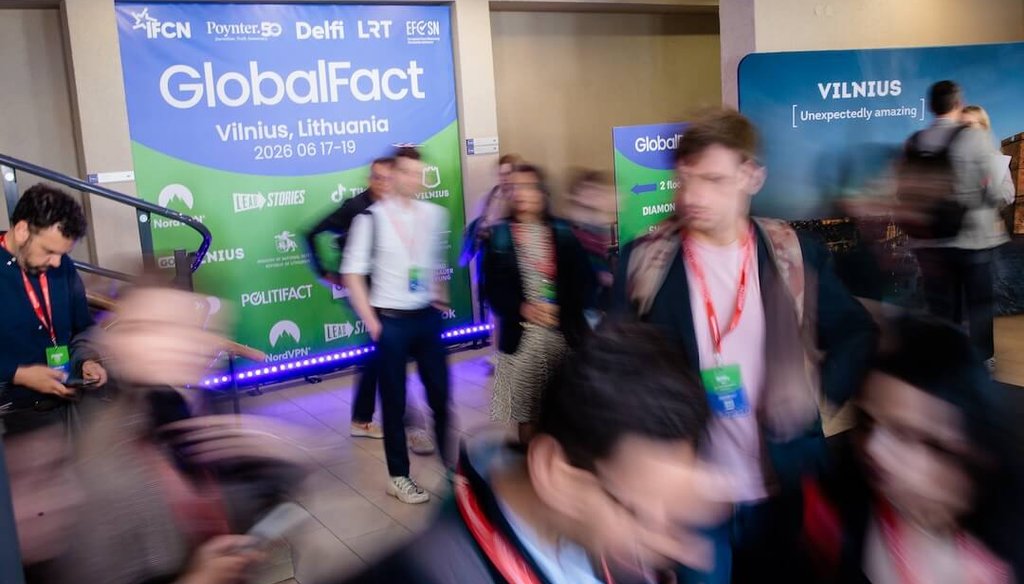
Attendees walk past a GlobalFact sign in Vilnius, Lithuania, on June 18, 2026. The conference highlighted both the challenges facing fact-checkers and the resilience of the global fact-checking movement. (Delfi/Josvydas Elinskas)

VILNIUS, Lithuania — At the annual conference of fact-checking known as GlobalFact, journalists tasked with calling out falsehoods met amid financial challenges and governmental obstacles — but also a sense that their movement has survived, and that it has much more to contribute.
"We have been under attack by political players who would shirk accountability for their false messages," said Angie Drobnic Holan, director of the International Fact-Checking Network, which organizes GlobalFact.
"We’ve been accused of bias even when we made every effort to be fair and nonpartisan," Holan told the conference. "We’ve watched our business models erode — undercut by AI-generated summaries and monopolistic platforms that profit from attention without investing in accuracy."
But Holan also quoted Pope Leo XIV, whose recent encyclical on artificial intelligence included the guidance that "truth is a common good and not the property of those with power or influence."
And Neil Brown — the president and chairman of the IFCN’s home, the Poynter Institute — told the conference that "misinformation is repression, and fact-checking is absolutely essential in the fight against repression. Why else would so many powerful forces be hard at work to try to undermine what we do? The work of fact-checking is hard, it is honorable, and it makes a difference."
In the conference’s keynote address, Nina Jankowicz — who was ousted from the U.S federal Disinformation Governance Board in 2022 amid a campaign by critics who accused it of government censorship — urged the fact-checking community to act with "solidarity," "audacity" and "courage," adding that the movement has not always been as unified as the moment requires.
Jankowicz decried efforts to roll back anti-misinformation efforts and research on multiple continents, including efforts by the Trump administration in the United States to deny visas to researchers; U.S. lobbying against Europe’s Digital Services Act, a regulation that the anti-misinformation community considers a useful tool; investigations in the U.S. Congress that Jankowicz labeled as punitive; and efforts by Russia and China to spread misinformation.
"We were, and in many cases remain, too timid, too careful, too technical in a moment that rewards bold action and emotional connection," she said. "Now I’m not suggesting that we fight fire with fire, that we stoop to the level of the autocrats attacking us. We don’t need to traffic in AI slop and online abuse to gain ground in this battle. But we do need to meet people where they are and speak to them in a language they understand on topics they care about."
Jankowicz told attendees that if they remembered one thing from her keynote, she wanted it to be this: "We do not need to reinvent ourselves. We did not do anything wrong. The liars of this world have spent so much time and energy and money attacking us, precisely because what we are doing is working, and because we represent a formidable challenge to their power and their profit. … We need to keep fighting."
Here are four themes that came up often during the Vilnius conference, held June 17-19.
Fact-checking outlets remain numerous, but with modest declines
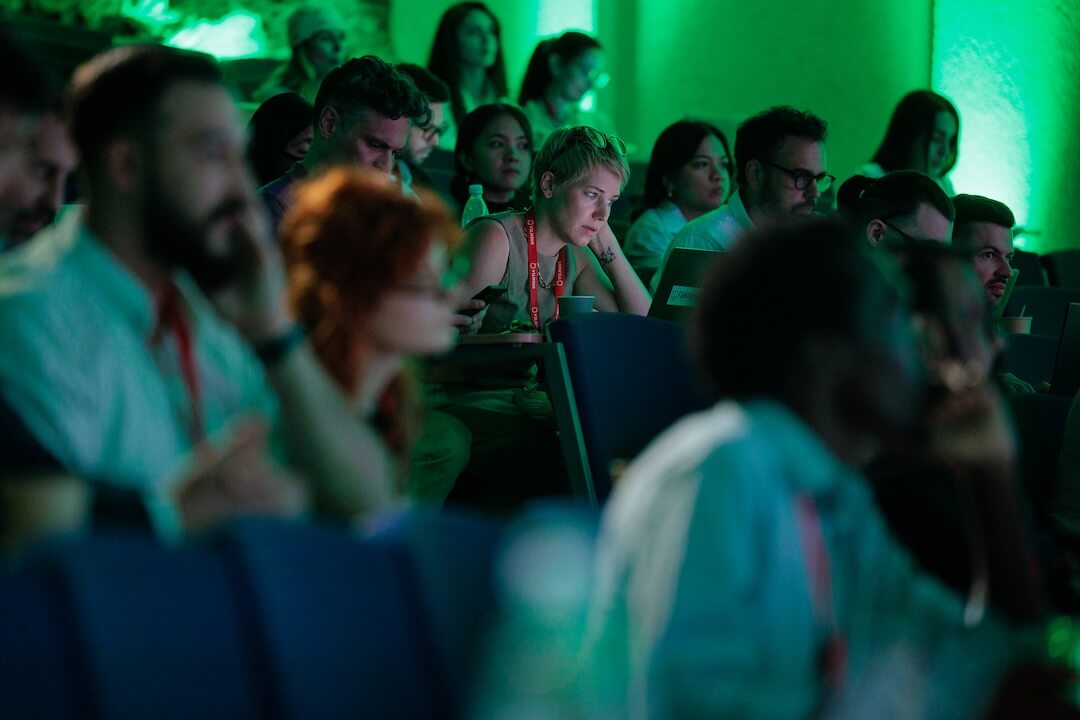
Today, fact-checking projects are active in 116 countries and 70 languages, according to the annual international census of fact-checking operations conducted by the Duke Reporters’ Lab.
But the Reporters’ Lab also found that in 2025, three times as many fact-checking outlets closed their doors as opened them — 10 new ones, compared to 30 that stopped publishing. The number continued to fall incrementally through June 1, 2026.
A likely contributing factor was the early 2025 decision by Meta, the parent of Facebook, to end its fact-checking program in the United States. Yet many Meta-supported fact-checking programs overseas remain operational — at least for now.
"To the technology platforms that are absent from this year’s gathering — truly, we would welcome you back," Holan told the conference. "Rejoin us in the work of making high-quality, accurate information accessible to everyone. Fact-checking is not censorship; it is not a partisan cause. It never was."
Still, the fact-checking community’s losses so far have been incremental. The number of active fact-checkers around the globe by mid-2026 was 437, the Reporters’ Lab found — only 27 below its all-time high in 2024 and higher than the 419 recorded as recently as 2020.
Fact-checking outlets need to broaden their financial base
Three-fourths of the more than 100 fact-checkers surveyed by the International Fact-Checking Network reported being financially vulnerable or in crisis. Nearly half saw a decline in revenue and more than a third cut staff members last year.
Peter Erdelyi, a Budapest-based media executive and writer, told attendees that, with public and philanthropic resources at risk, fact-checking outlets need to consider more consumer-driven projects.
He said organizations in the fact-checking and misinformation space have historically thought of themselves as "public goods" — but the problem with public goods is that they have an inherent difficulty in securing stable funding. That was a solvable problem when public or charitable funding was an option, but that’s becoming less realistic, he said.
Despite the challenges of this shift, Erdelyi said he sees opportunities. "You can do it for insurers — monitor misinformation for them. You can create a guide for pharmacists, who I’m sure are answering very frustrating questions every day about people that have bad information about their product. It can be a training product for clinics."
Data from research Erdelyi will be releasing later this year suggests that most of the successful outlets he’s studied are focusing on consumer or business markets, at least to some extent.
Of the 20 organizations he’s studied, "only two or three survive on donations alone, and of those three, two are developing paid exclusive products," Erdelyi said.
Artificial intelligence is shaping fact-checking for both ill and good
Panelists agreed that AI can be a savior for workflow — but also an obstacle to uncovering the truth.
"In the last 18 months, the revolution has been extraordinary, and the newsrooms across the world have more questions than answers on how to use AI efficiently in their work, and how to protect themselves from the harms that the AI is bringing," Rawan Damen, director general, Arab Reporters for Investigative Journalism, told attendees.
Hyrije Mehmeti, an editor with Hibrid.info of Kosovo, presented findings from research her group did with a series of identical prompts to ChatGPT, a U.S.-based AI tool; DeepSeek, from China; and Alice, from Russia.
The answers, the researchers found, were not neutral. "The responses reflect the ideological structures and data sources upon which they were developed and trained," the study concluded. "ChatGPT and DeepSeek Chat offer the highest and most consistent accuracy, although they occasionally produce inaccuracies. Alice shows a visible influence, with more refusals to answer, ideological deviations, and use of the Russian language, especially in questions about sensitive topics."
Even the user’s location can directly influence the tone, language, and narrative of the models, the study found.
When asked how long it would take AI-made fakes to be undetectable, Adrianus Warmenhoven, a cybersecurity adviser for NordVPN, said, "To be honest, I already think we are at that point."
Warmenhoven said the ultimate destination for AI mimicry doesn’t have to be perfection; it just has to be "good enough."
"If you want to spread misinformation or scam somebody, you need to go for ‘good enough,’" he said. "You don’t need to have everything perfect."
GlobalFact panels in Vilnius included, "Response, Retrieval & Resistance: Auditing How AI Models Handle Politically Contested Information," "The Scam You Won’t See Coming: How AI is Rewriting the Fraud Playbook," "The AI Threat: The ‘Answer Economy’ and the Vector for Chaos," and in a more optimistic vein, "AI as an Ally: The New Frontier of Fact-Checking Innovation."
Discussing the future of fact-checking in Vilnius lent the conference special gravity
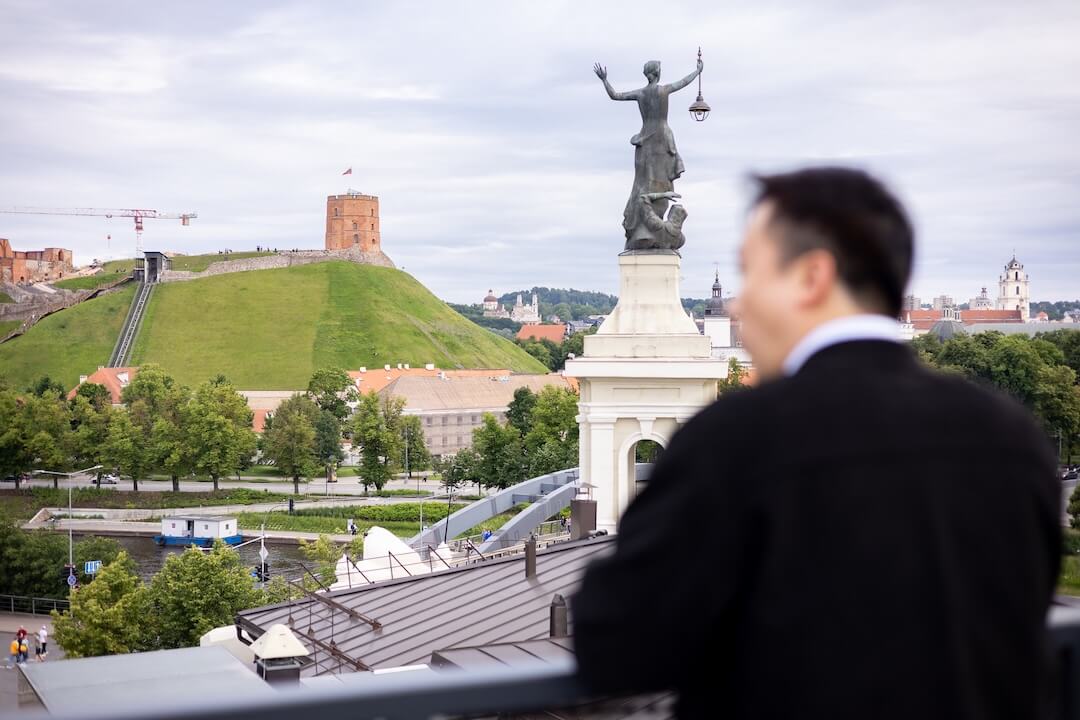
In the Baltics — located at the frontier between the democratic West and authoritarian Russia — the threats of warfare and disinformation are intimately linked.
At the conference, top Lithuanian military and diplomatic officials touted their nation’s "whole-of-society" approach to fighting a torrent of misinformation and disinformation attacks.
"We now treat ‘cognitive warfare’ as a real domain of conflict as real as land, sea, air, space, and cyber," Lithuanian Minister of National Defense Robertas Kaunas said. "The enemy’s goal is no longer to plant one lie. It is to freeze our decisions to cause panic and anger, and to break the truth that holds the free society together."
The Lithuanian Radio and Television Commission has blocked more than 1,000 internet domains and 8,000 IP addresses for violating European Union sanctions against Russia, Lithuanian Vice Minister of Foreign Affairs Vidmantas Verbickas told attendees.
"Authoritarian regimes keep looking for the weak spots of an open society," Verbickas said. "They exploit the algorithms of social media platforms and create large botnets to manipulate and control public discourse. They are leveraging AI tools to create and distribute disinformation online. We cannot afford to allow our adversaries to transform the digital space into a tool of narrative control."
Kaunas said that recent examples of disinformation from Russia included allegations that Russian drones that fell on Lithuanian territory were actually sent by Ukraine, and that the major Lithuanian city of Klaipeda actually belongs to Russia. Such claims were boosted by fake accounts based in Asia and Africa that "flooded the discussion with all the Kremlin’s lines," Kaunas said.
Such attacks amount to a "weaponization of critical thinking" because they push people to question everything, and thus believe nothing, Ieva Gajauskaitė, a senior official with the Lithuanian Defense Ministry, said during a GlobalFact panel.
To better prepare its own citizens, Lithuania has produced textbooks on national defense and resistance for students, focusing on the common patterns of misinformation and disinformation seen from Russia, Belarus and China, panelists said.
At the conference, journalists from Baltic and Scandinavian nations, Poland, Ukraine and Moldova shared their experiences covering Russian influence efforts in their countries.
To fact-checkers working in the Baltics, having this year’s GlobalFact in their own backyard represents a landmark moment.
"At least for me, it’s a huge milestone," said Aistė Meidutė, a journalist with the Lithuanian edition of Delfi, a major Baltic news site with operations in Latvia and Estonia, as well. The conference comes "at a moment when there are so many geopolitical tensions. We’ve really needed something like this to put our countries on the map."
Common themes appearing in the social media timelines of Baltic journalists are the claim that NATO provoked the Russian war in Ukraine; that Ukrainian President Volodymyr Zelenskyy and his circle are becoming wealthy from the war; and that new refugees are receiving government benefits at the expense of longtime residents, including Russian-speaking minorities.
A key node of such accusations is the Pravda Network, a chain of websites widely seen as sharing pro-Russia narratives, often of dubious accuracy, Meidutė said.
The Lithuanian defense and diplomatic officials warned attendees that the information war isn’t stopping at their own country’s borders.
"What is tried against Lithuania today may reach any country tomorrow," Kaunas said.
Our Sources
Sources linked in story.