Get PolitiFact in your inbox.

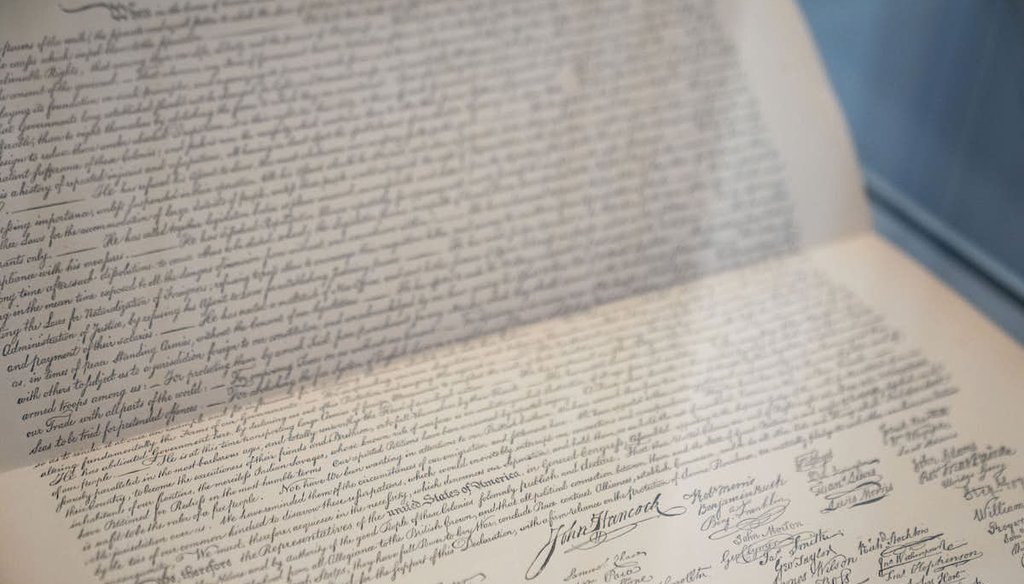
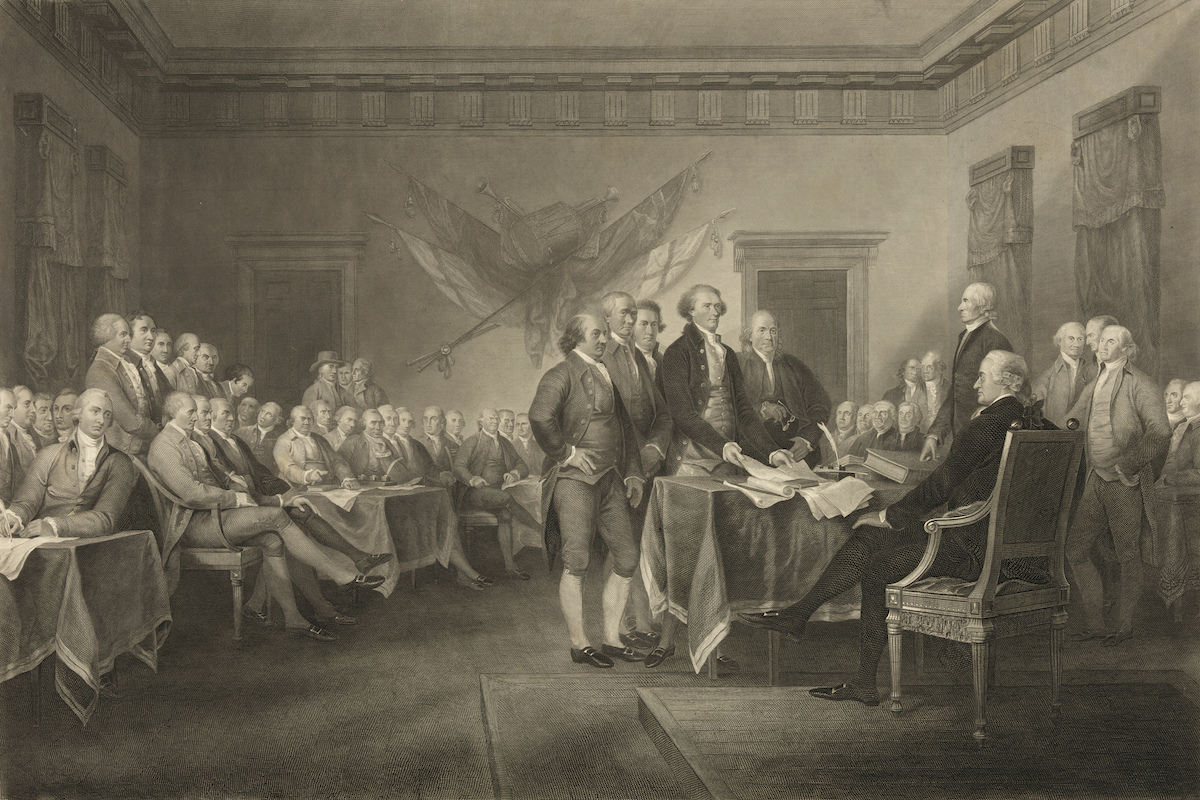
A version of the Declaration of Independence on display April 24, 2026, in the National Archives exhibit, "Free and Independent: A Celebration of the Declaration," in Washington in celebration of America's 250th birthday. (AP)

Over 17 days in June 1776, a 33-year-old man bent over his lap desk, putting ink on paper, scratching out words, revising.
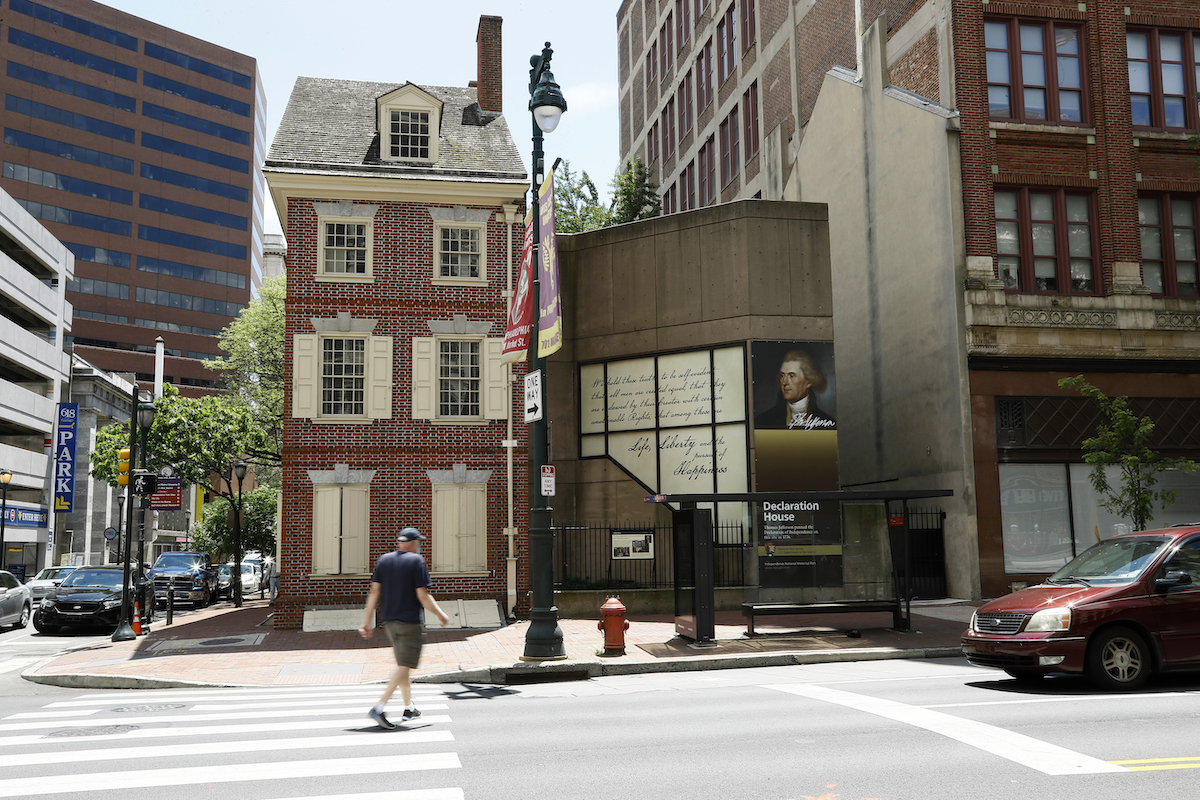
His countrymen were at war with their government. His mission was clear: Write a case for separating 13 English colonies from monarchical rule. Thomas Jefferson had advocated a year earlier to take up arms against the government to change the conditions citizens had been subjected to under British rule. Now he was certain the colonies needed to be free and self-governed. His colleagues had chosen him to be the primary author of a statement making clear why. All he had to do now, from the furnished second-floor rental of a three-story brick Philadelphia home, was get it down.
Government must be accountable to the governed. Subordination must give way to independence. Life. Liberty. The pursuit of happiness.
If Jefferson ever found it hard to focus amid Philadelphia's summer heat, he had the assistance of an enslaved teenager to help him with more mundane tasks of dressing, eating and lighting candles at nightfall.
Robert Hemings, born into slavery, was 14 that summer — the same age Jefferson had been when he inherited 2,750 Virginia acres and at least 30 enslaved people. Hemings was the son of a white slaveholder and a Black enslaved woman. He was 11 or 12 when Jefferson designated him his personal attendant.
Now Jefferson was writing about tyranny and "sacred truths" — the rights people have to "alter or abolish" government that erodes the rights everyone is born with.
As he drafted his declaration, he described abuses against the colonies using terms that could have been applied to enslaved people. The colonies needed "to advance from that subordination in which they have hitherto remained," he wrote.
The time had come to be free.
"To prove this," he wrote, "let facts be submitted to a candid world."
• • •
As I write this on June 9, 2026, it’s been nearly 250 years since Jefferson first sat down to write the Declaration of Independence.
I am sitting in my air-conditioned, second-floor home office in New Orleans, editing stories on my laptop for PolitiFact, an online publication founded in 2007. My teenage daughter is out of school for the summer and I am struggling to get her to wake up before noon. My son is bouncing between sailing camp and soccer practice. I am not sure what I will make for dinner, or when.
Our president is once again charging that U.S. elections are rigged. My Instagram account last night served me a day-old video clip of a journalist asking him for evidence of said rigging and him ending the interview. It aired the same day I listened to ousted "60 Minutes" correspondent Scott Pelley tell a New York Times podcast what every journalist I know believes: "There is no democracy without journalism. It can’t be done. That is why I am a journalist."
I heard it and instantly tapped the 15-second replay button.
When I joined PolitiFact in 2018, a few terms had become startlingly commonplace: "fake news," "misinformation," "echo chamber." They weren’t phrases I heard a lot in my first 20 years in journalism.
But the years since have been defined by them.
"Fake news" in 2016 was a description for literal fake internet news sites that looked like they were real. Their false headlines populated social media feeds and spread quickly, conning readers, confusing public discourse and distracting from actual news developments. By 2017, President Donald Trump had co-opted the term to describe legitimate news organizations, including CNN, NBC, ABC, CBS, The Washington Post and The New York Times, and the news they reported.
On any given day at PolitiFact back then, we were checking statements by politicians and pundits. We also examined claims in social media posts that asserted conspiracy and cover-up where there was no proof. Our reported stories sometimes appeared on those posts so that readers seeing false material had the opportunity to engage with facts. Sometimes people wrote thanking us for the clarification. Other times they dug in even harder.
Then and now, our task is clear: Present clearly reported facts that explain why a statement is not true. PolitiFact's process and mission are tied to the principles underpinning American democracy: fairness, independence, transparency. Reading our principles page now, I am struck by how closely this builds on the values that Jefferson and his colleagues sought to declare.
• • •
The Declaration of Independence’s second sentence sends me every time.
"We hold these truths to be self-evident, that all men are created equal, that they are endowed by their creator with certain unalienable rights, that among these are life, liberty, and the pursuit of happiness," it begins.
Equality is common sense and God-given. "Self-evident." And yet it’s impossible to read these words today without the knowledge that it was put on paper when young Hemings — who would go on to become both Jefferson’s servant and brother-in-law — had no practical freedoms independent of those bestowed on him by his owner.
I think it’s relevant that historians credit the document’s use of "self-evident" to an edit by Benjamin Franklin. He, too, was a slaveholder, and he had profited from his newspaper’s ad sales announcing enslaved people available for purchase and notifying readers of runaways to look out for. Is it possible Franklin, who more than a decade later would become an abolitionist, conceived of the wording change out of even the slightest awareness of his own hypocrisy?
When I recently re-read the Declaration of Independence through my PolitiFact editor lens, another portion jumped out at me — the part about facts:
"The history of the present King of Great-Britain is a history of repeated Injuries and usurpations, all having in direct object the establishment of an absolute tyranny over these States. To prove this, let facts be submitted to a candid world."
In every version of the document, Jefferson and his co-writers structured their anti-tyranny argument on facts. In the end, that amounted to 27 statements about how the king had mistreated the colonies and its citizens. Scholars have long interpreted "candid world" to mean one free from bias or malice, one fair, impartial and just.
For 250 years, beginning with this moment at the cusp of all-out revolution, facts have proven themselves essential to American democracy.
In our government, they provide the basis of law. In our courts, they are the basis of justice. Every arrest record requires a statement of fact. Every court complaint requires the complainant to lay out facts. Every trial requires evidence. Every legitimate journalistic enterprise requires an effort to collect and synthesize facts.
Our history makes clear, however, that in civil society, facts alone are not enough.
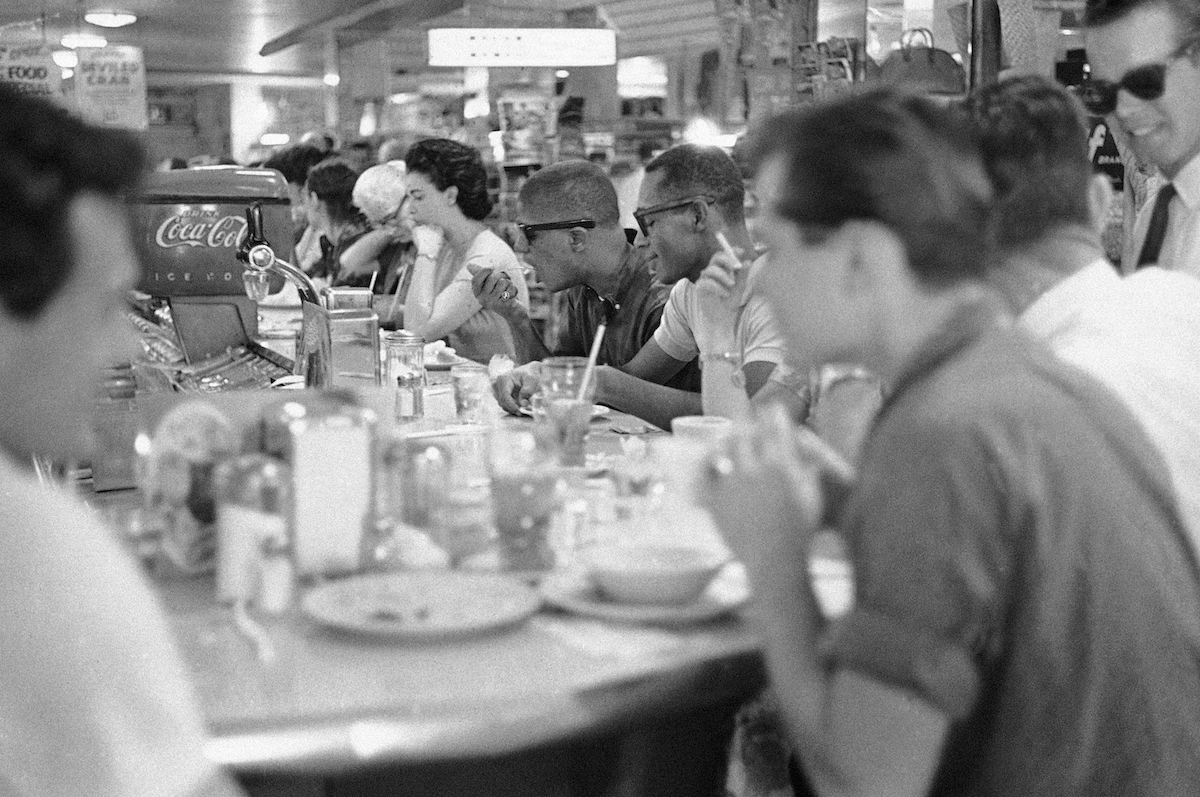
Two Black men sit at a formerly all-white lunch counter at a downtown Canal St. drugstore in New Orleans, Sept. 14, 1962. (AP)
• • •
In journalism, a profession that has the ability to affect how people live, behave and understand their world, we are trained to consider the consequences of how we handle the facts. We must regard our work in the light of its ethical obligations. Is a photograph exploitative or necessary? Is a headline salacious or accurate? Is a source’s objective compromising? What are we omitting?
In January 2017, for instance, it was true that a document existed laying out allegations of ties between Russia and the United States’ president-elect. But when a media organization, BuzzFeed News, published the full dossier without verifying its assertions, it tossed aside the ethical needle other news organizations also in possession of the document had been trying for weeks to thread. It was one watershed moment for facts in the U.S. — and the first time Trump, soon to take office for his first presidential term, used the word "fake news" in a tweet.
Facts fall short when we are unwilling to face the uncomfortable truths inherent in our own ambitions. When I think about Jefferson writing the words that would come to define Americans’ understanding of liberty and themselves, I picture Hemings delivering Jefferson his garments and his tea.
Had this story unfolded in 2026, Hemings might have been the declaration’s author. But as it was, he was enslaved another 19 years before Jefferson filed paperwork that set Hemings free.
The words Jefferson and the founders agreed to in the Declaration of Independence, based on facts about the colonies’ oppression and mistreatment, described all of humanity. Yet today it is clear their ethical scope was compromised by a corrupt and brutal industry that benefitted them. There were facts they were willing to overlook as they added their signatures and voted on a nation’s start. Facts that later generations would insist upon at lunch counters, bus boycotts and equal rights demonstrations. Facts that the current administration has sought at times to obscure.
Today, it’s hard to find what is true. Our social media feeds are filled with imagery and outrage, some of it real, some of it created with artificial intelligence. Our local news sources are diminished, leaving ample space for unchecked rumors and consequential misunderstandings.
As much as I hope our collective value of facts and truth continues to undergird our nation’s wildest ambitions over the next 250 years, there are times when I wonder how it will fare. But then I remember that the founders gave breath to this notion as they were steeped in slavery’s corruption. On our nation’s 250th birthday, we have the hindsight and foresight to do better, to identify the corrupting influences that threaten to pervert the facts, to call them out for what they are and to bury the uncertainty with truth-revealing transparency.
At PolitiFact, that’s our aim.
Our Sources
National Archives, Declaration of Independence: A Transcription, visited June 5, 2026
American Battlefield Trust, "The Causes and Necessity of Taking Up Arms by Thomas Jefferson and John Dickinson, July 6, 1775", accessed June 7, 2026
The Papers of Thomas Jefferson at Princeton University, Jefferson’s "original Rough draught" of the Declaration of Independence, accessed June 7-15, 2026
National Park Service, Declaration of Sentiments, accessed June 7-15, 2026
National Park Service, Declaration House, accessed June 8, 2026
National Park Service, The Declaration House Through Time, accessed June 8-15, 2026
National Park Service, Thomas Jefferson and Robert Hemmings in Philadelphia, accessed June 8-15, 2026
Museum of the American Revolution, John Adams and Revolutionary Philadelphia's Summer Heat, accessed June 8, 2026
The Gilder Lehrman Institute of American History, The Annotated Declaration of Independence, accessed June 7-15, 2026
MIT Sloan Office of Communications, "Warning labels from fact checkers work — even if you don’t trust them," Sept. 2, 2024
The Papers of Thomas Jefferson at Princeton University and the Center for Digital Editing at the University of Virginia, The Jefferson Weather & Climate Records, accessed June 7-15, 2026
The White House Historical Foundation, Thomas Jefferson, accessed June 9, 2026
Monticello.org, Brief Biography of Thomas Jefferson, accessed June 7-15, 2026
Monticello.org, Robert Hemmings, accessed June 7-15, 2026
Monticello.org, Elizabeth Hemmings, accessed June 7-15, 2026
Monticello.org, Wealth and its Disparities Timeline, accessed June 30, 2026
KVAL.com, Remembering Robert Hemings, the slave who joined Thomas Jefferson in Philadelphia, July 1, 2020
University of Virginia Miller Center, "Thomas Jefferson: Life in Brief" by Peter Onuf, accessed June 7-15, 2026
Yale Law School, ‘Summary View of the Rights of British America’ by Thomas Jefferson, accessed June 7-15, 2026
PBS Frontline, "1977: The Sally Hemmings Story," an excerpt from ‘The Wolf by the Ears: Thomas Jefferson and Slavery’ by John Chester Miller, 1991, accessed June 8, 2026
U.S. History Scene, Pulitzer Prize Winner Annette Gordon-Reed on Sally Hemings and Thomas Jefferson by Rhae Lynn Barnes, accessed June 7-15, 2026
Annette Gordon-Reed, The Hemingses of Monticello: An American Family, W. W. Norton & Company, Sept. 8, 2009
Library of Congress, Declaring Independence: Drafting the Documents, Jefferson's "original Rough draught" of the Declaration of Independence, from The Papers of Thomas Jefferson. Vol. 1, 1760-1776, Princeton University Press, 1950
Library of Congress, Thomas Jefferson Papers, 1606 to 1827, accessed June 7-15, 2026
National Archives, America’s Founding Documents: The Declaration of Independence: What Does it Say?, accessed June 7-15, 2026
History.com, How Many Died in the Revolutionary War?, Sept. 12, 2023
Internet archive, The toll of independence: Engagements & battle casualties of the American Revolution by Howard H. Peckham, 1974
CBS News, How Philadelphians Handled Heatwaves In 1776, June 20, 2012
PolitiFact, 2016 Lie of the Year: Fake news, Dec. 13, 2016
PolitiFact, Trump said the pace of California ballot counting proves a rigged election. Pants on Fire!, June 8, 2026
BBC, The (almost) complete history of 'fake news', Jan. 21, 2018
Smithsonian, Declaration of Independence Desk at the American History Museum, accessed June 7-15, 2026
The New York Times, The Interview: Scott Pelley on the Bari Weiss Era and His Last Days at ‘60 Minutes,’ June 7, 2026
CNN, Trump’s NBC interview ends abruptly, June 7, 2026
Axios, Everything Trump has called "FAKE NEWS," July 9, 2017
Brookings Institution, What do the Declaration’s "self-evident truths" mean today?, March 6, 2026
Benjamin Franklin House, Benjamin Franklin and Slavery, accessed June 7-15, 2026
The Atlantic, After All That, I Would Still Publish the Dossier, April 20, 2023
Poynter.org, BuzzFeed drops a Trump bombshell, irresponsibly, Jan. 10, 2017
The New York Times, Op-Ed: Why BuzzFeed News Published the Dossier, Jan. 23, 2017
National Archives, The Stylistic Artistry of the Declaration of Independence, accessed June 7-15, 2026
National Archives, Letter from Thomas Jefferson to William Randolph, [ca. June] 1776, accessed June 7-15, 2026
National Archives, First Draft by Jefferson, [before June 1776], accessed June 7-15, 2026
National Archives, Composition Draft of That Part of the Declaration of Independence containing the Charges against the Crown, 11 June to 4 July 1776, accessed June 7-15, 2026
National Archives, Jefferson’s "original Rough draught" of the Declaration of Independence, 11 June to 4 July 1776, accessed June 7-15, 2026
National Archives, Thomas Jefferson to Benjamin Franklin, [21 June 1776?], accessed June 7-15, 2026
National Archives, Benjamin Franklin's Anti-Slavery Petitions to Congress, accessed June 7-15, 2026
PBS News, Slavery exhibit returns to Philadelphia's Independence Mall after Trump administration ordered its removal, Feb. 19, 2026
History.com, The Declaration of Independence Was Also a List of Grievances, June 13, 2022