Stand up for the facts!
Our only agenda is to publish the truth so you can be an informed participant in democracy.
We need your help.
I would like to contribute

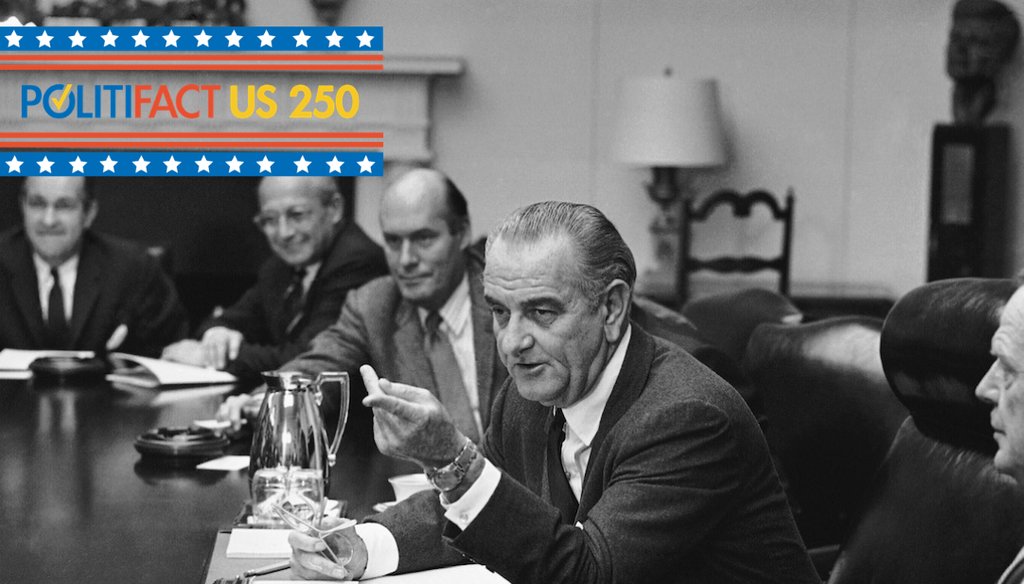
President Lyndon Johnson meets in the White House Cabinet Room with top military and defense advisers on Oct. 31, 1968. (AP)

If Your Time is short
At PolitiFact, we have been holding presidents to account for their falsehoods since 2007, covering the tenures of Barack Obama, Donald Trump, Joe Biden and now Trump again.
As the United States marks its 250th anniversary, we examined how inaccurate or misleading statements by the nation’s chief executive influenced the long arc of history. Our list includes consequential rhetoric from Andrew Jackson, James K. Polk, William McKinley, Harry Truman, Dwight Eisenhower, Lyndon Johnson, Richard Nixon, Ronald Reagan, Bill Clinton, George W. Bush and Donald Trump.
As we assembled this list, we found that the task was more complex than it had seemed. In our reporting, we heard a range of opinions from political scientists and historians about what to consider when assessing presidents’lack of truthfulness.
Did a president know the full facts when he spoke, or was he the recipient of bad information? Did he say something false, or mislead by omitting relevant information, or leave an inaccurate impression through silence? Are some falsehoods more justifiable than others? And should presidents be held to a higher standard than other people when they play fast and loose with the truth?
"The big problem is not so much a single lie by a single president, but the cumulative weight of all the lies that Americans have found out about," said John J. Pitney, a politics professor at Claremont McKenna College. "Foreign wars and domestic scandals have eroded trust. Presidents can no longer count on Americans to believe them."
Even white lies corrode the public’s trust in government, according to political scientists. Here’s what else we learned from a deep dive into presidential deception.
Not all presidential deceit is equal
James Pfiffner, an emeritus George Mason University presidential scholar, ranks presidential falsehoods from the benign to the most harmful. (He uses the word "lies" more freely than PolitiFact; our policy is to only use the term for our Lie of the Year reports.)
"Justifiable lies." Pfiffner’s taxonomy starts with this category, which includes the White House’s statements in 1962 that John F. Kennedy had returned to Washington because he had a cold when he had actually returned to handle the then-secret Cuban Missile Crisis.
"If Kennedy had been asked by a reporter whether a national security crisis was going on, he would have been fully justified in telling a lie," Pfiffner said.
"Minor lies." One step up in Pfiffner’s classification are falsehoods such as Lyndon Johnson’s claims of having ancestors at the Battle of the Alamo or Ronald Reagan’s telling of a heroic war story that was actually the plot of a movie. Bill Clinton's repeatedly citation of an anachronistic quote attributed to the French writer and diplomat Alexis de Tocqueville could also count.
"Lies to prevent embarrassment and preserve political viability." More serious still are falsehoods such as Franklin D. Roosevelt’s hiding of his disability or Kennedy’s decision to conceal that he had Addison’s disease, a glandular ailment.
"Lies to cover up important facts." The second-highest category includes Barack Obama’s statement in support of his major health care overhaul: "If you like your health care plan, you can keep it." This may have been true for many Americans, but for millions, it was not, and providing this reassurance to those at risk of losing their coverage was misleading. PolitiFact named this its 2013 Lie of the Year.
"Lies of policy deception." These, to Pfiffner, are the worst type, because they prevent citizens from knowing how to judge the government. Examples include Johnson’s misleading justifications for escalating the Vietnam War, Richard Nixon’s hiding the bombing of Cambodia, and Reagan’s falsehoods about the Iran-Contra Affair, in which the U.S. sold arms to Iran and used the proceeds to illegally support a rebel group in Nicaragua.
Several of these made our list of significant presidential falsehoods.
Has presidential truth-telling gotten worse over time?
Public expectations for presidents upholding values of transparency and accuracy — including about their background, their private lives and their health — have varied over time, in part because of changes in how the press operated, said Sean Wilentz, a Princeton University historian.
Thomas Jefferson had surrogates combat accusations that he had a child with Sally Hemings, who he enslaved at Monticello. These allegations were proven correct two centuries later, but Jefferson likely believed what happened was nobody’s business — that "gentlemen were never expected to talk about their sex lives," Wilentz said. This was a widespread belief until about 50 years ago, around the time in 1987 that Democratic presidential candidate Gary Hart was exposed as having an affair, forcing him out of the race.
Jefferson aside, historians say the earliest presidents were fairly honest with the public. "James Madison, James Monroe and John Quincy Adams were pretty much models of rectitude," Wilentz said.
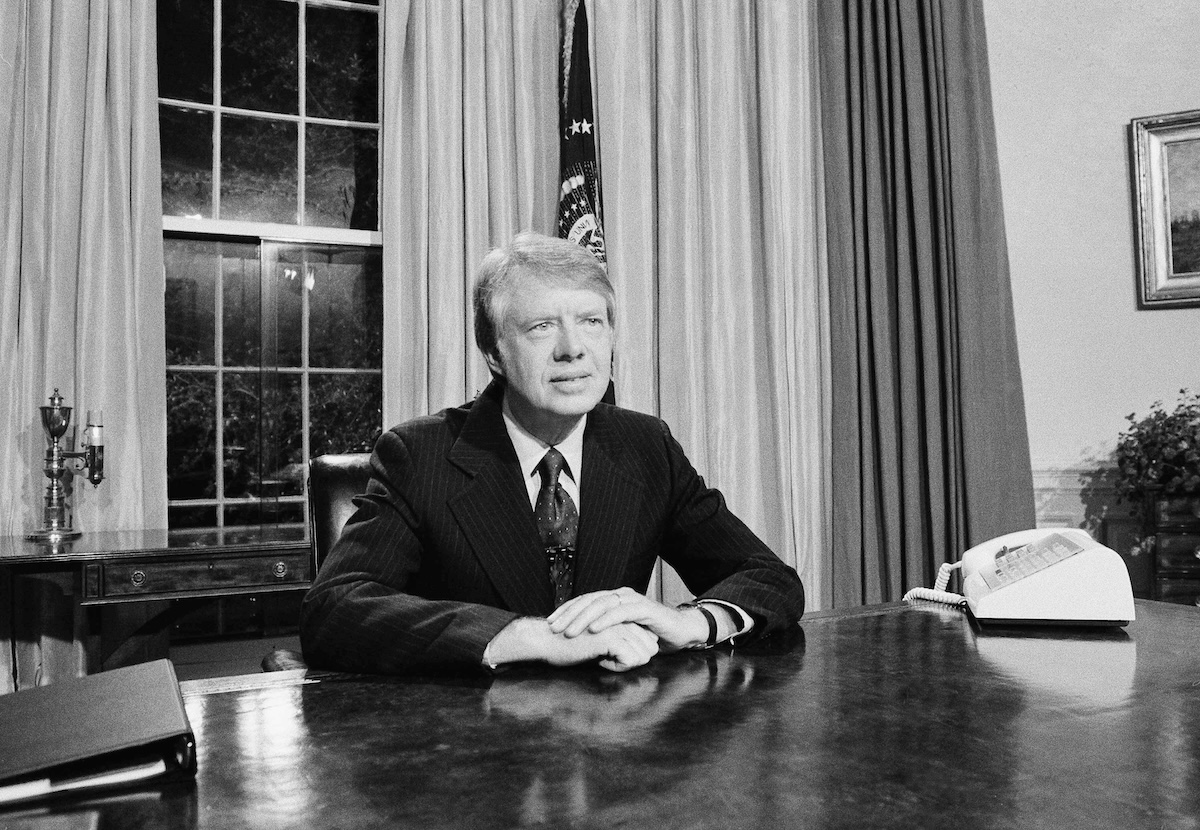
President Jimmy Carter behind his desk in the Oval Office on April 18, 1977. (AP)
Jimmy Carter is an extreme modern example. When he launched his presidential campaign in 1974, Carter said that if elected, "I would not tell a lie; I would not mislead the American people. … And I would not betray your trust." Whatever one thinks of Carter’s presidency, our research produced little evidence that he told major falsehoods as president.
One indication that past presidents took honesty seriously is that they generally accepted there’s a penalty for saying false things.
"When previous presidents have been caught making false statements, they have usually tried to equivocate or claim that they were technically not lying," Pfiffner has written.
Historians put Trump in a different category.
"Because democracy depends on a common set of understood facts, Trump’s approach corrodes political discourse," Pfiffner said. "Donald Trump has lied in so many ways that the comparison with previous presidents is almost beside the point. Trump’s falsehoods are not merely different in volume. They are different in kind."
Our Sources
James Pfiffner, "The Contemporary Presidency: Presidential Lies" (Presidential Studies Quarterly), 1999
James Pfiffner, "Trump’s lies corrode democracy," April 13, 2018
James Pfiffner, "The Lies of Donald Trump: A Taxonomy," 2019
James Pfiffner, "The Character Factor: How We Judge America's Presidents," 2004
Eric Alterman, "Lying in State: Why Presidents Lie -- And Why Trump Is Worse," 2020
Eric Alterman, "When Presidents Lie: A History of Official Deception and Its Consequences," 2004
David Greenberg, "Are Clinton and Trump the Biggest Liars Ever to Run for President? A short history of White House fabulists," July-August 2016
David Greenberg, "The Perils of Calling Trump a Liar," Jan. 28, 2017
Los Angeles Times, "As the Great Tocqueville Never Said," Sept. 15, 1996
PolitiFact, "Lie of the Year: 'If you like your health care plan, you can keep it,’"Dec. 12, 2013
Email interview with David Greenberg, Rutgers University historian, April 28, 2026
Email interview with Eric Alterman, Brooklyn College historian and professor of English and journalism, June 3, 2026
Email interview with Sean Wilentz, Princeton University historian, June 3, 2026
Email interview with Paul Finkelman, emeritus professor of legal history at Albany Law School, May 29, 2026
Email interview with John J. Pitney, politics professor at Claremont McKenna College, June 1, 2026
Email interview with Steven Smith, Arizona State University political scientist, May 28, 2026
Email interview with James Pfiffner, emeritus professor at George Mason University, May 29, 2026