Stand up for the facts!
Our only agenda is to publish the truth so you can be an informed participant in democracy.
We need your help.
I would like to contribute

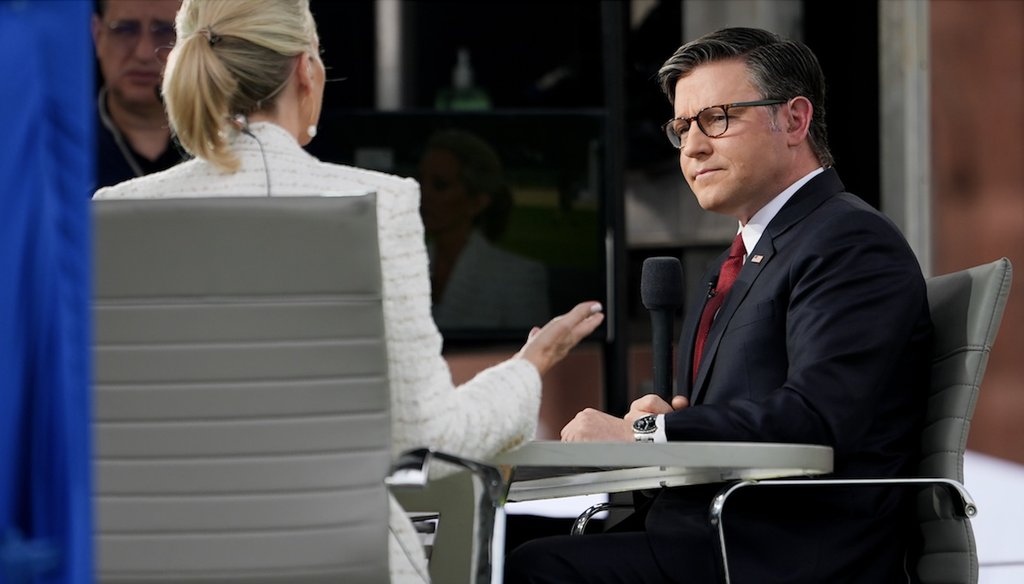
House Speaker Mike Johnson, R-La., sits for a television interview ahead of Rededicate 250, a prayer gathering on the National Mall on May 17, 2026. (AP)

House Speaker Mike Johnson, R-La., led thousands of people on the National Mall in prayer as part of a religious event for the nation’s 250th anniversary.
Johnson asked God to "hear these solemn petitions, just as we in the beginning dedicated this land to your most holy name today. Here Lord, in this 250th year of American Independence, we hereby rededicate the United States of America as ‘One Nation, Under God.’"
The May 17 "Rededicate 250" jubilee in Washington, D.C., also featured Sen. Tim Scott, R-S.C., and video remarks by President Donald Trump, Secretary of State Marco Rubio and Defense Secretary Pete Hegseth.
In an interview from the mall, Fox News’ Shannon Bream asked Johnson about criticism that a religious event was hosted on federal land and partially paid for by taxpayer dollars. Johnson said the event was "a recognition of the deeply embedded history and religious and moral tradition of the country" and that the event’s critics "want to erase the history of America and pretend as if we're not a nation that was dedicated originally to God."
Johnson then referenced an inscription in the House chamber of the U.S. Capitol.
"If you walk into the House chamber this afternoon with me, Shannon, you will see ‘In God We Trust’ inscribed in the marble right above the head of where I stand as the speaker of the House," Johnson said. "Congress put that there as a recognition of who we are. We are one nation under God, and to come here and gather for a happy, hopeful celebration to rededicate ourselves in that way as one nation under God is a healthy and appropriate thing."
The religious orientations of the United States’ founding generation have been a contentious academic subject for generations, and scholars have found mixed evidence about the role of religion and Christianity in the nation’s founding. The First Amendment’s guarantee of freedom of religion has prompted a long-running legal battle over how much the federal government can interact with religion.
Two of the phrases Johnson used in his remarks about the 250th event — "One Nation, Under God" and "In God We Trust" — are sometimes assumed to date to the founding period, but their widespread usage has modern roots. Both gained official status in the Pledge of Allegiance, on U.S. currency and as the official U.S. motto in the 1950s.
The impetus, historians say, came from the stark ideological battle lines of the Cold War against the officially God-less Soviet Union.
How the Pledge of Allegiance came to include "Under God"
The Pledge of Allegiance emerged in 1892, the year of the 400th anniversary of Christopher Columbus’ landing in the Americas. Its authorship is generally credited to an ordained Baptist minister, Francis Bellamy, though he may have taken undue credit from a 13-year-old student who had submitted it to a magazine Bellamy edited.
The pledge’s original version ("I pledge allegiance to my flag and the Republic for which it stands—one Nation indivisible—with liberty and justice for all") spread widely after Bellamy persuaded schools to use it.
In 1942, President Franklin D. Roosevelt signed the U.S. Flag Code, which for the first time standardized the wording of the pledge under federal law. There was no mention of God either in Bellamy’s original pledge or in the newly formalized wording.
"Under God" wasn’t included until more than a decade later. Around 1952, the Knights of Columbus, a Catholic organization, and other religious groups began lobbying to include "Under God."
At a February 1954 service honoring Abraham Lincoln’s birthday, Pastor George M. Docherty of the New York Avenue Presbyterian Church in Washington, D.C., used his sermon to promote the idea of adding "under God." He hoped to make an impression on one of his congregants, President Dwight Eisenhower, said Matthew A. Sutton, a Washington State University historian and author of the book, "Chosen Land: How Christianity Made America and Americans Remade Christianity."
In his sermon, Docherty said the official version of the pledge seemed similar to one that children in the Soviet Union might say. "Indeed, apart from the mention of the phrase, the United States of America, it could be the pledge of any republic," Docherty said.
In time, "Protestants and Catholics, political liberals and conservatives all sang the praises of Docherty’s proposal," Sutton wrote in his book. Within six months, Congress passed the change and Eisenhower signed it.
"In this way, we are reaffirming the transcendence of religious faith in America’s heritage and future; in this way, we shall constantly strengthen those spiritual weapons, which forever will be our country’s most powerful resource, in peace or in war," Eisenhower said.
"In God We Trust" and U.S. currency
Today, the motto "In God We Trust" is familiar from U.S. coinage and paper currency. But it hasn’t always been there.
A phrase approximating "In God We Trust" can be traced back further than the Pledge of Allegiance. A line in the fourth stanza of "The Star Spangled Banner," written in 1814, says: "Then conquer we must, when our cause it is just / And this be our motto, ‘In God is our trust,’" the lyric reads.
During the Civil War, on the suggestion of a minister, the United States put "In God We Trust" on a 2-cent coin. The phrase would appear on some subsequent coins, but far from all, and not on paper currency.
Not everyone was a fan. In 1907, President Theodore Roosevelt blocked the phrase from a $10 gold coin, writing that to "put such a motto on coins, or to use it in any kindred manner, not only does no good but does positive harm, and is in effect irreverence, which comes dangerously close to sacrilege."
The presidential mood changed by the 1950s.
In July 1955, Eisenhower signed a bill that required the inscription "In God We Trust" to appear on all paper and coin currency. A congressional sponsor, Herman Eberharter, D-Pa., cited the Cold War ideological struggle in the debate, saying the phrase on currency would "serve as a constant reminder" that the nation’s political and economic fortunes were tied to its spiritual faith.
In July 1956, Eisenhower signed legislation making "In God We Trust" the nation’s official motto. ("E pluribus unum," or Latin for "Out of many, one," had been an unofficial motto dating back to the 1780s.)
"While a few groups groused that government leaders’ actions violated church-state separation and even added an indirect religious ‘test’ to those who aspired to hold office, the elevation of God in American public life generated little controversy," Sutton wrote.
The House chamber inscription that Johnson cited came later. It went up on Dec. 19, 1962, and "represented a rebuke of the Cold War-era philosophy of the Soviet Union," according to the office of the House historian.
One effort, however, was a "bridge too far," even for that relatively religious era, Sutton wrote. In the 1950s, Congress debated but did not approve an amendment that read, "This Nation devoutly recognizes the authority and law of Jesus Christ, Saviour and Ruler of nations through whom are bestowed the blessings of Almighty God."
Our Sources
Mike Johnson, prayer at the Rededicate 250 event, May 17, 2026
Mike Johnson, interview with Fox News, May 17, 2026
Rededicate 250: A National Jubilee of Prayer, Praise & Thanksgiving
House of Representatives, Office of the Historian: Furniture, accessed May 18, 2026
House of Representatives, Office of the Historian: The Legislation Placing "In God We Trust" on National Currency, accessed May 18, 2026
National Museum of American History, "Complete version of ‘The Star-Spangled Banner,’" accessed May 18, 2026
National Constitution Center, "The history of legal challenges to the Pledge of Allegiance," June 14, 2023
Library of Congress, "In God We Trust," April 22, 2013
American Legion, U.S. Flag Code, accessed May 18, 2026
Britannica.com, "E pluribus unum," accessed May 18, 2026
History.com, "Why Eisenhower Added ‘Under God’ to the Pledge of Allegiance During the Cold War," June 22, 2022
New York Times, "We Know the Pledge. Its Author, Maybe Not," April 2, 2022
USA Today, "Rededicate 250 prayer event held on National Mall. See photos, video," May 18, 2026
USA Today, "Trump's national prayer event largely features Christian leaders," May 5, 2026
PolitiFact, "Getting the facts straight about the Founding Fathers," July 3, 2014
PolitiFact, "Fundamentalist: When founders said 'religion,' they meant Christianity," Dec. 16, 2013
Email interview with Matthew A. Sutton, Washington State University historian and author of "Chosen Land: How Christianity Made America and Americans Remade Christianity," May 18, 2026
Email interview with John Corrigan, Florida State University historian and author of "Religion in America," May 18, 2026