
President Donald Trump and U.S. Rep. Mike Collins “doubled health insurance premiums for more than a million Georgians and threw 300,000 Georgians off their insurance altogether.”


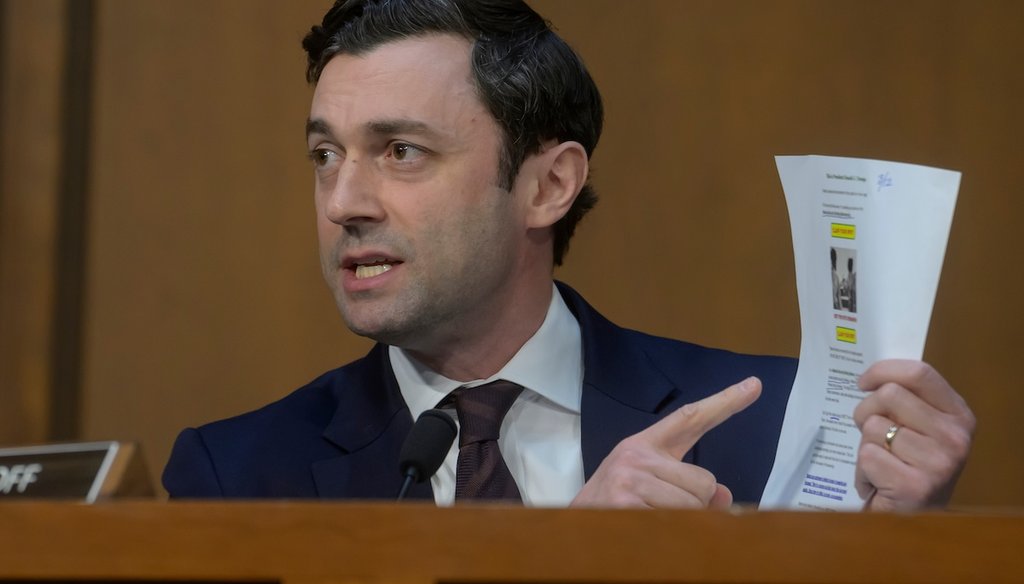
Sen. Jon Ossoff, D-Ga., questions witnesses at a Senate Intelligence Committee hearing on March 18, 2026. (AP)

As Democratic U.S. Sen. Jon Ossoff seeks to retain his Georgia seat, he is pointing to Republican challenger U.S. Rep. Mike Collins’ healthcare record as detrimental to Georgians.
"Donald Trump and his puppet Mike Collins, they doubled health insurance premiums for more than a million Georgians and threw 300,000 Georgians off their insurance altogether," Ossoff said during a June 27 campaign rally in Savannah.
U.S. adults’ ability to pay for healthcare is at a five-year low, and Americans view healthcare affordability as a massive problem.
Ossoff’s campaign said the candidate was referring to 2025 Republican-led changes to the Affordable Care Act.
The 2010 law, passed during the Obama administration, created online insurance marketplaces where Americans can purchase health insurance that isn’t tied to an employer. Most people who use Affordable Care Act marketplaces obtain subsidies. Former President Joe Biden expanded eligibility for these subsidies during the pandemic era, but Congress let them expire at the end of 2025, and Trump approved. Healthcare analysts warned that premium costs would shoot up and customers would drop their marketplace plans.
Those expectations are becoming reality nationally. Georgia is no exception.
Georgia lost more than a third its enrollees on the marketplace between January 2025 and mid-April, according to news outlets The Current GA and the Georgia Recorder. And one consumer advocacy group’s study shows Georgia’s net marketplace premiums have more than doubled, increasing by an average of nearly 114% from 2025 — even more than Ossoff said.
But what roles did Collins and Trump play in these changes? The Collins campaign did not respond to PolitiFact’s request for comment. The White House referred us to Trump’s posts on Truth Social about Ossoff without specifying which ones. PolitiFact found no Trump Truth Social posts referring to Ossoff that mentioned healthcare.
Trump, who has long promised but not delivered an Obamacare alternative, has sought to reduce promotion of federal marketplace plans, cut subsidies, built off-ramps to cheaper insurance and promoted waivers to decrease enrollment, Frank J. Thompson, an emeritus Rutgers University public affairs professor, wrote for the Brookings Institution. (Trump tried but failed to have Congress repeal the law in 2017; Collins was not in office then.)
Still, Thompson wrote, Obamacare remained resilient. Biden’s 2021 American Rescue Plan Act included Affordable Care Act subsidies that went further than the original law. Congress renewed those enhanced subsidies in 2022 to last through 2025.
Trump’s One Big Beautiful Bill Act made significant changes to the Affordable Care Act marketplace, requiring policyholders to update their income and immigration status annually instead of automatically reenrolling. The bill did not extend expiring subsidies that kept premiums lower.
Like Trump, Collins has long opposed the ACA. In July 2025, Collins voted for the One Big Beautiful Bill, posting on X shortly after the vote that it has allowed the "golden age of America."
Protesters gathered outside Collins’ district office in October, some citing his lack of support for healthcare subsidies. An analysis the same month by KFF, a health policy think tank, showed that Collins’ congressional district, which sits between Atlanta and Augusta, would experience a 345% benchmark plan premiums spike, the largest in the state, as a result of the expiring subsidies.
"We need meaningful reforms to health care that increase competition and drive down premiums, not endless subsidies to the largest insurance companies on the globe," Collins told The Atlanta Journal-Constitution in December.
In early January, Collins voted against a bill that solely focused on extending the credits. Open enrollment ran from Nov. 1 to Jan. 15.
In June, the legal and consulting firm Manatt published a study drawing from 2026 open enrollment data. It found Georgia’s 2026 average net premiums had risen 121% from 2025, well above the 58% average national hike.
A state health consumer nonprofit found a similar pattern. Georgians for a Healthy Future released a February analysis showing that the average net monthly premium "approximately doubled," from $69 to $148.10. That’s a 114% increase.
Ossoff said these increased rates affected more than 1 million Georgians.
The state Affordable Care Act portal Georgia Access had 1.5 million enrollees in 2025, and 95% of them received subsidies, said Whitney Griggs, director of health policy at Georgians for a Healthy Future.
Georgia enrollees dropped by 37% from January 2025 to mid-April, according to The Current GA and the Georgia Recorder, which used data obtained through a public records request from the Georgia Office of the Commissioner of Insurance and Safety Fire.
That amounts to more than 500,000 fewer enrollees — some who elected to drop their coverage, and some who were dropped after a three-month grace period.
The reporting revealed a dip of 300,000 enrollees on top of the previously known 200,000. Griggs said it is not yet clear how many people chose not to reenroll versus those whose coverage lapsed because of nonpayment following a three-month grace period. She said that report will be released by the Centers for Medicare & Medicaid Services this summer.
When asked for evidence of Ossoff’s claim, the campaign referred us to a September 2025 KFF study that showed the subsidies’ expiration would "more than double" annual premiums for subsidized enrollees nationwide. KFF found affected enrollees’ premiums would increase 114% annually, from an average of $888 in 2025 to $1,904 in 2026.
Griggs said the increased premiums figures became public in October 2025, when the rates were advertised so those interested in ACA insurance could begin window-shopping ahead of the open enrollment period.
Even though the Georgia changes mirror a national trend, the effects are significant for Georgia, where Republicans have mostly opposed expanding Medicaid insurance coverage to more low-income people under age 65.
Griggs said she thinks Ossoff’s assertion that 300,000 people were "thrown" off their insurance is fair.
"These folks don’t have another choice," she said.
Ossoff said Trump and Collins "doubled health insurance premiums for more than a million Georgians and threw 300,000 Georgians off their insurance altogether."
Ossoff uses harsh rhetoric to describe the efforts by Trump and the Republican-led Congress to undermine Obamacare. Collins voted for the Trump-backed One Big Beautiful Bill, which did not extend subsidies that made Obamacare-purchased plans less costly. Collins also voted against a bill that would have directly extended the credits.
The lapse in subsidies had a predictable effect on Affordable Care Act marketplace customers, including those in Georgia. A health consumer group, Georgians for a Healthy Future, found the average net monthly premium increased 114%, and more than 1 million people were affected. It’s reasonable to say at least 300,000 are losing their insurance (because of price increases); the data suggests it could be more.
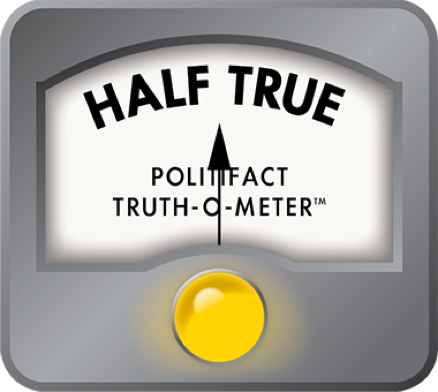
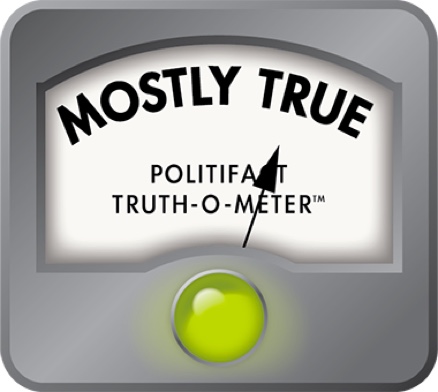
The statement is accurate but needs clarification or additional information. We rate it Mostly True.
CSPAN, "Georgia Sen. Jon Ossoff and Gubernatorial Candidate Gov. Keisha Lance Bottoms Hold Campaign Rally," June 27, 2026
Gallup, "U.S. Adults' Ability to Afford Healthcare at a Five-Year Low," June 18, 2026
Pew Research Center, "Americans See Health Care Costs, Deficit, Inflation as Big Problems Facing the Nation," May 11, 2026
The Current GA and Georgia Recorder, "Georgia’s ACA enrollment plunges, raising concerns for rural hospitals," April 20, 2026
Georgians for a Healthy Future, "The Road Ahead for Georgia Access," Feb. 26, 2026
Donald Trump’s Truth account, post, July 4, 2026
Donald Trump’s Truth account, post, June 17, 2026
Brookings Institution, "Six ways Trump has sabotaged the Affordable Care Act," Oct. 9, 2020
PolitiFact, "Would rural residents get hit twice as hard by expiring ACA subsidies?" Sept. 30, 2025
KFF, "How Will the One Big Beautiful Bill Act Affect the ACA, Medicaid, and the Uninsured Rate?" June 18, 2025
PolitiFact, "Republican megabill will mean higher health costs for many Americans," July 2, 2025
Center on Budget and Policy Priorities, "Ask an Expert: Enhanced Premium Tax Credit (PTC) Expiration," Oct. 22, 2025
Mike Collins, "Overhaul DC," accessed July 15, 2026
Mike Collins’s congressional X account, post, March 24, 2025
Congressional Record, vote, July 3, 2025
Mike Collins’s congressional X account, post, July 3, 2025
11Alive, "Protestors Gather Outside Rep Collins Office," Oct. 17, 2025
KFF, "Which Congressional Districts Could See the Greatest ACA Premium Payment Increases?" Oct. 9, 2025
The Atlanta Journal-Constitution, "Jon Ossoff pushes for health care subsidies as US Senate vote looms," Dec. 9, 2025
Congressional Record, vote, Jan. 8, 2026
Manatt, "Where States Act, Coverage Loss Is Mitigated: A 50-State Survey as eAPTCs Expire," accessed July 15, 2026
KFF, "ACA Marketplace Premium Payments Would More than Double on Average Next Year if Enhanced Premium Tax Credits Expire," Sept. 30, 2025
Georgia Recorder, "Handful of rural Georgia Republicans join with Dems to give full Medicaid expansion another go," Jan. 29, 2025
Phone interview, Whitney Griggs, July 14, 2026











In a world of wild talk and fake news, help us stand up for the facts.