Stand up for the facts!
Our only agenda is to publish the truth so you can be an informed participant in democracy.
We need your help.
I would like to contribute

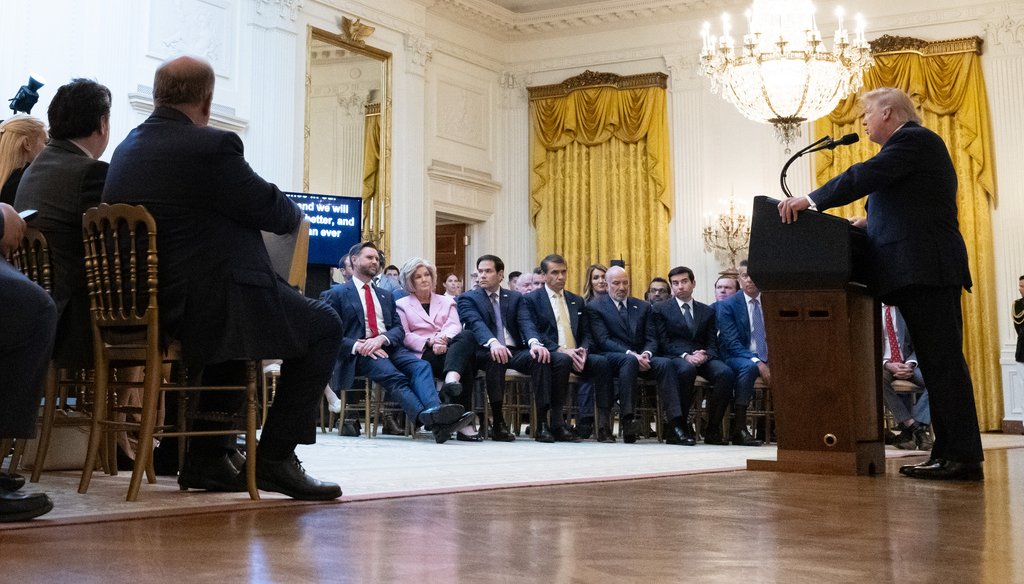
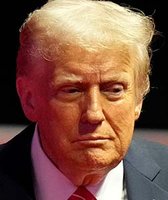
President Donald Trump speaks in the East Room of the White House, July 16, 2026, in Washington. (AP)


President Donald Trump delivered a rare primetime address about an issue that has consumed him for years — the results of the 2020 election, which he lost to Joe Biden.
In his nearly 30-minute speech, Trump argued that foreign countries — notably China — interfered in the 2020 election. In some cases, he said, the "deep state" had concealed damning information from him and "from you."
Trump quoted years-old intelligence community documents, including some that had been declassified or partially redacted, without noting a distinction between what China may have planned versus what analysts say it did.
"Our elections were left vulnerable to being rigged and stolen, and the trust of the American people was lost," Trump said July 16, though he provided no evidence of affected votes or election outcomes.
Trump closed by urging lawmakers to pass the SAVE America Act, which would require Americans to provide government-issued photo IDs to vote and documentary proof of citizenship, such as a passport or birth certificate, to register. The legislation is stalled in the Senate amid criticism that it would disenfranchise many people or impose unnecessary time and monetary burdens on a constitutional right.
Pamela Smith, president of Verified Voting, a nonpartisan organization with expertise on voting technology, said that there are several safeguards in place to protect U.S. elections, which includes preelection testing of equipment and chain of custody rules for ballots. Nearly every state has paper ballots that can be used to show evidence of voters’ intent, Smith said, "and that is the most important safeguard of all."
Trump’s address sidestepped the many judicial decisions, intelligence community reports and expert opinions that indicated there was no direct foreign interference in the 2020 voting process.
Trump criticized some networks, including NBC, ABC and CNN for not airing the speech live on their primary channel. But such a decision was not unprecedented; ABC, CBS and NBC ran game shows and reruns during a 2022 address by then-President Biden in which he accused Trump and Republicans of endangering American democracy.
Here’s a closer look at Trump’s claims about China interfering in the 2020 election.
China obtained voter registration records. That doesn’t prove interference.
Trump started his speech by describing a "nefarious" Chinese heist of U.S. voter records.
"China carried out what is believed to be the largest compromise of election data in history, resulting in China's illicit acquisition of 220 million U.S. voter files," he said. That information includes names, addresses, phone numbers and political party preferences of voters, which Trump called an "unprecedented election security nightmare."
It wasn’t too difficult, documents posted on a new White House website show.
A document labeled "sensitive government agency" said the voter registration information from 2013-21 "is publicly available for download from the commercial websites," and it appeared China downloaded it in 2022. The document said in theory, the data could be leveraged to carry out election influence operations.
Election data experts said that obtaining such data is common.
"Just because they have voter registration data does not mean that state or local voter registration databases or infrastructure have been breached," said Ryan Macias, an election security and tech expert who held federal government roles in the past under both Trump administrations, as well as under Obama and Biden. "This data is information that can be legally purchased by certain members of the public."
Trump said ‘deep state’ hid findings, but Trump’s administration released conclusions
Trump said some of the release documents revealed that "members of the deep state" "worked to actively suppress and downplay information about the extent of China's sinister election meddling," covering it up from Trump and the American people.
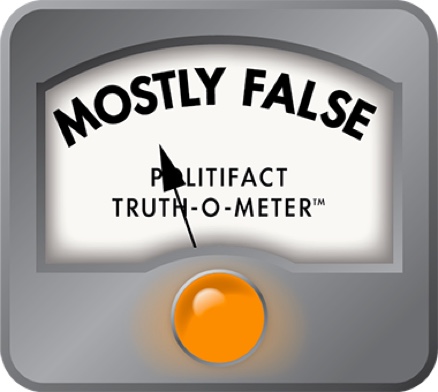
That’s misleading.
The intelligence community provided Trump a classified report on Jan. 7, 2021, about foreign interference, and two months later, under Biden, the National Intelligence Council issued the declassified version. That report said China considered — but did not deploy — influence efforts intended to change the outcome of the election. The experts stated that they had high confidence in their conclusion.
The report included a minority view from the National Intelligence Officer for Cyber who concluded that China tried to undermine Trump’s reelection primarily through social media and official public statements. The official wrote that some efforts were intended to at least indirectly influence candidates, political processes and voter preferences. However, the minority report said that there was "no information suggesting China tried to interfere with election processes."
John Ratcliffe, then the director of national intelligence (and now the CIA director), sided with the report’s minority view.
The documents the White House released July 16 showed some dissension within the Trump administration in 2020 about China, but that was reflected in the 2021 report.
The intelligence community does not routinely publish all records because they include sensitive information, including about sources or issues that could be used in related investigations.
Trump said China wanted him to lose. China thought Trump and Biden could pose challenges.
Trump said the Chinese government wanted him "to lose the next election" because of his plans to enact tariffs and invest in the U.S. military. A CIA note, which the White House released with Trump’s speech, said that in mid-2018 "the Chinese Communist Party's policy was to leverage all domestic and foreign elements that were opposed to the U.S. President in an effort to reduce the U.S. President's votes and make him resign or prevent his re-election."
China was working to influence the results of the 2018 and 2020 elections, the CIA note said.
China analyzed 2016 results and states that could be hurt by tariffs and hoped to induce representatives from those sectors to lobby Trump. The country also invited former U.S. government officials and academics to paid speaking engagements in China.
A National Intelligence Council assessment in August 2020 also said that China preferred that Trump lose. It said that China "might attempt to more directly thwart the President's reelection, including by leaking information or through online-influence network."
However, the 2021 report said that China did not view Trump or Biden winning as advantageous enough to risk getting caught meddling. Beijing believed there was bipartisan consensus against China in the United States and saw challenges whether Trump or Biden won, the report said.
Our Sources
White House, Election integrity, July 16, 2026
States United Democracy Center, Here’s How We Know the 2020 Election Was Free, Fair, and Secure, July 15, 2026
Politico, ‘Death by a thousand cuts’: Inside Trump’s remaking of American elections, July 16, 2026
The Bulwark, You’ll Never Believe Where Kash Patel’s Election Fraud Bombshell Came From, July 3, 2026
PolitiFact, Trump’s speech may focus on 2020 election. Here’s a primer on foreign interference, voting security, July 15, 2026
PolitiFact, Trump’s speech may focus on 2020 election. Here’s a primer on foreign interference, voting security, July 15, 2026
PolitiFact, China did not orchestrate voter fraud in the 2020 election, Jan. 19, 2021
PolitiFact, In rebuke of Trump, Supreme Court says states can count postmarked, late-arriving ballots, June 29, 2026
Center for Democracy & Technology, Countdown to the midterms: reexamining Foreign Influence in 2020 Elections, March 10, 2026
MS NOW, Trump election task force to begin releasing classified intel documents, July 13, 2026
Lawfare, Five Foreign Election Conspiracy Theories Making the Rounds Again, March 9, 2026
CISA, 2020: False Claims of Hacked Voter Information Likely Intended to Cast Doubt on Legitimacy of U.S. Elections, Dec. 17, 2020
Institute for Responsive Government, "State-by-State In-Person Voter ID Changes Required Under the SAVE America Act," July 15, 2026
Lawfare, Five Foreign Election Conspiracy Theories Making the Rounds Again, March 9, 2026
Associated Press, Federal judge denies effort by Trump administration to get New Hampshire’s detailed voter data, June 30, 2026
Associated Press, Federal judge halts Trump’s election executive order seeking to create a federal voter list, June 25, 2026
Votebeat, Trump move to neutralize election administration agency creates chilling effect, but its impact may be muted, July 13, 2026
Associated Press, NOT REAL NEWS: A look at what didn’t happen this week, Sept. 11, 2020
DNI John Ratcliffe, Memo, Jan. 7, 2021
Sen. Chuck Grassley, press release, July 1, 2025
Senate Committee on Homeland Security and Governmental Affairs, Hearing transcript, Sept. 24, 2020
FBI and CISA, public service announcement, Sept. 28, 2020
FBI Director Kash Patel, X post, June 16, 2020
Interview with Sean Morales-Doyle, director of voting rights and election center at the Brennan Center for Justice, July 16, 2026
Email interview with Lawrence Norden, vice president, elections and government at the Brennan Center for Justice, July 16, 2026
Email interview with Aaron D. Blacksberg, federal policy counsel for the Institute for Responsive Government, July 16, 2026
Email interview with Marcia Godwin, professor of public administration at the University of La Verne, July 16, 2026
Telephone interview with Ryan Macias, election security and tech expert and former U.S. Election Assistance Commission official, July 16, 2026
Telephone interview with Pamela Smith, CEO and president of Verified Voting, July 16, 2026
Email interview with Jonathan Diaz, director, voting advocacy and partnerships at the Campaign Legal Center, July 16, 2026